


Fair Value Gap Trading Strategy: How to Trade FVGs


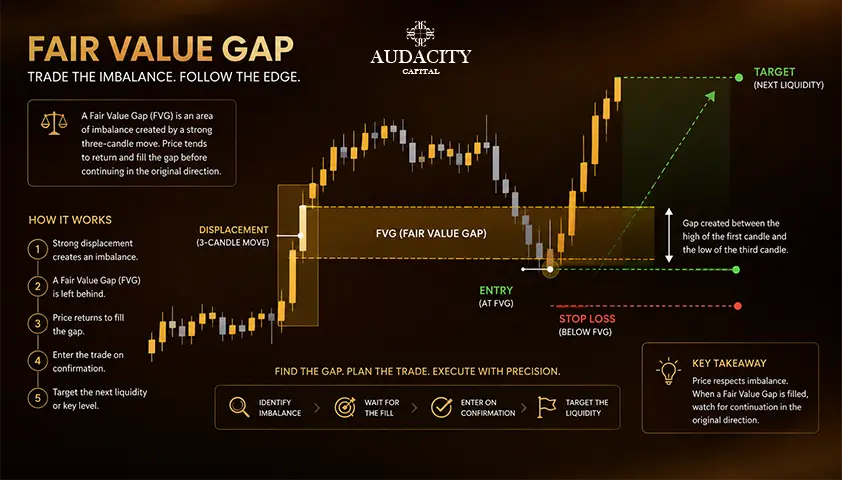
A Fair Value Gap is a three-candle imbalance where price moved so fast in one direction that the middle candle left a zone with no two-sided trading behind it.
Traders use that untraded zone as a location to re-enter in the direction of the move. That's the entire concept in a nutshell, and if you're here to learn a practical Fair Value Gap Trading Strategy instead of a philosophy lesson, you already have the essence.
In this guide today, we will discuss how to identify an FVG,
- the three "real" trading setups,
- exact entry, stop and target mechanics,
- how to use gaps and order blocks together
- market structure, which timeframes and markets suit them,
- the hidden account-draining errors,
- and what all of this means when you are under prop firm evaluation.
The first rule to remember before going any further: A Fair Value Gap is a probability tool, not a guaranteed indicator of success. There are lots of them that don't work out. The value of FVs is created by the traders who filter hard and manage risk harder.
What is a Fair Value Gap?
A Fair Value Gap is the area where the price of candle 1 and candle 3 did not overlap within a three-candle pattern, so that there was a gap in the middle of candle 2 where price did not touch both sides of the trade.
In simple terms, the price has changed too fast for a balanced trade to take place evenly over that band, leaving a pocket of "unfilled" price.
The current terminology comes from Michael Huddleston or Inner Circle Trader (ICT), whose framework popularized the term Fair Value Gap in the retail Smart Money Concepts (SMC) community.
However, this is not a new idea. Price imbalance or untraded price zones have been discussed for decades and every trader whether young or old can describe it using imbalance, price value gap, or 123 gap.
The intuition is simple. A fast one-sided move indicates that one side dominated that section of price, and many traders believe that price is likely to return to that zone later to “rebalance” the zone before moving on.
It is useful as a working assumption but no more than that. An FVG is not evidence of where banks or funds were executed. It indicates the fast-moving price areas, and traders select them as significant locations.
How to Identify a Fair Value Gap on a Chart
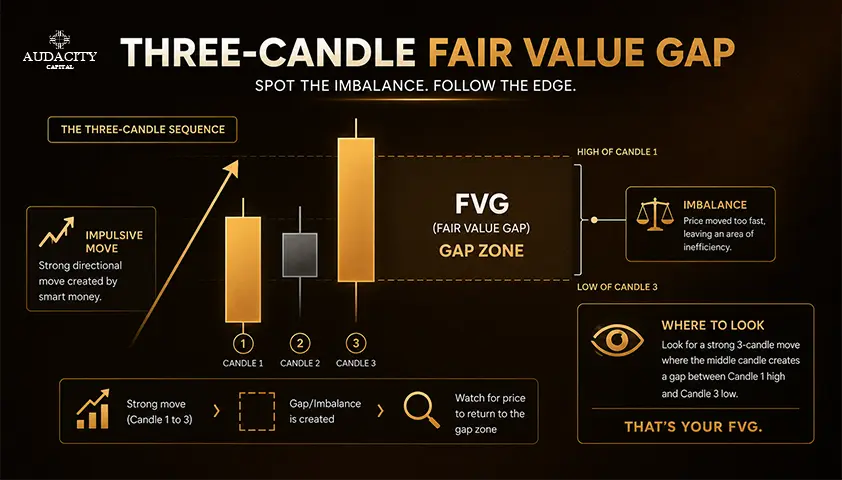
There are two versions of the pattern that allow it to be used in either direction, and one filter question that is more important than either.
1. Bullish fair value gap
A bullish fair value gap forms when the high of candle 1 is below the low of candle 3, forming an unsatisfied price gap within the range of candle 2. This pattern forms when there is a bullish displacement, which means a decisive and robust move higher. Traders will be looking for retracement within this gap to form entries in the same direction as the initial movement.
What people often miss: The space between is between the top of candle 1's wick and the bottom of candle 3's wick, not between the candle bodies. Measure from wick to wick.
2. Bearish fair value gap
The bearish fair value gap is the opposite. After a strong down move, the low of candle 1 sits above the high of candle 3, leaving a gap inside candle 2's range. It is created when there is a bearish displacement, and traders search for short entry trades when the price retracts back up into the gap. The same three-candle pattern, but in reverse.
What Makes an FVG Worth Trading (validity filters)
A gap alone won’t tell you much. There are four filters that separate out a gap that is worth trading versus a gap that just chops you up.
1. Displacement quality.
The middle candle must be a strong displacement candle and must have a large body compared to all the recent candles. A small, doji-ish gap has weak conviction and has a tendency to whipsaw.
2. The four-candle rule.
Some traders do not consider the FVG to be tradeable until four candles have passed after its formation. By this time, if price has not blown back through it, it is more likely to hold.
3. Structural location.
The gap should be at or close to a real level: prior swing high or swing low, structure break, order block, session high or session low, or higher timeframe FVG. A gap in the middle of a range is of low quality.
4. Ignore mechanical gaps.
Overnight gaps in stock futures and weekend gaps in forex are a different phenomenon. Never trade them using this approach.
How to Trade a Fair Value Gap? The three setups
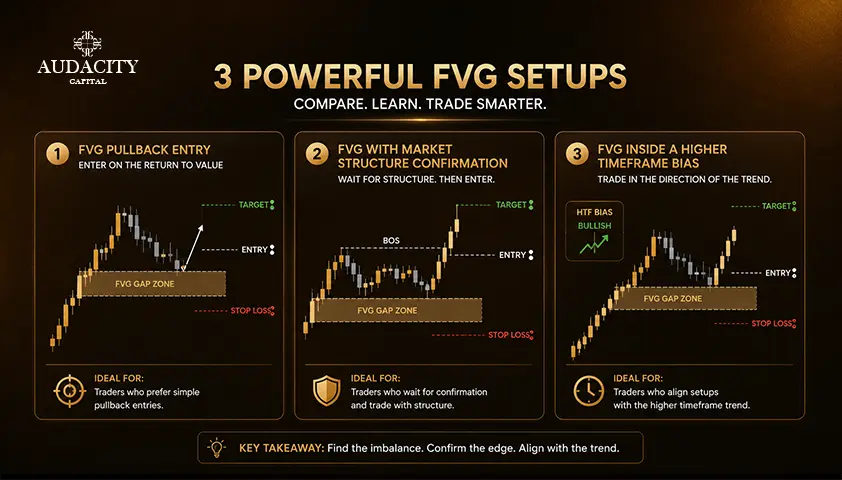
The pattern can be traded in three ways, as follows. Use them as a toolkit, not a ranked list. Consider the entry, stop, and target rules as examples of starting points.
The actual numbers will vary based on your timeframe, market, and volatility; backtest them first before trading any of these live.
Setup 1: The pullback-to-FVG continuation entry
This is the traditional and widely-used version.
Price makes the impulsive move, leaves a gap and then retreats into the gap. You enter in the direction of the original impulse when price touches the near edge of the gap (aggressive) or the far edge (conservative).
Set your stop on the other side of the gap (or beyond the swing that created the impulse) to help protect the setup. Look for the previous swing high or low or the next liquidity pool.
The thing about this setup is that the more filtering you do (structure, displacement, alignment with higher timeframes), the better your chances are. An isolated pullback to the gap is practically a coin toss.
Setup 2: The 50% midpoint entry (Perfect FVG)
It is a more advanced version, called “The Perfect FVG” (Alchemy Markets). Rather than entering right at the edge of the gap, you wait for price to trade into the gap and reject at or before the 50% mark for the gap.
When price retraces, but does not close at the middle, you pass on the trade—the deep fill is seen as a sign the gap is being invalidated.
You eliminate lower quality entries and in return you lose some quick reactions. Fewer signals, higher average quality.
Setup 3: The inverse fair value gap (IFVG) reversal
In case the price breaches the FVG in the other direction, then the gap is termed as “flipped,” meaning that a bullish gap turns into a bearish inverse fair value gap and vice versa.
Traders should now be focused on testing the flipping area as an entry point for a price swing in the other direction.
Remember the trade-off here. The IFVG has a higher tendency to trade against the trend than with the trend and thus needs more confirmation, either by means of breaking structure (BOS) or a rejected candle in the flipping area.
Stop-loss, Take-profit, and Position Sizing for FVG trades
If a good pattern is coupled with a bad stop then it is still a losing trade in the long term.
Stops go beyond the opposite edge of the gap, or beyond the impulse swing, whichever is further. The idea is to invalidate the trade if the trade is really broken, not if it is just the usual noise in the gap. Any stop that is set too tight will be cut by the same volatility that caused the pattern.
Typically, targets are set at the previous swing high or low, the next liquidity pool that's visible, or set at a fixed R multiple. The typical minimum risk-to-reward is a 1:2 ratio, with a goal of at least twice what you risk. This way you can be wrong more than right and still hold your ground.
Position sizing is not based on the chart pattern, but rather based on the stop distance and account risk. A basic guideline that is often used for prop-firm-style discipline is that you risk 0.5% to 1% of your equity per trade. You must allow your lot size to change to accommodate the stop, not the stop to your lot size.
Combining FVGs With Order Blocks, Market Structure And Liquidity
An isolated gap is a weak signal. The probability is much better when the gap corresponds with the rest of your SMC toolkit. Three combinations make the bulk of the work.
1. FVG plus order block.
An order block is the final opposite-direction candle that occurs before a significant move. The cleanest entries are formed at a cross between a same-direction FVG and an order block on the same or higher timeframe. Two independent reasons are better than one regarding a reaction from the same zone.
2. FVG plus break of structure.
After the occurrence of a break of structure in your direction, the next FVG which occurs in your new direction is the normal continuation entry (according to the BOS-plus-FVG strategy from Alchemy Markets). The BOS confirms the shift and the gap provides you with the location.
3. FVG plus liquidity sweep.
If price sweeps beyond the previous swing high/low, and sets up a reversal FVG in the new direction (with stops sitting above or below), that is the standard FVG reversal setup. It clears out the positions, and provides the fuel for the position reversal.
One structural habit that tends to hold it together is finding the bias and the location on the higher timeframe (1H or 4H) and then refine your actual entry down on the 5 or 15-minute timeframe.
Note: These are all commonplace, discretionary approaches and not proven institutional facts.
Best Timeframes and Markets for FVG trading
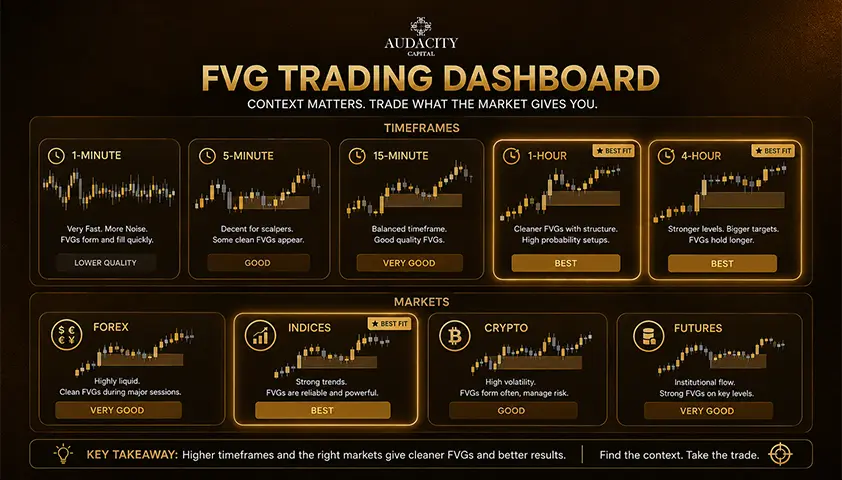
The three candle pattern is formed on every liquid market, including forex majors, index futures, large-cap stocks intraday, and major crypto. It also generates on any timeframe from a few ticks and above. However, higher timeframes (1H, 4H, daily) will show clearer, more likely gaps, as it removes noise that distorts the lower charts.
A sound, workable approach is to be alert to bias on the higher timeframe for your FVGs, and then look at a 5 or 15 minute chart to time the entry. It is not a matter of one timeframe being more profitable, it is just that one is cleaner. The warning that needs repeating is that the FVGs on 1-minute timeframes and thin liquid assets whipsaw severely. It is not the place for a newer trader to begin.
Common Mistakes When Trading Fair Value Gaps
1. Swapping any gap without considering the situation: If you don't have a structure, no displacement and no higher time frame bias, you don't have an edge. You are just guessing.
2. Reacting to the impulse instead of waiting for the retrace: In the end, you buy into the top of the move just before it pulls back due to the gap failing to catch the move.
3. Placing the stop inside the gap: Normal noise kicks you out before your setup has a chance to play out.
4. Trading overnight or weekend gaps as intraday imbalances: A new pattern, new behavior, avoidable loss.
5. Over-leveraging based on a failing pattern: Just one losing streak is enough to close down your undercapitalized account.
6. Taking the SMC and ICT terminology as a concrete set of rules: It is a commonly adopted discretionary approach, not a record of institutional trading activity.
7. Fading major moves with 5-minute IFVGs: Attempting to fade a strong higher-timeframe trend from a smaller gap is a very quick route to losing money.
Fair Value Gap trading for prop firm and funded traders
If you are trading a simulated funded account, the rules change how you should apply this strategy. Audacity Capital is a proprietary trading firm and doesn't operate as a broker, its trading programs are based on MT5 and DXTrade. The rules for an FVG-based approach are as follows:
Limitations in daily drawdown mean that you do not have enough margin to afford several consecutive gap misses. This renders selection based on the validity filters and incorporating order blocks and BOS much more vital on an evaluation than on a personal trading account since there you are able to tolerate a tough period.
Your sizing should be dependent on your stop distance, typically the far end of the gap, and not some fixed lot size. The width of the gap changes all the time and fixed lots would result in an over-sized risk.
Be straight with yourself about one thing: no strategy, FVG or otherwise, improves your odds of passing a challenge on its own. It requires discipline and management of risks. The funded program is paid, not everyone passes it and the capital is simulated. The strategy is a device. Your procedure is the advantage.
Conclusion
A Fair Value Gap Trading Strategy comes down to reading a three-candle imbalance as a location to enter in the direction of the impulse that created it.
You can trade it as a pullback continuation, refine it with the 50% midpoint entry, or occasionally play the inverse-FVG reversal. All three work better when they share a level with structure and order blocks.
Keep the framing intact: gaps fail regularly and are one probability tool among several. The edge is not the pattern itself. It comes from combining it with market structure, order blocks, and higher-timeframe bias, then protecting every trade with disciplined stops and sizing.
Once your setup is dialed in on the charts, the next real test is trading it somewhere the rules and stakes are structured, not just backtested. Audacity Capital's free competition and evaluation routes give you a place to apply what you are learning under defined conditions.
Related Articles
ICT Trading Strategy: A Complete Beginner's Guide to Trading Like the Smart Money
FAQ
No. Many do, particularly on the high time frames, but a lot of gaps lie unfilled for days, weeks and even forever if the market continues to trend vigorously. A filled-gap assumption is a probability, not a rule.
Most traders tend to use them interchangeably. Imbalance is the older/broader concept of an untraded price zone and Fair Value Gap is the ICT-favored term for the three candle version of it.
An FVG is a three-candle zone price ran through without two-sided trading. Order blocks are simply the final price action candle that formed before a significant price action. They are frequently overlapping and the best SMC entries tend to be where they intersect.
The pattern forms on any liquid market and any timeframe, but the setups are cleaner on higher-timeframe charts of liquid instruments. Gaps gain little significance on 1-minute charts or on thin markets.
Yes. The three-candle imbalance is a pattern anyone can spot on a chart. The ICT and SMC vocabulary just names it and connects it to other price-action concepts. A price-action trader can use gaps without ever calling them by the ICT name.
It is a gap that price has closed through in the opposite direction, flipping its polarity. A bullish FVG that gets closed through becomes a bearish IFVG, and traders then retrade that zone as a reversal area rather than a continuation area.
Some traders use a four-candle rule: if price has not blown back through the gap within four candles of formation, the setup is treated as still live. It is a filter, not a guarantee, and higher-timeframe traders often wait for a full retest before entering.
No. A gap is a probability location tool, not a guaranteed signal. Gaps fail regularly, especially without structural confirmation, which is exactly why stops and position sizing matter more than the pattern itself.

Pronto ad applicare un rischio disciplinato alle criptovalute? Esplora i nuovi strumenti crypto di Audacity Capital e porta la tua strategia di trading.
Scopri di PiùNewsletter
Iscriviti alla newsletter per restare aggiornato.
Unisciti Alla Nostra Community Social

Inizia Il Tuo Viaggio Oggi Con La Nostra Prova Gratuita
Mostra con orgoglio le tue abilità e i tuoi risultati attraverso certificati e ottieni riconoscimenti per il tuo duro lavoro e dedizione da potenziali investitori e colleghi.
Prova GratuitaArticoli Correlati

ICT Silver Bullet Strategy: Windows, Setup and Execution Rules
The ICT Silver Bullet windows, the setup step most guides skip, entry and stop rules, and what the published win rates rest on.

Inside Bar Trading Strategy: Rules, Entries and Backtest Guide
Learn a rule-based inside bar trading strategy. Get the pattern definition, three entry models, stop and target logic, and a backtest framework for your market.
Keltner Channel Trading Strategy: How to Read Volatility With Context
Discover how Keltner Channels measure market volatility, spot trend pullbacks, and confirm breakouts. Includes setup rules, settings, and testing methods.

Martingale Strategy in Trading
How the martingale trading strategy works, what the doubling arithmetic actually costs, why position sizing cannot create an edge, and where it is banned.