



Currency Pairs Explained: Majors, Minors & Exotics (2026)


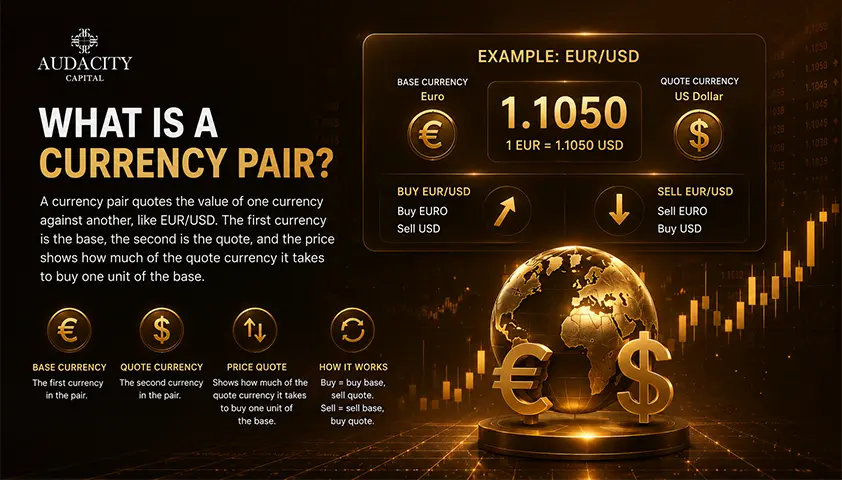
In short - A currency pair quotes the value of one currency against another, like EUR/USD. The first currency is the base, the second is the quote, and the price shows how much of the quote currency it takes to buy one unit of the base. Pairs split into three groups: majors (always include the US dollar), minors or crosses (two major currencies, no US dollar), and exotics (a major paired with an emerging-market currency). Beginners are usually best starting with the majors. |
What Is a Currency Pair?
In forex, you never trade one currency on its own, you always trade one against another, and together they form a currency pair. The pair is a price quote that shows the value of the first currency in terms of the second. The first currency is the base currency and the second is the quote currency.
Take EUR/USD. The euro is the base and the US dollar is the quote. If EUR/USD is trading at 1.10, one euro buys 1.10 US dollars. When you buy the pair you are buying euros and selling dollars at the same time; when you sell, you do the reverse. Every forex trade works this way, which is why understanding the base-and-quote structure is the foundation of everything else.
How to Read a Currency Pair Quote
Every pair is shown with two prices: the bid (the price you can sell the base currency at) and the ask (the price you can buy it at). The ask is always slightly higher than the bid, and the gap between them is the spread, which is the main cost of the trade. Because you enter at the ask and exit at the bid, the price has to move in your favour by at least the spread before you break even.
Price moves are measured in pips. For most pairs a pip is the fourth decimal place (0.0001), so EUR/USD moving from 1.1050 to 1.1051 is a one-pip move. For pairs that include the Japanese yen, a pip is the second decimal place (0.01) instead. The cash value of a pip depends on the pair and your position size, which is why working out pip value is a key step before sizing any trade.
The Three Types of Currency Pairs
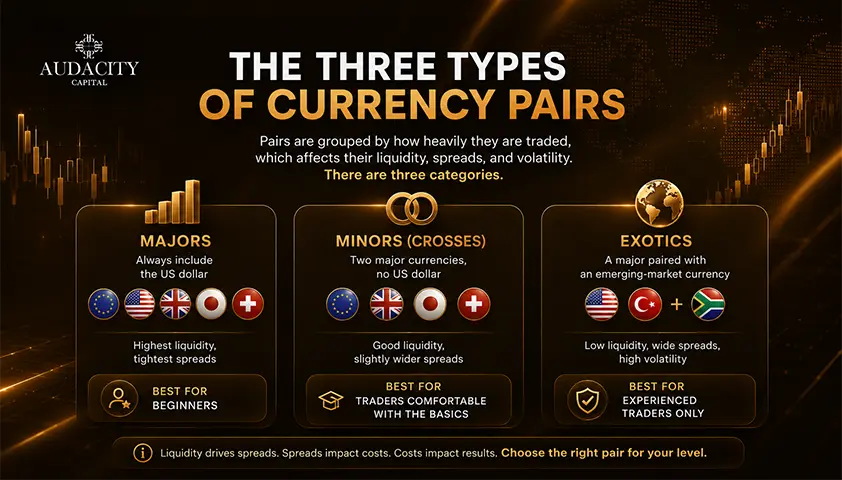
Pairs are grouped by how heavily they are traded, which in turn drives their liquidity, spreads, and volatility. There are three categories.
Major currency pairs
Major currency pairs always include the US dollar paired with another large economy's currency. They are the most heavily traded pairs in the world, which gives them deep liquidity and the tightest spreads, and their moves tend to be better researched and more orderly. The most traded of all is EUR/USD. The four traditional majors are EUR/USD, USD/JPY, GBP/USD, and USD/CHF, each with a trader nickname (the “cable” for GBP/USD, the “swissie” for USD/CHF, and so on).
Minor currency pairs (crosses)
Minor currency pairs, also called crosses, are made up of two major currencies without the US dollar. Common examples include EUR/GBP, EUR/JPY, and GBP/JPY. They are still actively traded but carry slightly wider spreads than the majors because their liquidity is lower. A cross is often most liquid when both of its currencies are in active trading hours, GBP/JPY, for instance, is busiest during the London and Tokyo overlap.
Exotic currency pairs
Exotic currency pairs combine one major currency with a currency from a smaller or emerging-market economy, such as USD/TRY (US dollar / Turkish lira) or USD/ZAR (US dollar / South African rand). They have the lowest liquidity, the widest spreads, and the sharpest, least predictable moves, and brokers often require more margin to trade them. That combination makes exotics the riskiest of the three groups, so most beginners leave them until later.
Type | US dollar included? | Liquidity & spread | Best for |
Majors | Always | Highest liquidity, tightest spreads | Beginners and most traders |
Minors (crosses) | No - two majors | Good liquidity, slightly wider spreads | Traders comfortable with the basics |
Exotics | Major + emerging currency | Low liquidity, wide spreads, volatile | Experienced traders only |
What Moves Currency Pair Prices?
A pair's price reflects the relative strength of its two economies, so it moves on the news that changes that balance. The main drivers are interest-rate decisions from central banks, inflation and growth data, employment figures, and overall market sentiment toward risk. Commodity prices matter too: currencies like the Canadian, Australian, and New Zealand dollars often move with oil and metals because those exports drive their economies. Because the forex market runs 24 hours a day, five days a week, prices can react to global events at almost any time.
Which Currency Pairs Should Beginners Trade?
If you are starting out, begin with the major currency pairs. Their tight spreads keep your trading costs low, their deep liquidity means orders fill cleanly, and the wealth of analysis available makes their behaviour easier to learn. EUR/USD is the natural first pair for most people. There is no genuinely “easy” pair, what makes any pair manageable is a sound strategy and proper risk management, but the majors are the most forgiving place to build those skills before you explore crosses and, much later, exotics.
How Many Pairs Should You Trade at Once?
Fewer than you might think. Trying to follow everything leaves you understanding nothing, so a common piece of advice is to start with no more than two or three pairs and learn how they move. The more time you spend watching a specific pair, the better your feel for its rhythm, its typical daily range, the sessions it comes alive in, and how it reacts to news. Mastering a couple of majors will take you further than spreading your attention across a dozen markets.
Trade Major Pairs With a Funded Account
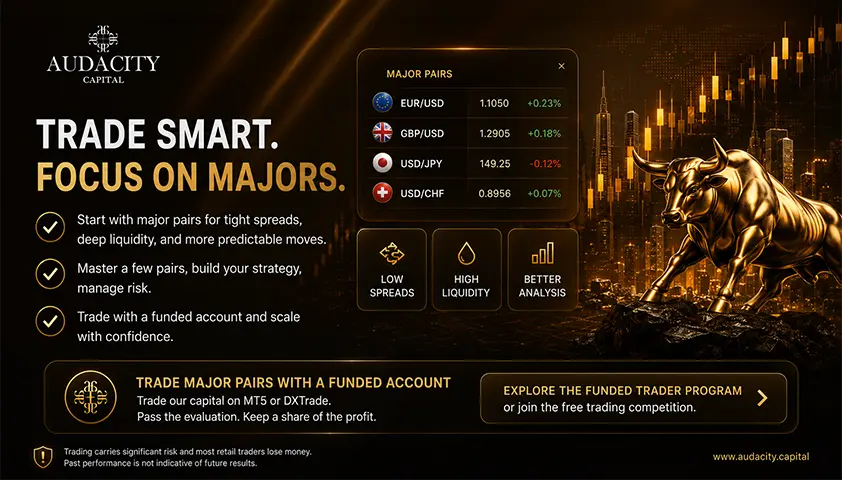
Once you understand how currency pairs work and have a tested approach, the next hurdle is usually capital. A prop firm like Audacity Capital lets you trade the firm's capital on the major and minor forex pairs after passing a skills-based evaluation, on MT5 or DXTrade, so you can trade meaningful size without risking a large personal balance and keep a share of any profit.
As always, keep the risk in view: the capital is simulated and payouts are real, but a funded account gives you size and structure, not a guaranteed edge. Trading carries significant risk and most retail traders lose money, so it is best once your strategy is proven. If that fits where you are, explore the Funded Trader Program or test your skills first in the free trading competition.
Frequently Asked Questions
The base currency is the first one listed in a pair and the quote currency is the second. The price tells you how much of the quote currency is needed to buy one unit of the base, so in GBP/USD at 1.27, one pound buys 1.27 dollars.
EUR/USD is the most traded pair in the world. It combines the world's two largest economies, which gives it the deepest liquidity and typically the tightest spread of any pair.
Spreads reflect liquidity. Majors attract enormous global trading volume, so the gap between bid and ask stays small, while exotics trade in much lower volume, which widens the spread and raises the cost of trading them.
Yes. For pairs that include the Japanese yen, a pip is the second decimal place (0.01) rather than the fourth (0.0001) used for most other pairs, which changes how you calculate pip value and risk.
These are currencies whose value tends to track key exports. The Canadian dollar often moves with oil, while the Australian and New Zealand dollars move with metals and agricultural goods, so their pairs can react to commodity prices.
Generally no. Exotics have wide spreads, low liquidity, and sharp, unpredictable moves, which makes them costly and risky to learn on. Most beginners start with majors and only explore exotics with more experience.
Two or three is plenty. Concentrating on a small number of pairs lets you learn how each one moves and reacts to news, which builds far more useful skill than trying to trade many markets at once.

Trade Now With Audacity Capital
Get Funded NowForex Currency Pairs In Depth
Explore The Best Funded Trader Program With Audacity Capital

Готовы применить дисциплинированный риск к криптовалютам? Изучите новые криптоинструменты Audacity Capital и примените свою торговую стратегию.
Узнать большеРассылка
Подпишитесь на нашу рассылку.
Присоединяйтесь к нашему сообществу

Начните свое путешествие сегодня с нашей бесплатной пробной версией
С гордостью демонстрируйте свои навыки и достижения с помощью сертификатов и получайте признание за свой тяжелый труд и преданность делу от потенциальных инвесторов и коллег.
Бесплатная пробная версияПохожие статьи
__webp__orig.webp)
From Demo To Live: When Are You Ready To Go Live?


The First 30 Days: What New Traders Should Focus On (And Ignore)

Swing Trading vs Day Trading: Which Is Right for You?
One style costs you your afternoons. The other costs you your sleep. Here is how swing trading vs day trading really compare, and how to pick.

Introducing Ability One: One Step To Funding With Static Drawdown