


Currency Pairs in Forex: Meaning, Types and Examples



Do you look up the dollar rate before traveling to foreign countries or wonder why the value of the rupee changes against the dollar? This is the simplest way to understand forex trading. In the global market, every currency is compared to another, and that is known as a currency pair.
Some examples of currency pairs are EUR/USD, GBP/USD and USD/JPY. These pairs have two parts: base currency (first currency) and quote currency (second currency). And the rate between these two is known as the exchange rate.
Forex pairs can be classified into 3 categories based on the currencies involved, such as major, minor and exotic pairs. Even though there are thousands of possible combinations, only a few of them contribute to most of the forex trading activities. That’s what today’s article is all about.
Key Takeaways
- A currency pair compares the value of two currencies.
- The three types of forex trading pairs are: major, minor and exotic.
- Seven traditional major pairs and eight major currencies exist.
- Liquidity, spreads and volatility vary across pairs.
What Are Currency Pairs in Forex?
A currency pair is a quotation that displays the value of one currency against another. In forex, currencies are always traded in pairs since purchasing one currency implies selling another.
Let us take an example of EUR/USD, where EUR stands for euro and USD stands for US dollar. If the exchange rate is 1.1500, then it signifies that one euro is equivalent to 1.15 US dollars.
A currency pair consists of two components:
- Base currency: The first currency in the pair. It’s the currency that is being bought or sold.
- Quote currency: The second currency in the pair. This currency indicates the amount of the currency required to buy one unit of the base currency.
In the case of EUR/USD, EUR is the base currency while USD is the quoted currency.
The same is true for USD/INR. For instance, you plan to buy a device worth $100 on an American website. If $1 is equal to ₹83, then the cost will be ₹8,300. If $1 increases to ₹85, then the same device would now cost ₹8,500.
There is a standard three-letter code system for currency pairs worldwide. Some common currency codes are listed below:
Currency Code | Currency Name |
USD | US Dollar |
EUR | Euro |
GBP | British Pound Sterling |
JPY | Japanese Yen |
CHF | Swiss Franc |
AUD | Australian Dollar |
CAD | Canadian Dollar |
NZD | New Zealand Dollar |
INR | Indian Rupee |
These codes make it easier to identify currencies across global forex markets.
How Do Currency Pairs Work?

When trading currency pairs, you will always be buying one currency and selling another. The decision to buy or sell a pair is based on the direction in which you think that the exchange rate will move.
Let’s understand this with the example of EUR/USD.
Buying a currency pair: While buying EUR/USD, you are buying euros and selling US dollars.
You are expecting that the euro will appreciate against the dollar. If the exchange rate increases from 1.1500 to 1.1600, then the euro will become stronger compared to the dollar.
Selling a currency pair: While selling EUR/USD, you are selling euros and buying US dollars.
You are expecting that the euro will depreciate against the dollar. If the exchange rate decreases from 1.1500 to 1.1400, then the euro has weakened against the dollar.
There are several other terms to explain forex prices:
- Bid price: the price at which the broker is ready to purchase base currency from you.
- Ask price: the price at which the broker is ready to sell base currency to you.
- Spread: the difference between the bid and ask price. Spread is one of the core transaction costs in foreign exchange market.
- Pip: the standard unit to measure price changes. One pip equals 0.0001 for most currency pairs; however, for currency pairs with Japanese yen it equals 0.01.
In case EUR/USD rises from 1.1500 to 1.1510, then the movement is 10 pips.
Currency prices continuously fluctuate based on the demand and supply changes in the foreign exchange market. Economic news, central banks' actions and global events may affect the movement of such fluctuations.
What Are the Different Types of Currency Pairs?
The types of currency pairs can be classified into three categories: major, minor and exotic. The classification depends on the currency included in the pair and the pair's function within the global foreign exchange markets.
Type | What It Means | Examples | Typical Characteristics |
Major | USD paired with another heavily traded major currency | EUR/USD, USD/JPY, GBP/USD | High liquidity and low spread |
Minor / Cross | Major currencies paired without USD | EUR/GBP, EUR/JPY, GBP/JPY | Moderate liquidity, lower than that of major pairs |
Exotic | A major currency paired with an emerging or smaller-market currency | USD/INR, USD/ZAR, USD/TRY | Low liquidity and wide spread |
Major Currency Pairs
This includes the US dollar and other major currencies, like euro, British pound, Japanese yen. These pairs make up a considerable part of the global foreign exchange trading volume and are readily available at retail forex brokers.
The seven traditional major currency pairs are explained in detail in the next section.
Minor Currency Pairs
Minor currency pairs, a part of cross-currency pairs, are made up of two major currencies but do not include the US dollar. Some examples are EUR/GBP, EUR/JPY and GBP/JPY.
These pairs might have a significant volume of trades, but their liquidity and spreads might be different from those of major pairs. The price is affected by economic news from both currency zones.
Exotic Currency Pairs
Exotic currency pairs consist of a major currency and a currency from an emerging economy or a small foreign exchange market. Examples are USD/INR, USD/ZAR (US dollar/South African rand) and USD/TRY (US dollar/Turkish lira).
These pairs usually have less liquidity and larger spreads compared to major pairs. Prices can also be affected by local economic news, politics and changes in the regulation of currency.
Note: Currency-pair classifications may vary slightly between brokers and educational sources.
What Are the Major Currency Pairs?
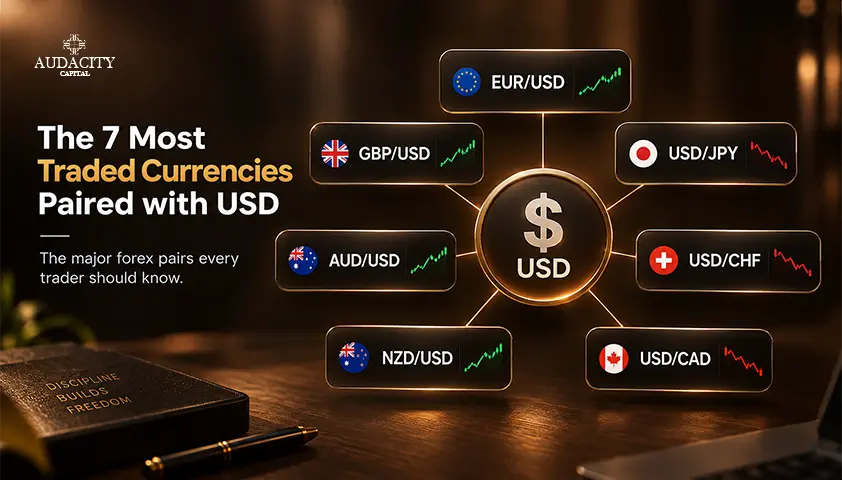
Major currency pairs are forex pairs which consist of the US dollar combined with another currency. These are amongst the most frequently traded currency pairs within the worldwide foreign exchange market.
Traditionally, the retail forex category includes seven major currency pairs. Each one of these contains USD either on its base or quote side.
Here are 7 major currency pairs list:
Major Currency Pair | Currencies |
EUR/USD | Euro / US Dollar |
USD/JPY | US Dollar / Japanese Yen |
GBP/USD | British Pound / US Dollar |
USD/CHF | US Dollar / Swiss Franc |
AUD/USD | Australian Dollar / US Dollar |
USD/CAD | US Dollar / Canadian Dollar |
NZD/USD | New Zealand Dollar / US Dollar |
These currency pair combinations are known as major currency pairs as they include currencies of the largest countries in the world.
Common Features of Major Forex Pairs
While each pair has its own price movement, there are some common features of major forex pairs:
- Higher liquidity: These pairs usually have more buyers and sellers, making them easy to trade.
- High trading volume: They make up a large percentage of the total forex trades.
- Wide availability: Almost all retail forex brokers offer these pairs.
- Tight spreads: Due to higher trading volume, they usually have smaller differences between bid and ask prices than less-liquid pairs.
- Sensitive to economic news: Interest rates, inflation, employment reports, and central bank news may affect their exchange rates.
In addition, you may encounter references to four traditional major pairs: EUR/USD, USD/JPY, GBP/USD and USD/CHF. This is a narrower definition. In general, the retail forex market convention includes all seven pairs listed above.
These classifications are based on market conventions. The most active pairs according to the recent market data may not correspond to the list of seven majors.
Why Are There 7 Major Currency Pairs but 8 Major Currencies?
A typical query from beginners is why just seven major currency pairs are recognised by the market even when there are eight major currencies.
And the simple answer is that the USD forms a pair with each of the other seven currencies.
The eight currencies that are normally classified under the traditional major currencies include:
Currency | Currency Name | Currency Code |
🇺🇸 | US Dollar | USD |
🇪🇺 | Euro | EUR |
🇯🇵 | Japanese Yen | JPY |
🇬🇧 | British Pound Sterling | GBP |
🇨🇭 | Swiss Franc | CHF |
🇦🇺 | Australian Dollar | AUD |
🇨🇦 | Canadian Dollar | CAD |
🇳🇿 | New Zealand Dollar | NZD |
As the USD forms a pair with each of the other seven currencies, seven major forex pairs emerge using the traditional classification system.
But what about 28 currency pairs?
Using simple mathematics, eight currencies form 28 two-currency combinations. This results from the combination formula:
8 × 7 ÷ 2 = 28
All these 28 pair combinations, however, cannot be said to be the major pairs.
There are only seven currency pair combinations that are recognised as major forex pairs. All the other 21 combinations are made up of two major currencies but do not include the US dollar. These currency pairs are considered minor or cross-currencies.
Which Are the Most Traded Currency Pairs?
It is not the case that all forex currency pairs receive the same amount of attention. There are some currency pairs which account for more volume than others.
According to the Triennial Central Bank Survey by Bank for International Settlements (BIS), OTC foreign exchange turnover in April 2025 averaged approximately $9.6 trillion per day. The US dollar featured on one side of 89.2% of the total transactions.
The below table outlines some important currency pairs and their proportion of forex turnover:
Currency Pair | Share of Global FX Turnover |
EUR/USD | 21.2% |
USD/JPY | 14.3% |
USD/CNY | 8.1% |
GBP/USD | 7.6% |
USD/CAD | 5.3% |
AUD/USD | 4.9% |
USD/CHF | 4.9% |
Observe that USD/CNY is included in the list of most traded currencies although it is not one of the traditional seven major currencies.
The major currency pairs have a standard classification, whereas the most traded currency pairs are ranked based on the actual volume of trade.
All ten of the highest volume currency pairs contained the US dollar according to the BIS survey. This illustrates the significance of the US dollar in global foreign exchange transactions.
What Moves the Price of Currency Pairs?

The prices of currency pairs fluctuate when there is increased or decreased demand for one currency compared to another. Several factors may impact the demand.
There are five key factors that impact forex currency pairs.
1. Interest Rates and Central Bank Decisions
Interest rate policies of central banks like the US Federal Reserve and RBI play a major role in determining currency values.
A rise in interest rate attracts foreign investors seeking better returns, hence creating more demand for that particular currency.
But expectations from the market also have to be taken into account. If the rise in the interest rate is expected, it might already be priced in the exchange rate.
2. Inflation and Economic Performance
Inflation indicates the pace at which the cost of goods and services rises. High inflation levels can impact the purchasing power of the currency and influence central bank decisions.
There are other economic factors such as gross domestic product (GDP), employment and consumer expenditure that help gauge the economic conditions.
3. Political and Geopolitical Events
Events such as elections, government policy changes, wars and trade restrictions can impact currency demand.
For instance, if there is uncertainty regarding the economic and political future of a nation, it can result in exchange rate fluctuations.
4. Market Sentiment and Risk Appetite
Market sentiment is the general level of confidence of investors in the financial environment. Investors who are risk-takers may increase demand for some currencies of emerging economies.
However, during periods of uncertainty, they may look for safe-haven currencies such as the US dollar and Swiss franc.
5. Commodity Prices
The price of commodities may impact currencies of major exporters in the same way. The fluctuations in the price of crude oil may affect the Canadian dollar, while the changes in metal prices may have an impact on the Australian dollar.
These factors may affect the forex pair in different ways depending on the economic situation and expectations of both currencies.
How Do Currency Pairs Differ From One Another?
Although all forex pairs use the same pricing mechanism, they have different market behaviour.
Below are five characteristics that differentiate them.
1. Liquidity
Liquidity means that the currency pair is easy to buy and sell without causing any significant price changes. Pairs like EUR/USD feature higher liquidity as they generate many trades. Less frequently traded pairs may have fewer buyers and sellers.
2. Spread
Spread is the difference between bid and ask for the pair. It is one of the transaction costs to be taken into consideration by traders while opening and closing trades.
Well-traded pairs tend to feature smaller spreads compared to less liquid pairs. When traders want to compare transaction costs, they can check some of the best forex pairs with the lowest spreads.
3. Volatility
This is the degree of change in the prices of a currency pair over time. While some currency pairs have less volatility, others tend to be more volatile.
Knowledge about which currency pairs are most volatile can give traders an idea of potential price changes and risks.
4. Trading Sessions
Foreign exchange transactions occur in several global financial centers, such as London, New York, and Tokyo. The opening of these markets might increase trading volume.
Knowing the best forex trading sessions and times can help traders identify periods of higher market activity.
5. Correlation
Correlation refers to the relationship between two currency pairs. Depending on whether these pairs move in tandem or inversely to one another, they might share the same currency or react to the same economic conditions.
Traders also analyze trending forex pairs and forex pairs for scalping for a better understanding of market behaviour.

Trade Now With Audacity Capital
Get Funded NowConclusion
Currency pairs are the first thing one needs to study in order to learn how forex trading works. Each currency pair represents the value of two currencies, where the exchange rate defines how much one currency is worth relative to another.
Differentiation into major, minor and exotic pairs is helpful for beginners to understand how currency pairs are divided depending on their combination. Moreover, it is useful to know how liquidity, spreads, volatility and economic news affect their prices.
After you acquire this knowledge, you can easily explore specific currency pairs and discover how they behave on the market without thinking that all forex pairs work alike.
Frequently Asked Questions About Currency Pairs
A currency pair shows the value of one currency relative to another. For instance, the EUR/USD pair shows how many US dollars one needs to buy one euro. The first currency is referred to as the base currency, while the second one is the quote currency.
The seven traditionally recognised major currency pairs are:
EUR/USD (Euro/US Dollar)
USD/JPY (US Dollar/Japanese Yen)
GBP/USD (British Pound/US Dollar)
USD/CHF (US Dollar/Swiss Franc)
AUD/USD (Australian Dollar/US Dollar)
USD/CAD (US Dollar/Canadian Dollar)
NZD/USD (New Zealand Dollar/US Dollar)
Each currency pair consists of the US dollar and one more major currency.
The conventional set of major currencies consists of eight currencies: USD, EUR, JPY, GBP, CHF, AUD, CAD and NZD.
Seven traditionally recognised major pairs are formed by the combination of the US dollar with each of the other seven currencies. That is why there are eight major currencies but only seven major pairs.
No. Eight major currencies could form 28 different combinations of currencies. But only seven of them are traditionally recognised as major forex pairs.
The other 21 pairs do not contain the US dollar and are usually referred to as minor or cross-currency pairs.
There is no exact number of forex currency pairs worldwide. Theoretically, thousands of different currency combinations may exist but in practice. The number that are available for trade varies from broker to broker, trading platform, and market.
Major, minor and exotic pairs represent the three main categories of classification.
Difference lies in the currency involved and their market characteristics.
Major pairs: Consist of the US Dollar and another major currency. For example, EUR/USD.
Minor pairs: Consist of two major currencies but not including the US Dollar. For example, EUR/GBP.
Exotic pairs: Consist of a major currency and an emerging market currency. For example, USD/INR.
Major currency pairs usually have higher liquidity and tighter spreads while minor and exotic pairs are less liquid and have wider spreads.
No. In the global conventional forex classification, USD/INR is generally considered an exotic currency pair and not one of the seven traditional major currency pairs.
But it is an important currency pair for the Indian market as it shows the value of the US dollar against the Indian rupee.
Forex Currency Pairs In Depth
Explore The Best Funded Trader Program With Audacity Capital

暗号資産に規律あるリスクを適用する準備はできていますか?Audacity Capitalの新しい暗号資産商品を探索し、あなたの取引戦略を持ち込んでください。
詳細を見るニュースレター
ニュースレターに登録して最新情報を入手。
ソーシャルコミュニティに参加

関連記事

10 Best Futures Prop Firms for Swing Trading In 2026
Compare the best futures prop firms for swing trading in 2026 with overnight holding, flexible rules, fast payouts, and funded accounts.


How To Choose The Right Prop Firm – A Complete Checklist
Learn how to choose the right prop trading company with our expert guide. Compare fees, rules, profit splits, and platforms to trade confidently.

Introducing Ability One: One Step To Funding With Static Drawdown

Trading Psychology for Funded Traders: Pressure, Fear and Revenge Trading
Struggling with pressure and tilt? Master trading psychology for funded traders with concrete systems to avoid revenge trading and stay disciplined.