


What Is a Prop Firm and How Does It Work?


Traders often find themselves in a situation where their strategy is sound, but their money is not.
A prop firm helps fill this void by providing traders with access to trading capital in accordance with set guidelines. This enables them to engage in market trading such as forex, indices and commodities without risking huge amounts of their own money.
Most of today's retail companies have an evaluation or funding process to determine who receives access.
This guide will introduce you to what a prop firm is, how it operates step by step, what firms are looking for in a trader, and risks you should consider before you get started.
What Is a Prop Firm?
A prop firm is a company that trades in financial markets with its own funds instead of obtaining money from outside investors or clients.
That is where the term comes from: the capital is proprietary, meaning it belongs to the firm. In order to understand what a prop firm is, one should distinguish between two functions:
The firm provides capital and establishes the risk framework. The trader provides the skill, the strategy and the discipline to trade in that framework.
It is fundamentally different from when the firm's capital is pooled from external clients, as it occurs in other financial systems. In this case, the stakes are the firm's own funds.
If the trader does his job well enough within the rules, the outcome is shared. The firm takes its agreed share, while the trader receives the rest via profit sharing.
This mutual success model is the backbone of the system: the firm supports traders that they think have the potential to deliver returns in a responsible way, and both parties benefit when that happens.


Audacity Capital Empowering Traders Since 2012
Join the Prop FirmTraditional Prop Firms vs Modern Retail Prop Firms
Nowadays, the term "prop firm" refers to two distinct but related entities.
Traditional prop trading firm
The firm directly employs professional traders. These traders work in-house, trade the firm's capital and operate within the firm's professional infrastructure with internal risk desks and oversight.
Access is typically gained through a hiring process, not a public sign-up.
Modern retail prop firm
It is an entirely different story. Independent traders work remotely from anywhere they are permitted to. Most companies conduct a paid test to determine their skills and risk management abilities, and all trading follows the predetermined set of rules.
The funded stages can be either simulated trading or live trading, depending on the firm. High performance results can earn real payouts.
They both have the same concept of investing in traders with financial capital, but the retail version made it available to a much broader audience.
How Does a Prop Firm Work?

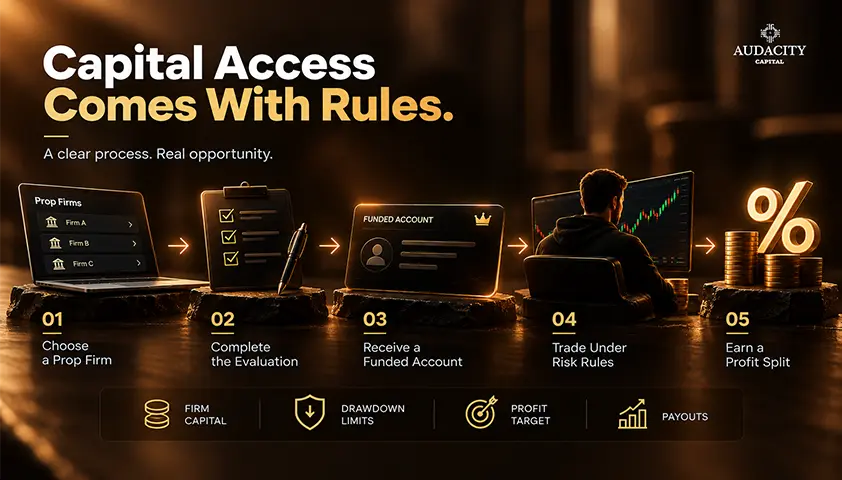
It is much easier to understand how a prop firm works if it is viewed as a chain of events. The usual journey is as follows:
Choose Program → Evaluation → Pass Rules → Funded Account → Trade → Profit → Payout
Each of the above steps has its purpose, but all of them aim at one goal: finding a trader who possesses a disciplined approach and consistent trading methods. Here is how this process takes place.
Step 1: Choose a Prop Firm Program
The first decision is which program to join. Each firm presents options for account sizes and options for how you'll fund your account, so it is important to select the one that best fits your experience, your strategy, and how you want to prove yourself.
Those who prefer the evaluation route can show their skills and get funding after passing several stages of testing. Others may prefer instant funding, in which you gain access to a funded account without a multi-stage test.
The Ability Challenge at Audacity Capital is a two-step evaluation and the Ability One is a one-step evaluation. The FTP offers instant funding.
It's important to consider that fee structures and requirements may be different in each of these cases; therefore, picking one that fits your style of trading is always the best approach.
Step 2: Complete the Prop Firm Evaluation
In the case of evaluation-based routes, the next step of the process is taking the prop firm challenge. It's aimed at proving that you can manage to grow the trading account while at the same time managing risks.
Read more about How to Pass a Prop Firm Challenge
A lot of retail prop firms' evaluations take place in a simulation environment. Typically, you'll be required to hit a set profit target while observing certain risk limitations.
Achieving the profit target is not sufficient. You also need to respect the rules throughout the evaluation. Evaluations are generally in one-step or two-step formats. In a one-step evaluation, you will be required to show your worth in a single step.
A two-step evaluation divides that into two stages, each having a slightly different goal. Both require consistency, not luck.
Step 3: Meet the Trading and Risk Requirements
All evaluations are built around a set of prop firm rules, and the reason for them is more important than knowing each individually.
Common parameters are the profit target, daily loss limit and maximum drawdown. There are also some programs that have a minimum number of trading days.
Consistency rules may apply at other firms or be limited in certain trading practices.
These rules are not being put in place to catch traders off-guard. These are simply in place to prove that you can maintain your performance.
Firms looking to allocate capital want assurance that your good performance is not due to luck. They need to know that you can manage your risk even when the market turns against you. The rules are the structure that distinguishes disciplined trading from gambling.
Step 4: Receive a Funded Trading Account
If you succeed in passing the assessment, the funded phase is next.
This is where the model lives up to its promises because it will give you a funded trading account supported by the firm. This process will normally involve the allocation of your account and the confirmation of your trading terms.
The risk limits will still apply at this stage since the firm is already putting its money in line with your decisions.
As a funded trader, your job will be to trade according to your plan and follow the limits. Treat the funds with the same discipline as you did when you were undergoing the assessment period.
In short, the account changes, but the expectations stay consistent.

Audacity's Trading Competition
Free Prop Firm ChallengeStep 5: Trade Within the Firm's Rules
A popular misconception is that passing the challenge removes the rules. It does not.
Prop firm funding comes with ongoing responsibilities, which means risk management continues for as long as you hold the account.
Breaching a daily loss limit or a maximum drawdown can cause termination of a funded account regardless of how profitable you were before the breach occurred.
Funding gives you access to capital, but it does not create a trading edge or guarantee profitability.
Step 6: Earn a Profit Split and Request a Payout
When you trade profitably within the rules, you earn a share of the results through a profit split. The firm takes a set percentage, and you receive the rest.
Audacity Capital provides up to 90% of the profits and same-day payouts on approval.
The terms and conditions for payouts depend on the firm; hence, it is important to know them before you commit. Some firms have payout on demand once the conditions are met, while others have a scheduled payout process.
Step 7: Scale the Account
Many firms reward sustained performance with the chance to scale. Scaling means the firm increases your account allocation over time, giving disciplined traders access to more capital.
However, scaling is not a guarantee. It is dependent on certain factors, such as consistent results within a specified period. Different companies have different criteria, but the main principle remains the same.
What Does a Prop Firm Look for in a Trader?
Firms are not simply hunting for the trader who can post the biggest single profit. They are looking for something more durable.
The traits that stand out are:
- Consistent performance across time, not one strong session
- Risk control and sensible position sizing
- The ability to follow rules without exception
- Discipline under pressure, especially after a loss
- Avoiding excessive risk even when a trade looks tempting
- A repeatable trading strategy that can be applied again and again
Here is the point that many new traders miss: a prop firm is testing whether your results can be achieved within defined risk limits. A large profit taken through reckless sizing tells a firm very little. A steady, controlled return tells them everything.
Are Prop Firm Accounts Real or Simulated?
This question comes up often, and it deserves a clear answer.
Evaluation Accounts
Evaluation and challenge accounts are typically simulated. That makes sense: the firm is assessing your skill and risk control before committing capital, so there is no reason to expose real money during the test.
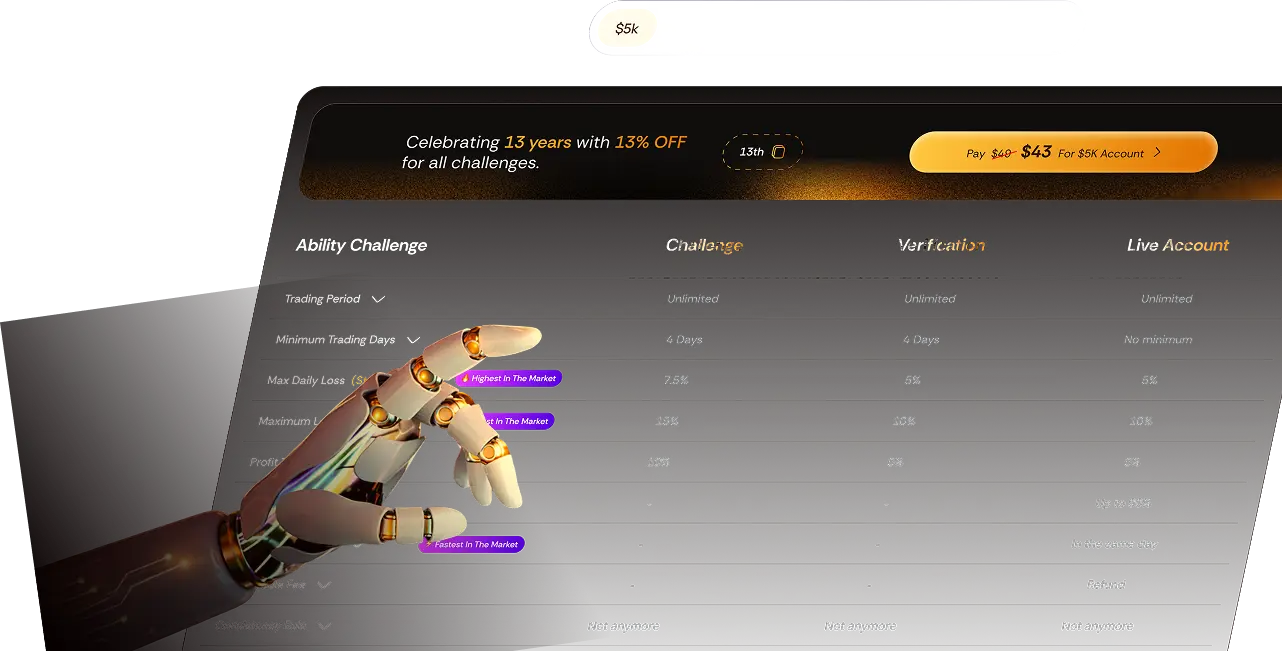
Funded Trader Program
Start Funded TradingFunded Accounts
Funded accounts can differ by firm. Some operate as simulated funded accounts, some as live accounts, and some use models where selected traders or trades are moved to live execution based on performance.
The most important thing to understand is this: a simulated funded account does not automatically mean the payout is simulated.
Real payouts can be tied to your performance in a simulated environment. What matters for you as a trader is whether the firm pays out on the results you produce, and Audacity Capital reports $250M+ paid out to traders.
Check How Traders Get Funded?
Check about Audacity Capital's Prop Firm free Trial Program
How Do Prop Firms Make Money?
It is natural to ask how a firm sustains this model.
In broad terms, prop firms can earn through evaluation or challenge fees and through their share of the profit split when funded traders perform. Some firms may also charge other program or account fees.
Depending on the firm, trading activity and internal risk management also play a role in the overall model.
The exact economics vary, and the business model is more detailed than a single section can cover. If you want the full picture of how these revenue streams work together, the dedicated breakdown on how prop firms make money goes deeper.
Read more about Prop Trading Business Model
Prop Firm vs Trading With Your Own Money

For many traders, the real question is whether a prop firm is better than simply trading a personal account. This comparison makes the trade-offs clear.
Factor | Prop Firm | Personal Trading Account |
Trading capital | Firm/program allocation | Trader's own capital |
Personal capital at risk | Usually program/evaluation cost | Full trading balance |
Profit | Shared via profit split | Trader keeps all profit |
Trading rules | Firm-defined | Trader-defined |
Drawdown limits | Usually strict | Trader decides |
Scaling | May be available | Depends on personal capital |
The appeal is straightforward. A prop firm lets you trade a larger account while limiting your personal exposure to the cost of the program. In exchange, you share profits and trade within firm rules.
Trading your own money means you keep 100% of the profit. However, your full balance is at risk, and your trading size is limited by whatever you can personally fund.
Read more about Prop Trading Vs Trading Your Own Capital
Prop Firm vs Broker
Prop firms and brokers are sometimes confused, but they play different roles.
A broker provides market access so you can trade your own capital. You fund the account, you take the risk, and you keep the outcome.
A prop firm provides a structured program and capital or account allocation under firm-defined conditions. You are not just accessing markets; you are participating in a program built around evaluation, rules, and shared results.
Prop Firm | Broker | |
Capital used | Firm allocation | Your own funds |
Rules | Firm-defined | Your choice |
Outcome | Shared profit split | You keep it all |
Main service | Funding program | Market access |
Read detailed blog about Prop Firm vs Broker: Which One Is Better for Traders
Advantages of Trading With a Prop Firm
Working with a prop firm offers several practical benefits:
- Access to larger account sizes than most traders could fund alone
- Less personal capital at risk, since your main outlay is the program cost
- A defined risk framework that encourages disciplined trading
- The potential to earn a profit split on your results
- Scaling opportunities for consistent performers
- A professional trading structure that mirrors how serious traders operate
These advantages give skilled traders room to grow. They do not, on their own, make trading easier or profitability certain. The edge still comes from you.
Risks and Limitations of Prop Firms
A balanced view means being clear about the downsides too.
- Evaluation fees can be lost if you do not pass the challenge
- Drawdown rules are often strict, and small mistakes can end a phase
- Account termination can follow a rule breach, even after strong performance
- Profit sharing means you do not keep 100% of what you earn
- Certain trading strategies may conflict with a firm's rules
- Payout conditions vary, so terms need checking upfront
- Funded capital does not create a trading edge; you still need a proven approach
- Repeated challenge attempts can become expensive over time
None of this should discourage a prepared trader. It should simply set realistic expectations before you commit.
Read more about Prop Trading Challenges & Rules
What Happens If You Break a Prop Firm Rule?
Rules have their consequences, and it is important to understand what a violation is all about.
In case of evaluation, a rule violation normally entails evaluation failure, and you will probably have to start all over again. On a funded trading account, a violation might result in account termination.
Some firms offer reset or retry options; however, such options vary depending on conditions.
The important thing here is the fact that the profitability does not safeguard your account from violating a rule.
A daily loss limit or drawdown breach can end an account even if you were up beforehand. This is exactly why risk control is treated as the priority, not an afterthought.
How to Choose a Prop Firm
If you decide a prop firm suits you, weigh a few essentials before you commit:
- Clear trading rules you can actually understand
- A fair and transparent drawdown structure
- Reasonable payout terms and conditions
- A reliable trading platform, such as MetaTrader 5 or DXTrade
- The markets available for your strategy
- Fees across the program
- A competitive profit split
- A verifiable track record and longevity
- Whether accounts are simulated or live
- Responsive customer support
Choosing well is less about finding the flashiest offer and more about finding rules and terms you can trade under confidently.
Detailed guide about How To Choose The Right Prop Firm – A Complete Checklist
Is a Prop Firm Suitable for Beginners?
Prop firms may be available to beginners, but availability does not equate to suitability. Everyone can apply for the evaluation process; not all of them are prepared to pass through it.
Before spending money repeatedly for evaluations, the beginner traders must have an understanding of risk management, proper position sizing, their own strategy, drawdown characteristics, and the specifics of the program.
If you are still learning the fundamentals, it is often wiser to build those skills first. The educational platforms, such as Trader University, were meant to help with that process.
Trading is a skill and a challenge can expose any weaknesses right away.
Related Articles
Read more about What is Prop Trading?
Check About Audacity's Free Prop Firm Challenge
Frequently Asked Questions About Prop Firms
A prop firm is a company that gives traders access to its own capital to trade markets, under a defined set of rules, and shares the results through a profit split.
You choose a program, complete an evaluation or take an instant-funding route, trade within the firm's rules, and earn a share of your profits when you perform. Risk limits apply throughout.
It varies. Evaluations are usually simulated. Funded accounts may be simulated, live, or a mix depending on the firm. Importantly, a simulated funded account can still lead to real payouts based on your performance.
Your main financial outlay is usually the cost of the program or evaluation. You are not trading your full personal balance the way you would with a standard broker account.
You move to the funded stage and receive a funded trading account. Risk limits continue, and you can begin earning a profit split on results that stay within the rules.
Losses are managed through the firm's risk rules. Breaching a daily loss limit or maximum drawdown can lead to account termination, even if the account was previously profitable.
When you trade profitably within the rules, you receive your agreed share of the profits. Payout schedules and conditions depend on the firm. Audacity Capital offers up to 90% profit share with same-day payouts on approval.
Retail prop firm programs generally do not require formal trading qualifications to participate. You do, however, need to meet the program's rules and respect any restrictions that apply in your jurisdiction.
Beginners can access prop firm programs, but suitability depends on preparation. Understanding risk management, position sizing, and the firm's rules first improves your chances of passing an evaluation.
It depends on the route. Instant-funding programs provide a funded account without a lengthy evaluation, while evaluation-based routes take as long as you need to meet the targets within the rules. One-step and two-step formats will differ in pace.

Готовы применить дисциплинированный риск к криптовалютам? Изучите новые криптоинструменты Audacity Capital и примените свою торговую стратегию.
Узнать большеРассылка
Подпишитесь на нашу рассылку.
Присоединяйтесь к нашему сообществу

Начните свое путешествие сегодня с нашей бесплатной пробной версией
С гордостью демонстрируйте свои навыки и достижения с помощью сертификатов и получайте признание за свой тяжелый труд и преданность делу от потенциальных инвесторов и коллег.
Бесплатная пробная версияПохожие статьи

Best Local Payment Methods for Forex Prop Trading
Compare the best local payment methods for forex prop trading by region and learn faster, cheaper prop firm withdrawals with fewer delays.


Instant Funding vs the Challenge: Which Funded Account Should You Choose?
Two routes to a funded account, one honest comparison. See how instant funding vs challenge differ on cost, drawdown, and profit split, and which route fits you.

10 Best Prop Trading Firms in Malaysia in 2026
Compare the 10 best prop trading firms in Malaysia for 2026, ranked on swap-free accounts, payout speed, fees, and payments that work from Malaysia.

Do You Pay Taxes on Prop Firm Payouts? A Funded Trader's Guide
In almost every country, prop firm payouts are taxable income, not capital gains. Learn how they are taxed, what you can deduct, and why records matter.