


Day Trading vs Long Term Investing: Key Differences, Risks, Costs and Strategies


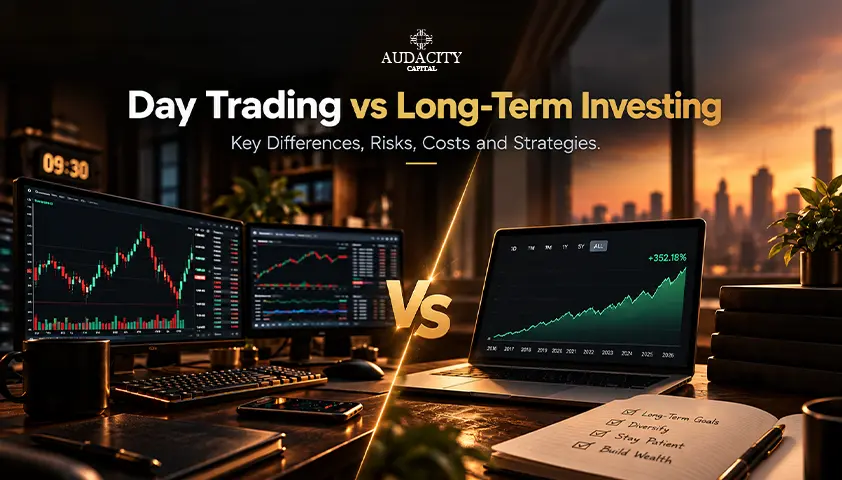
On a Monday morning, a day trader opens her brokerage app and resolves to close every position before dinner. Across town, an investor opens his and resolves to leave every holding alone for ten years. That picture captures day trading vs long term investing at a glance, and the difference between day trading and long-term investing extends well beyond the holding period into objectives, analysis, risk, and daily routine.
If you are studying long-term investing vs day trading, expect no single winner, since goals, risk tolerance, free hours, capital, and knowledge decide which path fits. Here’s a detailed elaboration that will help you choose between day trading or long term investing with open eyes.
Day Trading vs Long Term Investing: Key Differences at a Glance
The table below follows the main factors in the order a newcomer encounters them, from the first decision about time to the daily habits that follow.
Factor | Day Trading | Long-Term Investing |
Holding period | Minutes to hours, with every position closed before the session ends (intraday trading) | Years to decades under a buy-and-hold plan |
Primary objective | Profit from small short-term trading price movements | Wealth that grows across a long investment horizon |
Trading frequency | High, with many executions in one session | Low, with a few adjustments each year |
Market monitoring | Continuous screen time during market hours | A scheduled review each quarter, half year or year |
Core analysis | Technical analysis, order flow and news catalysts | Fundamental analysis, earnings, valuation and macro trends |
Risk exposure | Market volatility packed into hours, with execution and slippage risk | Market downturns, inflation and company decline spread over years |
Risk management | A loss limit fixed before each entry | Asset allocation across the whole portfolio |
Leverage | Common, through margin accounts or derivatives | Minimal, and often absent |
Transaction costs | Pile up through spreads and commissions on every round trip | Stay low because few trades occur |
Trading psychology | Fast decisions under pressure, with strict discipline on every trade | Patience through long drawdown periods and no urge to sell in a panic |
Main return driver | Trading edge and price movement | Compounding of earnings growth, dividends and reinvestment |
Time commitment | Substantial daily hours | A few hours each year after the plan is set |
Position management | Intraday entries and exits guided by stop-loss orders and position sizing | Portfolio management through rebalancing and diversification |
Capital requirements | Margin account minimums apply, and a small balance leaves little room for losses. | Small, regular contributions can start the process. |
What Is Day Trading?
Day trading is a short-term trading approach in which a trader opens and closes positions within the same trading day. The goal is to capture relatively small price movements during an active market session.
For day trading for beginners, the basic process is straightforward:
- Identify a potential setup.
- Open a position.
- Manage the trade while the market moves.
- Close it before the trading session ends.
A trader can take either a long position when expecting prices to rise or a short position when expecting them to fall.
Day trading is common across several markets, including stocks, forex, futures, options, and other actively traded financial instruments. The specific opportunities available depend on the broker, market, and trading account.
Common Day Trading Strategies
Four approaches appear most often:
- Momentum: Trade stocks moving quickly on high volume, often after news.
- Breakout: Enter when price moves above or below a key level.
- Range: Buy near support and sell near resistance within a sideways market.
- Scalping: Take very small price moves, sometimes holding positions for seconds.
What Skills Does Day Trading Require?
These strategies demand a particular set of skills.
- Technical analysis teaches the trader to read charts, volume, and price levels quickly.
- Market observation trains the eye on order flow and news as a session unfolds.
- Execution means placing clean orders, attaching a stop-loss to each, and applying careful position sizing.
- Risk management sets daily and per-trade loss limits before the first order goes in.
- An understanding of market volatility tells the trader when a fast market calls for smaller size.
- A written plan fixes entries, exits, and limits in advance, and trading psychology keeps the trader loyal to it through a losing streak.
What Is Long-Term Investing?
Long-term investing is building wealth over years or decades. Investors usually choose assets based on their underlying value, hold them through market cycles, and allow time, compounding, and reinvestment to contribute to portfolio growth.
For long-term investing for beginners, having a clear investment horizon and a strategy that can withstand periods of market volatility is important.
How Long-Term Investing Works?
The buy-and-hold approach is central to long-term investing. Investors buy assets they believe can grow in value over time and avoid making frequent decisions based on daily market movements. The length of the investment horizon influences how much risk an investor can take and how a portfolio is divided between assets such as stocks and bonds. Unlike long-term investing vs day trading, the focus is on participating in long-term growth.
How Long-Term Investors Judge Opportunities?
Long-term investors look beyond price charts and examine the underlying investment:
- Company fundamentals, including Business model, competitive position, and financial health.
- Earnings and revenue for Growth, profitability, and consistency over time.
- Valuation, such as the price-to-earnings ratio, can help assess how an asset's price compares with its earnings.
- Industry conditions like competition, demand, and changes affecting the sector.
- Macroeconomic trends like Interest rates, inflation, and broader economic conditions.
- Spreading investments across assets, companies, or sectors can reduce reliance on a single investment.
Day Trading vs Long-Term Investing: 8 Differences That Matter
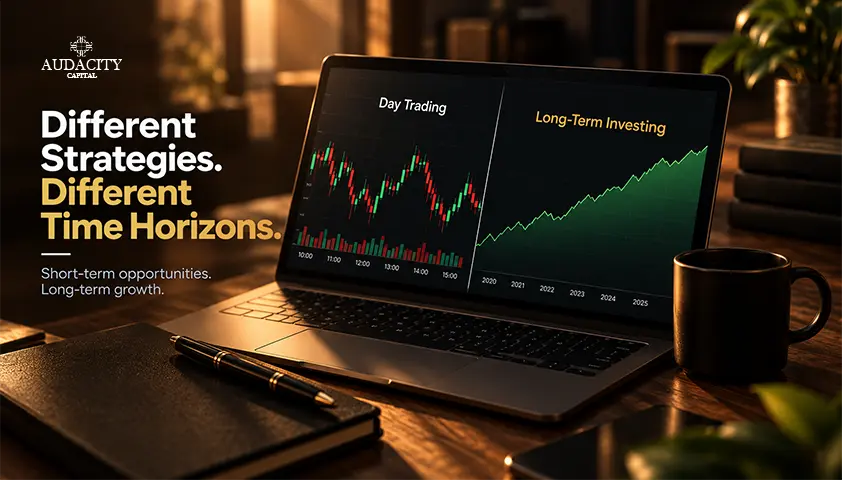
Day trading vs long term investing both involve putting capital into financial markets. But both have different approaches.
The biggest differences come down to how long positions are held, how often decisions are made, how risk is managed, how returns are generated, and how much time the strategy demands. Let’s look at them side by side and understand the practical differences easily.
1. Holding Period
The clearest difference is how long a position stays open. Day trading focuses on short-term price movements, with trades typically lasting from a few minutes to several hours. This avoids exposure to price gaps caused by news or events that occur while the market is closed.
Long-term investing works on a much longer timeline. Positions are held for years and decades, letting investors remain invested through different market and economic cycles. Short-term price movements still affect portfolio values, but they are less central to the strategy.
2. Trading Frequency and Time Commitment
Day trading requires frequent decisions and close attention to the market. Traders scan for opportunities before the session, monitor prices while the market is open, manage positions in real time, and review performance afterward.
Long-term investing usually involves far fewer transactions. The main work happens during selecting investments, deciding on an appropriate asset allocation, and building a diversified portfolio. After that, investors may review their holdings periodically, rebalance when necessary, or continue making regular contributions.
3. Risk and Volatility
It is too simple to call day trading high risk and long-term investing low risk. The two approaches face different types of risk.
Day traders deal with rapid price movements, execution risk, slippage, and the possibility of losses building quickly when markets move unexpectedly. Using leverage can increase this exposure further. Closing positions at the end of the session can reduce overnight gap risk, but it does not remove intraday market risk.
Long-term investors face a different set of challenges. Market-wide declines, inflation, economic downturns, concentration, sector disruption, or a business performing worse than expected can affect their portfolios. A longer time horizon can provide more time to recover from temporary declines, but it does not guarantee that an investment will recover or produce a profit. Diversification and asset allocation can help manage portfolio risk.
4. Returns and How Profits Are Generated
Day traders try to generate returns by repeatedly capturing short-term price movements. The result depends on the outcome of individual trades after spreads, commissions, and other costs. A strategy can have many winning trades and still lose money if the average losses are larger than the gains or trading costs consume the edge.
Long-term investment returns can come from increases in asset value, dividends, interest, and the reinvestment of those returns. Over time, reinvestment allows gains to generate further gains, creating the potential for compound growth. However, investments do not offer a guaranteed rate of return.
5. Costs and Fees
Frequent trading creates more opportunities for costs to reduce returns. Depending on the market and product, day traders may pay spreads, commissions, platform fees, market-data charges, borrowing costs for short positions, and financing costs when using margin. Each charge may look small, but repeated transactions can make the total cost significant.
Long-term investors generally experience less trading friction because they buy and sell less often. Their costs may instead come from fund expense ratios, account or platform charges, and occasional transaction costs when changing the portfolio.
Taxes can also affect the final result for either strategy, although the rules depend on the investor's country, account type, asset, and holding period.
6. Capital Requirements and Leverage
There is no single capital requirement for day trading worldwide. Requirements vary by country, broker, account type, and financial product.
In the United States, day-trading margin rules changed in 2026. The previous $25,000 pattern-day-trader equity requirement was replaced by new intraday margin requirements, which took effect on June 4, 2026. Brokerage firms have until October 20, 2027, to transition to the new framework. The new rules do not impose a $25,000 minimum specifically for day trading. However, $2,000 remains the minimum equity required to trade on margin, and individual firms may set higher requirements.
Elsewhere, leverage rules can work differently. For example, UK and EU rules for retail CFDs impose leverage limits based on the underlying asset and include protections such as margin close-out and negative balance protection.
Long-term investors generally do not face a day-trading-specific margin framework, but borrowing to invest still increases potential losses.
7. Skills, Tools and Research
The tools used by each approach reflect its different time horizon.
Area | Day Trading | Long-Term Investing |
Analysis | Technical and price analysis | Fundamental and valuation analysis |
Data | Real-time and intraday data | Daily, quarterly and long-term data |
Research | News, catalysts and market activity | Earnings, financials, industry and business trends |
Tools | Charting and trade execution platforms | Research and portfolio-management tools |
Risk management | Position sizing and trade exits | Asset allocation and diversification |
Main focus | Short-term price behaviour | Long-term business and portfolio value |
A day trader needs to interpret changing market conditions quickly. A long-term investor generally has more time to study an investment before acting and can focus more heavily on financial performance, valuation, and long-term prospects.
8. Psychology and Emotional Discipline
The emotional challenges are different, but both approaches require discipline.
Day traders work under time pressure and may face FOMO, overtrading, and revenge trading after a losing position. Fast decisions can make it easy to abandon a trading plan or take unnecessary trades in an attempt to recover losses.
Long-term investors face a different test. A major market decline can create the urge to sell after prices have already fallen sharply. Investors may also become distracted by short-term market noise and lose sight of their original goals.
Day trading vs Long Term Investing: Which Requires More Time?
Day trading needs more active time because decisions, order execution, and position management happen during market hours. A typical workflow includes pre-market research, live market monitoring, trade execution, and a post-market review. The exact commitment varies by market, strategy, and trading frequency.
Long-term investing has a different rhythm. An investor spends more time initially defining goals, researching investments, and establishing an appropriate portfolio. After that, they monitor periodically with reviews and rebalancing when circumstances or portfolio allocations change.
In simple terms:
Day trader: Market Preparation → Active Session → Trade Management → Performance Review
Long-term investor: Research → Portfolio Construction → Periodic Review → Rebalancing
Neither approach requires a fixed number of hours.
How Do Day Trading vs Long Term Investing Differ in Risk?
The risk profile differs mainly because the two approaches operate over different time horizons and manage market exposure differently.
Day traders face rapid price movements, execution risk, and, when margin is used, the potential for leverage to magnify losses. Frequent trading can also increase the impact of spreads, commissions, and other transaction costs. Intraday trading can be particularly demanding for people with limited experience, resources or tolerance for financial losses.
Long-term investing does not remove risk. Investors can still face market declines, company-specific losses, inflation, and prolonged periods of falling prices. Holding positions for years also means remaining exposed to overnight and weekend market movements.
How Do Long Term Investing vs Day Trading Differ in Costs?
Costs can have a bigger effect on performance than they first appear. The return you make before expenses is not the amount you ultimately keep.
Day trading creates opportunities for costs to accumulate because positions are opened and closed frequently. Traders may pay spreads and commissions, execution and routing charges, data subscriptions, platform fees, short-borrow costs, and, where applicable, margin interest. Slippage can add another layer of cost when prices move quickly. With enough turnover, these expenses can make a profitable-looking strategy unprofitable after costs.
Long-term investing generally has lower turnover, so transaction costs occur less frequently. Investors may still pay fund expense ratios, custody or platform fees, and occasional transaction costs when buying, selling, or rebalancing. The lower the ongoing cost, the more of the return remains invested and available for compounding.
The basic distinction is simple: Gross return is not the same as net return.
Day Trading vs Long Term Investing: What About Taxes?
Tax treatment is another area where we need to handle comparisons carefully. There is no single tax rule for day trading vs long term investing because treatment depends on the country, asset, account structure, holding period, and classification of the activity.
For example, in the United States, investments held for more than one year can qualify for long-term capital gains rates. Whereas assets held for one year or less are generally subject to short-term capital gains treatment.
The UK has a different framework. Buying certain UK shares can involve Stamp Duty Reserve Tax, while selling shares may create a Capital Gains Tax liability. Other products, such as CFDs and spread bets, can have different tax treatment.
The product therefore matters as much as the holding period.
Therefore, when researching long-term investing vs day trading, consider tax alongside transaction costs.
Which Is Better for Beginners: Day Trading vs Long Term Investing
There is no universal starting point that suits every beginner. Always examine the demands of each strategy and compare them with your available time, capital, knowledge, and ability to handle losses.
Day trading for beginners should begin with technical analysis, order execution, market structure, position sizing, and risk management before putting significant capital at risk. It also requires enough dedicated risk capital that potential losses would not interfere with essential financial needs.
Long-term investing requires a different foundation. A beginner needs to understand diversification, asset allocation, investment costs, and the investment horizon. They also need to accept that a long-term portfolio can fall during market downturns without abandoning the overall plan.
Can You Combine Day Trading and Long-Term Investing?
Yes, as an investor, you can maintain a long-term portfolio while keeping a separate pool of capital for active trading.
One way to structure this is through a core-satellite approach. The core portfolio is dedicated to long-term buy-and-hold investments, such as diversified funds or other assets intended for multi-year wealth building. Later, you can use a smaller satellite allocation for short-term trading.
The important part is keeping the objectives and risk controls separate. Trading losses should not automatically force changes to a long-term portfolio, while a long-term investment should not be sold simply because a short-term trade has performed poorly.
There is no universal percentage that needs to be allocated to either activity. The appropriate balance depends on financial circumstances, goals, risk capacity, and the amount of capital that can genuinely be exposed to active trading.
For someone comparing long-term investing vs day trading, separating the two strategies can also make performance easier to evaluate.
Common Mistakes When Choosing Between Day Trading and Long-Term Investing
- Chasing expected profits: Potential returns mean little if the risk, costs, and drawdowns are too high.
- Using maximum leverage: Your broker’s maximum is a ceiling, and leverage can magnify losses just as quickly as gains.
- Ignoring costs: Spreads, commissions, slippage, and financing can quietly eat into returns. Look at what you keep, not just what you make.
- Confusing activity with control: More trades do not mean better results. A clear process and sensible position sizing matter more.
- Using money you need: Keep rent, bills, and emergency funds away from risky investments.
- Switching too quickly: A few wins or losses do not prove a strategy works or fails. Give your approach enough time to evaluate it properly.
How to Decide Between Day Trading and Long-Term Investing

When considering day trading vs long term investing, start with the practical requirements.
Consideration | Ask These Questions | For Day Trading | For Long-Term Investing |
Financial goal | What am I trying to achieve? | Capture short-term price movements | Build capital over multiple years |
Available time | How much attention can I give the market? | Regular monitoring during active sessions | Periodic reviews and rebalancing |
Risk capacity | How much loss can I withstand? | Frequent short-term losses | Potential multi-year drawdowns |
Capital | What money can I put at risk? | Dedicated risk capital | Capital intended for longer-term goals |
Skills | What do I need to understand? | Technical analysis and execution | Fundamental analysis and valuation |
Psychology | How do I respond to volatility? | Fast decisions under pressure | Patience through market cycles |
Costs | How much will turnover affect returns? | Higher trading friction | Generally lower turnover |
Horizon | When might I need the money? | Positions generally closed the same day | Several years or longer |
Wrapping Up.
Day trading and long-term investing are different ways of approaching the same financial markets. Day trading focuses on short-term price movements and requires active monitoring, technical analysis, rapid execution, and strict risk management. Long-term investing focuses on a longer investment horizon, with greater emphasis on asset selection, diversification, portfolio management, and compound growth.
When deciding between the two, you should base your decision on more than potential returns.
At Audacity Capital, our team of dedicated professionals can help you understand different approaches to trading and develop a strategy that suits your goals and trading style.
You can also put your trading knowledge into practice by joining Audacity Capital’s free prop trading competition. It gives you the opportunity to test your strategy in a competitive environment and compete for a chance to win a funded funded account challenge without risking your own trading capital.
FAQs
The main difference is the holding period and objective. Day trading involves opening and closing positions within the same trading session to capture short-term price movements. Long-term investing involves holding assets for years or decades to participate in longer-term capital growth and compounding.
The risks are different, and you can’t simply give a high-risk versus low-risk label. Day traders face rapid price movements, execution risk, slippage, transaction costs, and potential leverage-related losses. Long-term investors face market downturns, inflation, business risk, and prolonged drawdowns.
Day trading creates opportunities to profit from short-term price movements, but consistent returns are difficult to achieve.
The time commitment depends on the strategy, but active day trading can require several hours of preparation, live market monitoring, order execution, and post-market review.
There is no universal market definition that applies to every situation. In general investing terms, long-term investing refers to holding assets for several years or longer.
Yes. The you can operate these two strategies separately, with different objectives, accounts, or capital allocations. Keeping the strategies distinct can make it easier to track performance and prevent short-term trading decisions from unnecessarily affecting a long-term portfolio.
It is not a simple yes or no. You can learn day trading as a beginner, but it requires a solid understanding of markets, execution, and risk management.
Yes, they can be. Tax treatment depends on the jurisdiction, asset, account structure, holding period, and classification of the activity.

Handa nang maglapat ng disiplinadong panganib sa crypto? Galugarin ang mga bagong instrumento ng crypto ng Audacity Capital at dalhin ang iyong diskarte sa pangangalakal.
Matuto PaNewsletter
Sumali sa aming newsletter.
Sumali sa Aming Social Community

Simulan ang Iyong Paglalakbay Ngayon Gamit ang Aming Libreng Pagsubok
Ipagmalaki ang iyong mga kasanayan at tagumpay sa pamamagitan ng mga sertipiko at makakuha ng pagkilala para sa iyong pagsusumikap at dedikasyon mula sa mga potensyal na mamumuhunan at kasamahan.
Libreng PagsubokMga Kaugnay na Artikulo

Are Funded Accounts Legit? An Honest, Balanced Answer
Some funded account firms are real, some are scams. Find out if funded accounts are legit, how to spot a payout-denying firm, and what to check before you pay.


Instant Funding vs the Challenge: Which Funded Account Should You Choose?
Two routes to a funded account, one honest comparison. See how instant funding vs challenge differ on cost, drawdown, and profit split, and which route fits you.

10 Best Prop Trading Firms in Malaysia in 2026
Compare the 10 best prop trading firms in Malaysia for 2026, ranked on swap-free accounts, payout speed, fees, and payments that work from Malaysia.

How Much Does an Instant Funded Account Cost?(2026 updated)
Sticker price tells only half the story. See what an instant funded account cost really covers, why it runs 2 to 3x a challenge, and if it's worth it.