



Bid and Ask Price Explained: What Every Trader Needs to Know


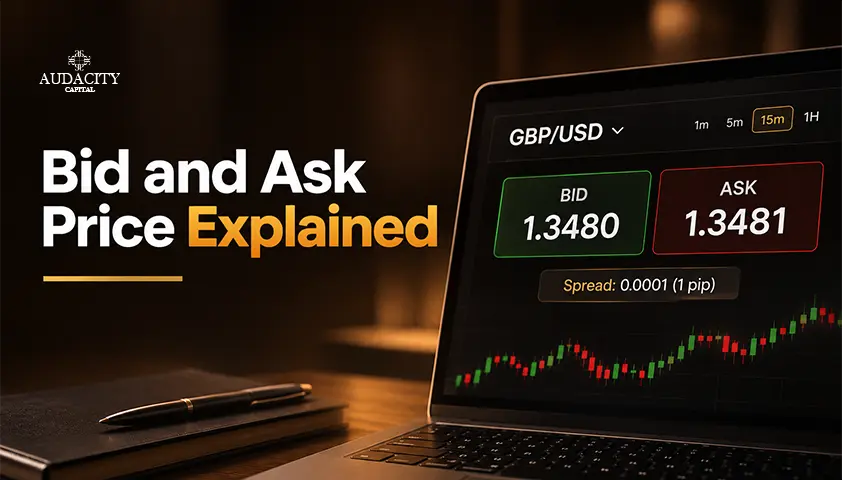
You spot a setup, hit buy, and the trade opens in the red. Price has not moved, yet you are already down a few pips. Nothing is wrong with your platform. You have just paid the spread.
Every market you trade has two prices at any moment: a bid and an ask. They decide where your trades open and close, where your stop loss is hit, and how much each trade costs you before it has a chance to work.
This guide explains what the bid and ask prices are, what the spread is, when it gets wider, and how to make it work for you rather than against you.
What Is the Bid and Ask Prices?
The bid is the highest price a buyer is willing to pay right now. The ask is the lowest price a seller is willing to accept right now. The ask is also called the offer, and it almost always sits above the bid
The simple way to remember it:
- When you buy, you pay the ask. You are buying from someone who is selling.
- When you sell, you get the bid. You are selling to someone who is buying.
Say GBP/USD shows 1.3480 / 1.3481. The first number is the bid and the second is the ask. If you buy, you get in at 1.3481. If you sell, you get in at 1.3480.
Both prices change all the time as orders come in and get filled. They show you where the market will trade with you right now, not where it last traded.
What Is the Spread?
The spread is the gap between the bid and the ask. It is the first cost of every trade you take, and you pay it the moment you enter.
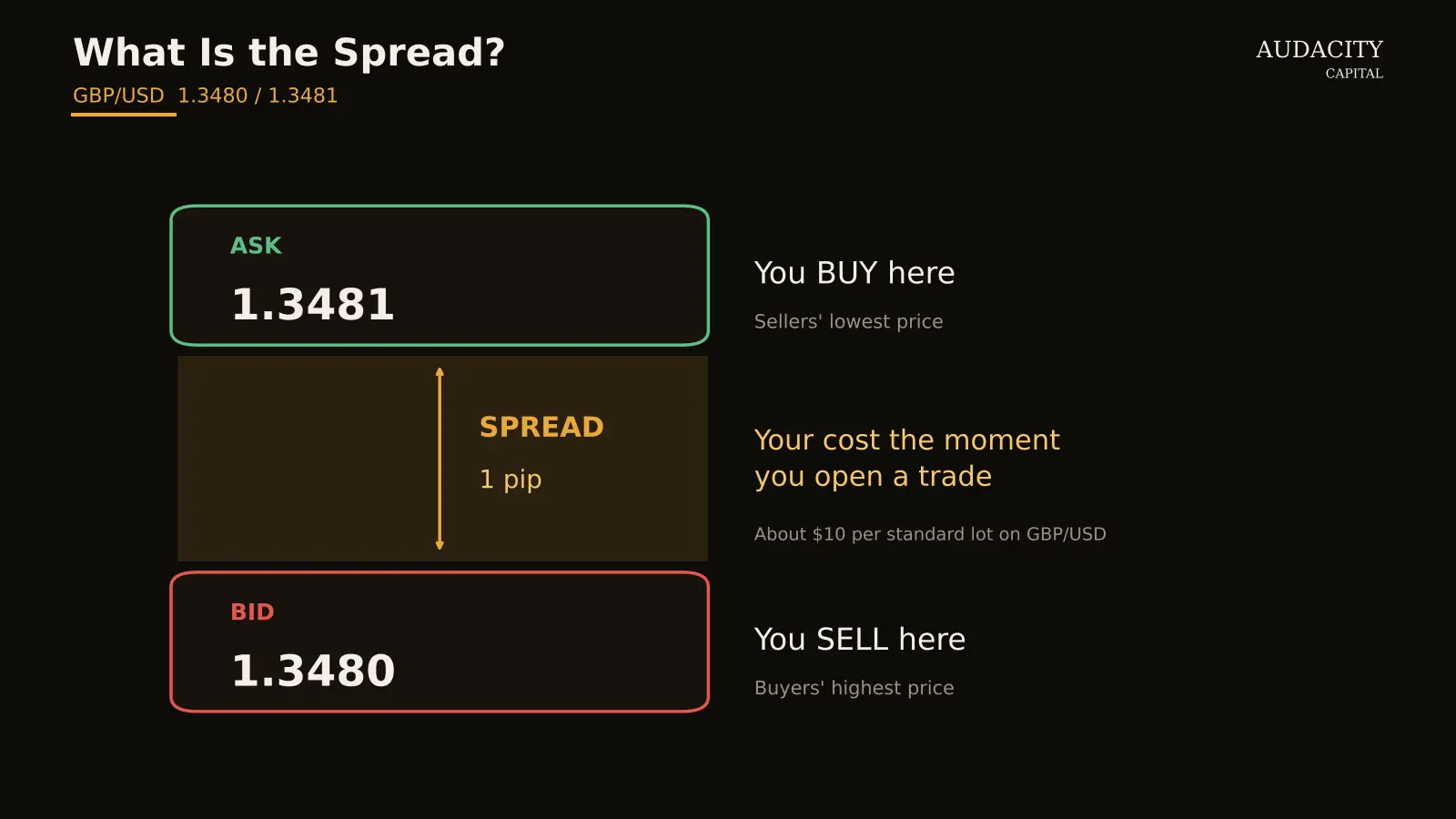
In the GBP/USD example above, the bid is 1.3480 and the ask is 1.3481. That is a gap of 0.0001, or 1 pip.
The spread works as a cost because of how you get in and out:
- You buy at the ask (1.3481).
- If you closed straight away, you would sell at the bid (1.3480).
- You are down 1 pip before price has moved at all.
So every trade starts slightly in the red, and price has to move by the size of the spread just for you to break even. On a 1 standard lot GBP/USD trade, 1 pip is worth about $10. A 1-pip spread costs you around $10 per trade, and a 3-pip spread around $30.
The same idea works in every market. On a stock with a $19.50 bid and a $20 ask, the spread is $0.50. That is 2.5% of the price, gone on entry. Busy markets like EUR/USD, gold and the major index futures usually have tight spreads. Quieter markets usually have wider ones.
How Bid and Ask Affect Your Trades
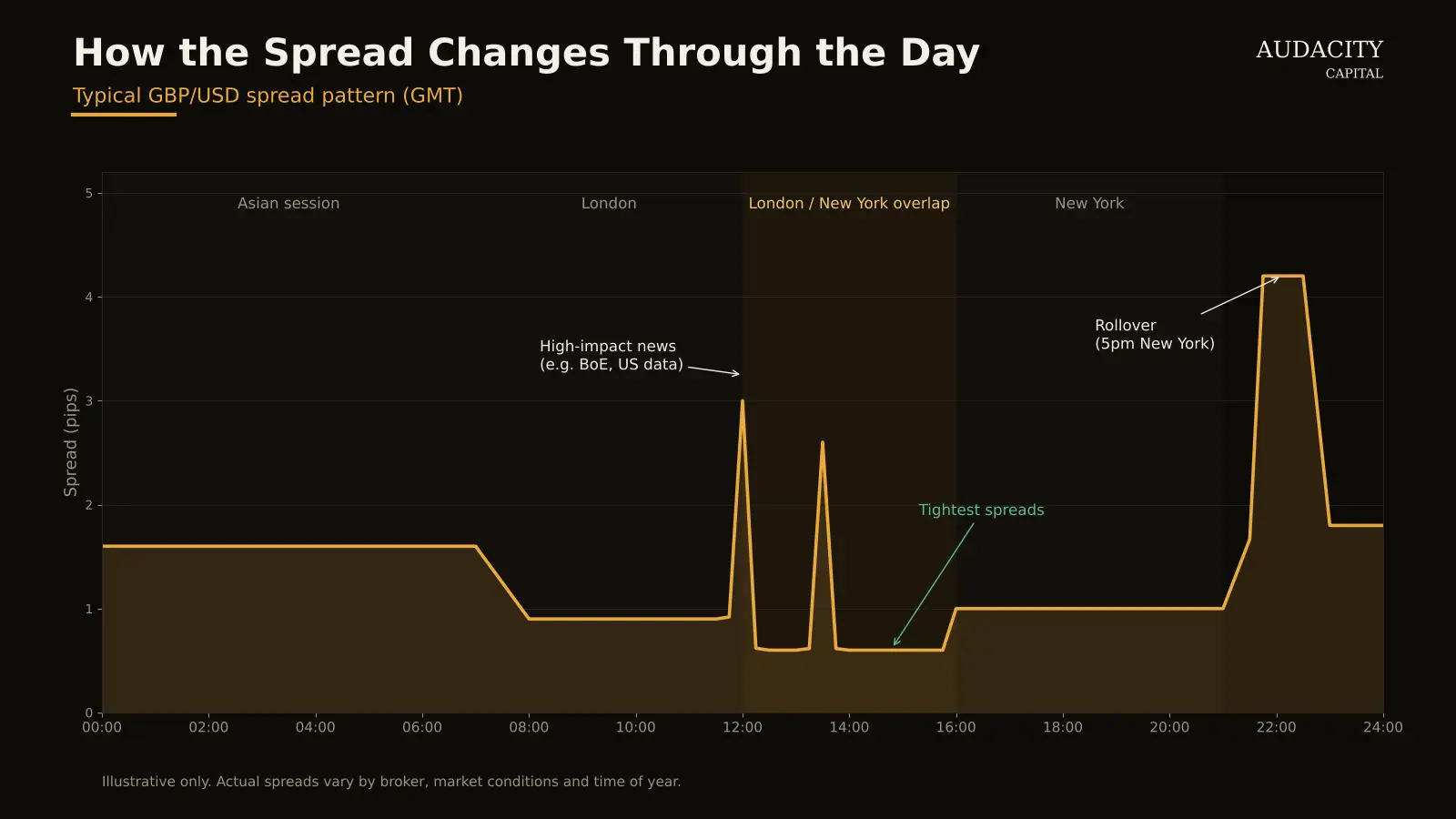
This is where most traders get caught out. Knowing which price applies to which order saves you from stops that seem to trigger for no reason.
Action | Price used |
|---|---|
Open a buy (long) | Ask |
Close a buy (long) | Bid |
Open a sell (short) | Bid |
Close a sell (short) | Ask |
Stop loss or take profit on a long | Triggered by the bid |
Stop loss or take profit on a short | Triggered by the ask |
Your chart usually shows the bid. On most platforms, including MetaTrader, the candles are drawn from the bid price only. The ask is hidden unless you switch on the ask line in your chart settings.
That matters most when you are short. Your stop loss sits above price and is triggered by the ask, which you cannot see on the chart. If the spread widens, the ask can jump up and hit your stop even though the candle on your chart never touched that level.
The same goes for a short take profit. Price on your chart might tag your target, but the ask has not got there yet, so the order does not fill.
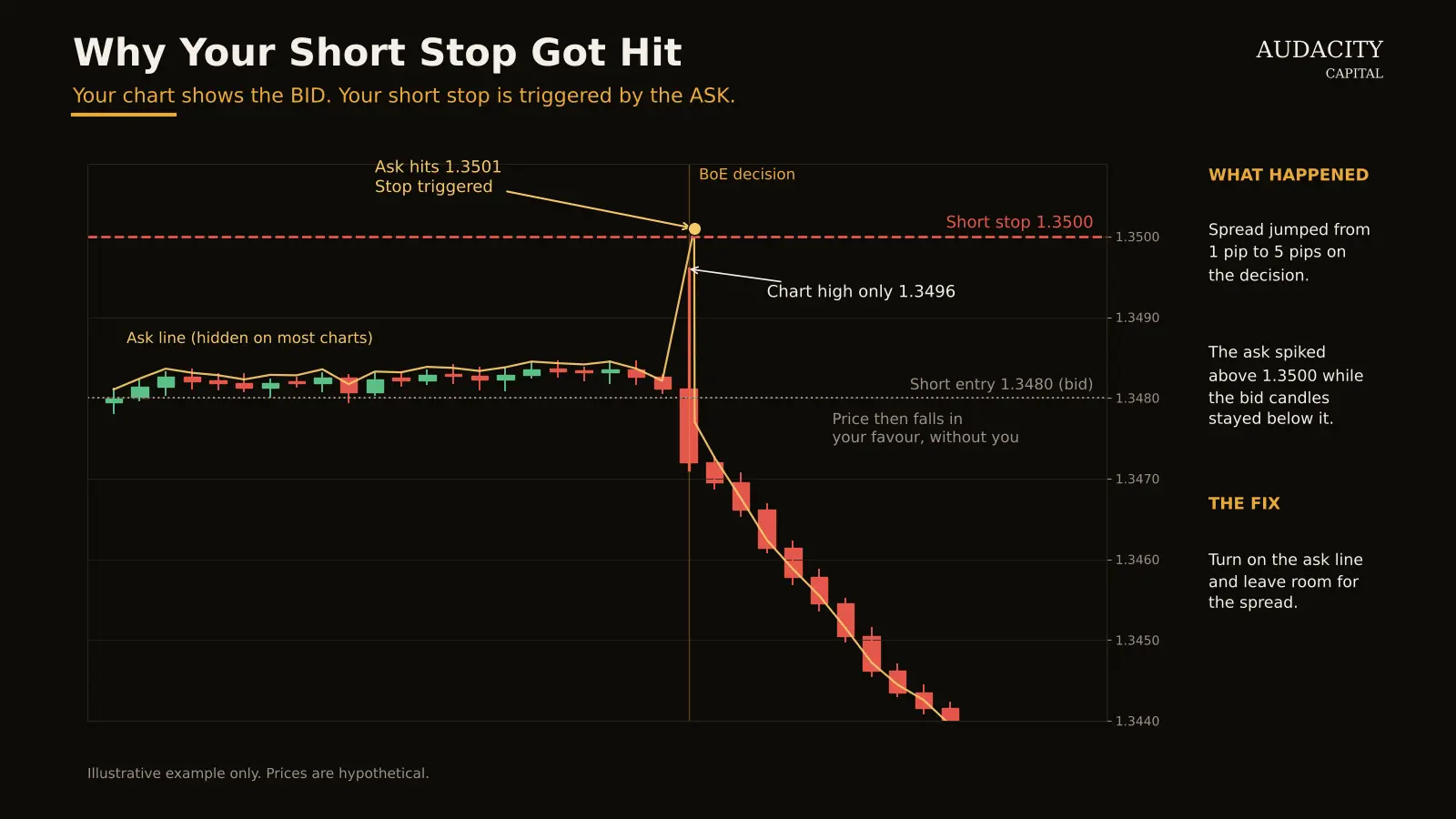
The fix: switch on the ask line, and give short stops and targets a bit of extra room for the spread.
What Makes the Spread Widen?
Spreads change throughout the day. The spread you saw at 9am London time is not the spread you will get around a central bank decision. These are the main things that widen it:
- Low liquidity. Fewer buyers and sellers means a bigger gap between them. The more a market trades, the tighter its spread tends to be.
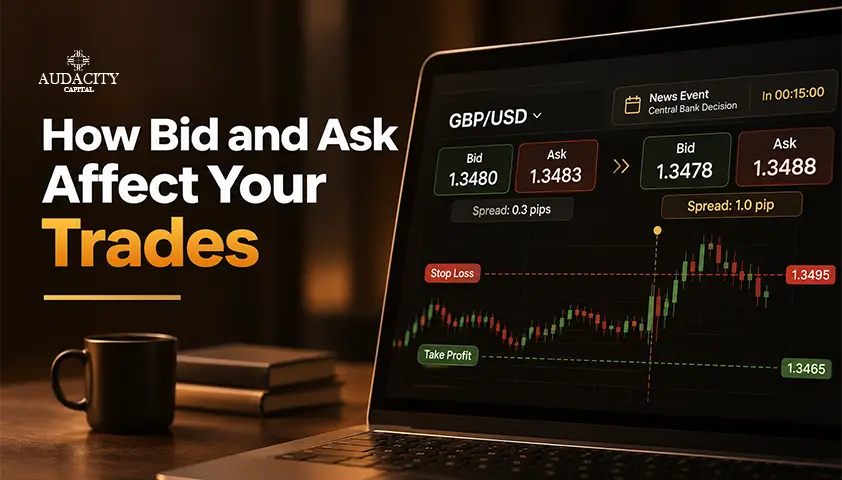
- Quiet trading sessions. Forex spreads are usually tightest when London and New York overlap. They tend to widen in the late US session and early Asian session.
- Market rollover. Around the daily rollover, near 5pm New York time, many pairs see their widest spreads of the day.
- High-impact news. Before and right after big releases like Non-Farm Payrolls, CPI or a central bank decision, liquidity providers pull back. Spreads can blow out for a few seconds or a few minutes.
- Volatile markets. When price is swinging hard, the people quoting prices take on more risk, so they charge more for it with wider spreads.
- Less popular markets. Exotic forex pairs, small-cap stocks and smaller crypto coins usually carry wider spreads than the majors.
A useful habit: check your economic calendar before each session. If a high-impact event is due, expect wider spreads around it.
Market Orders vs Limit Orders
The type of order you use decides how much control you have over the price you get.
A market order puts you into a trade instantly at whatever the current price is right now (the Ask price for buying, or the Bid price for selling).
Your trade is guaranteed to go through, but your exact price isn't locked in. If the market is moving quickly, the price you actually get might be slightly different from the one you saw on your screen when you clicked. That difference is called slippage.
Limit orders let you set the price you want. A buy limit only fills at your price or lower, and a sell limit only fills at your price or higher. You control the price, but the order may never fill if the market does not come to you.
A simple way to think about it:
- Use a market order when getting in matters more than the exact price.
- Use a limit order when the price matters more, especially in markets with wider spreads.
One point that trips people up: a buy limit is filled off the ask, not the bid you see on the chart. If price on your chart reaches your buy limit but the ask is still a pip higher, your order will not fill.
Worked Example: Shorting GBP/USD Into a Bank of England Decision
This example is for illustration only. The prices are made up to show how the spread works.
- The setup. You have a $10,000 account and risk 1% per trade, so $100. You want to short GBP/USD into a Bank of England rate decision.
- The quote. GBP/USD shows 1.3480 / 1.3481. The spread is 1 pip.
- The entry. You sell at the bid, 1.3480. You place your stop loss 20 pips above, at 1.3500.
- The size. $100 of risk divided by 20 pips is $5 per pip, which is 0.5 lots. The 1-pip spread costs you $5 the moment you enter.
- The decision lands. Liquidity thins out and the spread jumps from 1 pip to 5 pips.
- The spike. The bid on your chart pops up to 1.3496, then drops. On your chart, price never touched 1.3500.
- The stop. Your short stop is triggered by the ask. With a 5-pip spread, the ask hit 1.3501. You are stopped out for a full $100 loss, and the market then moves in your favour.
What would have helped:
- Turning on the ask line, so you could see where your stop was really at risk.
- Placing the stop at 1.3505 to leave room for the spread, and cutting size to 0.4 lots to keep the risk at $100.
- Or simply waiting for the spread to settle after the decision before entering.
Your trade idea was right. The spread is what took you out.
Why the Spread Matters in a Funded Account
When you trade a funded or challenge account, you have daily and overall drawdown limits to respect. The spread eats into that room on every trade.
- Scalpers feel it most. If you aim for 5 pips and pay a 1-pip spread, 20% of your target is gone before you start. On a 3-pip spread, that becomes 60%.
- It adds up. Ten trades a day at $10 of spread each is $100 a day in costs. Over a month, that can be a big part of your drawdown buffer.
- News spikes can hit your daily limit. A stop that fills on a wide spread, or slips past your level, can turn a planned loss into a bigger one.
The traders who last tend to treat the spread as part of their plan. They know the normal spread for each market they trade, they factor it into their stops and targets, and they avoid entering just before major news unless that is their strategy.
Common Mistakes to Avoid
- Treating the last traded price as the real price. The last price only shows the most recent trade. Use the live bid and ask to judge what you can actually trade at.
- Forgetting the chart shows the bid. Short stops and targets work off the ask. Switch on the ask line.
- Placing stops too tight. A stop only a pip or two from price can be hit by the spread alone.
- Trading right into news. Spreads widen around big releases. Unless news trading is your plan, let the spread settle first.
- Scalping a wide-spread market. Small targets only make sense where spreads are tight.
- Ignoring the cost over time. One spread looks small. Hundreds of trades a month do not.
Key Takeaways
- The bid is the highest price buyers will pay. The ask is the lowest price sellers will accept.
- You buy at the ask and sell at the bid.
- The spread is the gap between them, and it is a cost you pay on every trade.
- Most charts show the bid, so short stops and targets can behave differently from what you see.
- Spreads widen in quiet sessions, around rollover, and around high-impact news.
- Know the normal spread for each market you trade, and build it into your stops, targets and position size.
Frequently Asked Questions
Sellers want to sell high and buyers want to buy low, so the lowest selling price sits above the highest buying price. The gap is the spread, which pays the people who keep prices available to trade.
You buy at the ask and sell at the bid.
If you were short, your stop is triggered by the ask, but your chart shows the bid. A wider spread can push the ask into your stop while the bid stays below it.
It depends on the market. Major forex pairs like EUR/USD often trade on spreads of around a pip or less in busy hours. Exotic pairs, small-cap stocks and smaller crypto coins usually carry much wider spreads.
Usually during the London and New York overlap, when the most volume is going through the market.
Not completely. You can keep it low by trading liquid markets, trading busy sessions, avoiding entries just before big news, and using limit orders where they suit your strategy.

Ready to apply disciplined risk to crypto? Explore Audacity Capital's new crypto instruments and bring your trading strategy.
Learn MoreNewsletter
Join our newsletter to stay up to date on features and releases.
Join Our Social & Community

Start Your Journey Today With Our Free Trial
Proudly showcase your skills and accomplishments through certificates and get recognition for your hard work and dedication from potential investors and peers.
Free TrialRelated Articles
Stochastic Oscillator vs RSI: How They Differ and How to Use Them
Compare RSI and the Stochastic Oscillator, understand their signals, and choose the right indicator for your trading strategy.

NQ in Trading – What is NQ in Trading?
Learn what NQ means in trading, how E-mini Nasdaq-100 futures work, their contract specifications, trading hours, strategies and risks.
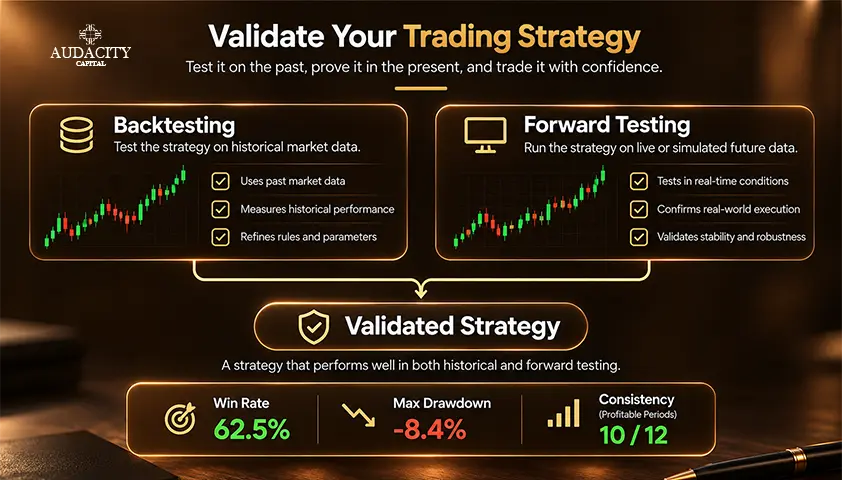
Backtesting vs Forward Testing: How to Validate a Trading Strategy
Compare backtesting vs forward testing, learn how each works, why results differ, and how traders use both to validate a trading strategy.
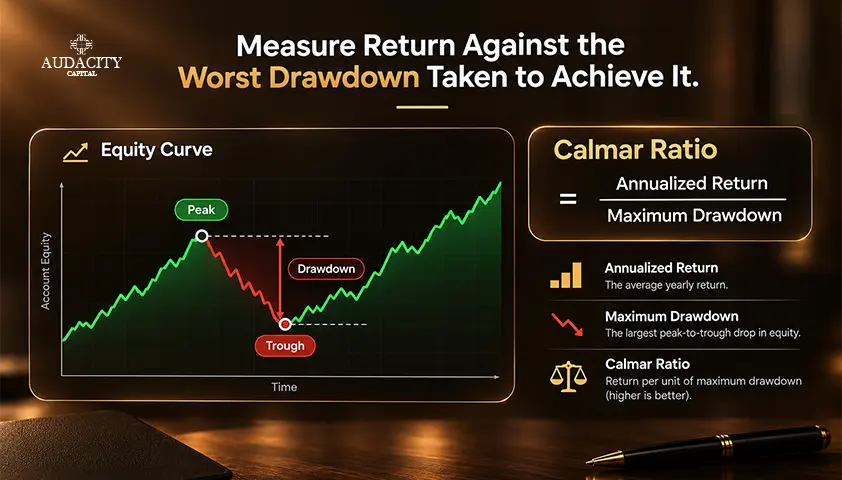
Calmar Ratio: Meaning, Formula and Examples
Learn what the Calmar Ratio means, how to calculate it, interpret results, and compare it with Sharpe and Sortino ratios.