


Paper Trading vs Live Trading: What's the Difference?



Before risking their hard-earned money, many new traders have to go through a comparison between Paper trading vs live trading. Definitely, it is confusing, but surely not very difficult.
Some traders start with paper trading for beginners because it lets them test strategies, learn how order types work, and get comfortable with a platform without any financial exposure. Although it builds technical skill, it does not fully prepare a trader for what happens once actual capital enters the picture.
Individuals who begin with Live trading invite financial risk and emotional pressure that no simulator can copy. This experience means losses stop being numbers on a screen and start affecting a real account balance.
Demo trading vs. live trading is not only a difference in stakes, but also a difference in discipline and decision-making under pressure.
This guide breaks down what each method involves, where the two diverge, and how a trader can use both stages to build toward consistent execution in live markets.
What Is Paper Trading?
Paper trading is a way to practice trading that involves virtual funds instead of real money. You will see most brokers or platforms offering some version of a paper account that mirrors live market prices in real time. Orders fill at the same rates a trader would see in a real account. However, nothing is actually bought or sold, as every position exists only inside the simulation.
Paper trading setups exist for one clear purpose -> letting new traders test ideas, learn platform tools, and understand how positions move without any financial exposure attached to the outcome.
Paper trading benefits tend to show up early in the learning process. A trader can repeat the same strategy dozens of times within a single week, track win rates across those attempts, and refine entries without waiting for capital to recover from a loss. It also gives beginners room to make mistakes that would otherwise be expensive, which is what makes this stage worth taking seriously rather than rushing through.
Read more about our detailed guide about What Is Paper Trading
Paper Trading at a Glance
Advantages
- No financial risk during the learning phase.
- Unlimited attempts to test and refine a strategy.
- Builds familiarity with platform tools and order types.
Limitations
- No real emotional pressure tied to outcomes.
- Fills are often unrealistic compared to live markets.
- It can create false confidence before a trader goes live.
What Is Live Trading?
Live trading means placing real trades with real money inside an actual market. Every order affects a real account balance, and every fill draws from genuine market liquidity. It is the stage where individuals test their paper trading knowledge against conditions they can’t fully recreate on a demo account. Real execution involves other traders, real order books, and price movement that responds to actual supply and demand.
Live trading also forces a trader to balance risk against reward in a way that paper trading never requires. Position sizing, stop loss placement, and daily loss limits all carry real consequences, and a trader has to manage each of them while also managing their own reaction to watching money move in real time.
Paper Trading vs Live Trading: Key Differences
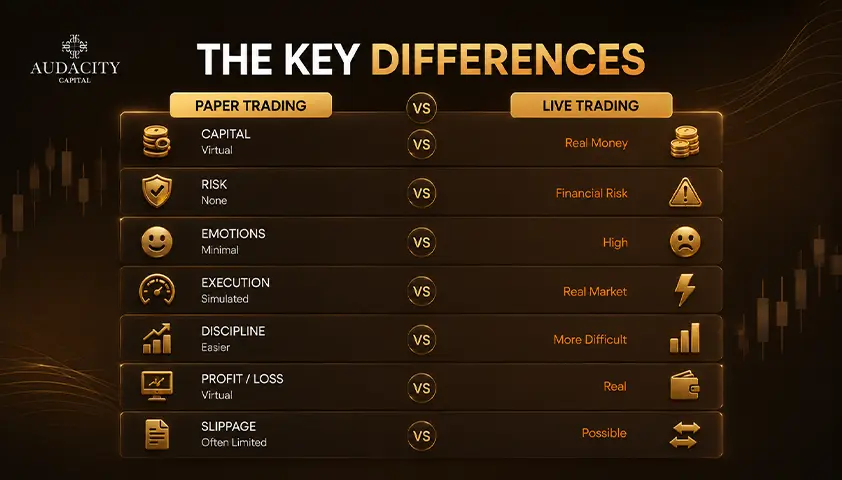
Starting with a virtual account feels easy, but moving to real money changes everything. Understanding these differences early helps you handle the actual market without big surprises.
- Money and Risk: Paper trading uses play money, so mistakes cost you nothing. Live trading uses real money, meaning every loss affects your actual bank account, so you have to plan every trade carefully.
- Emotions: It is easy to stay calm in demo trading because you cannot actually lose money. With live trading, real money is on the line, which can make you feel scared or greedy and cause you to make panic decisions.
- Order Execution: In paper trading, your trades usually buy or sell instantly at the exact price you want. In real trading, prices move fast, and you might get filled at a slightly worse price due to market delays.
- Discipline: Following your trading rules on paper is simple because there is no pressure. Live trading tests whether you can stick to those same rules when real money is floating in the market.
Paper trading teaches the lessons, and live trading tests whether you learned them.
Comparison Table:
Feature | Paper Trading | Live Trading |
Capital | Virtual | Real Money |
Risk | None | Financial Risk |
Emotions | Minimal | High |
Execution | Simulated | Real Market |
Slippage | Often Limited | Possible |
Discipline | Easier | More Difficult |
Profit/Loss | Virtual | Real |
But none of this makes paper trading pointless, and it’s still a useful practice for building technical skill before risking real capital. Nevertheless, it works best when treated as preparation and not a confirmation that a strategy is already ready for a live account.
The Mechanics: Order Execution, Slippage, and Liquidity Differences
Order execution is where live trading and paper trading diverge in their behavior.
A demo account fills a trade instantly at whatever price was requested, since there is no actual order book on the other side of it.
Whereas a live account has to match against real buyers and sellers who might not be sitting anywhere near that price. The gap widens sharply during events like NFP or CPI releases, when prices can move several points within seconds, and a live fill lands well away from the level a trader intended.
Simulated trading vs live trading also plays out differently once broker routing enters the picture. A live order travels through a broker's own execution path, and even a small delay in that routing can shift the price a trader actually gets compared to what was showing on screen a moment earlier.
Advantages of Paper Trading
Paper trading for beginners works because it removes the one thing that stops most new traders from experimenting freely, “the fear of losing real money”.
A trader can test a fresh idea against a full market cycle, from a strong trend to a choppy range, without worrying about what a string of losses would do to an actual balance. This is also where a trader gets comfortable clicking through order types, adjusting position sizes, and finding their way around a platform before any of that needs to happen under pressure.
Paper trading benefits extend past the technical side, too. Running the same setup across dozens of trades builds a kind of muscle memory. It carries over once a trader eventually opens a demo account vs live account and needs to move quickly without hesitating over which button does what.
Limitations of Paper Trading
Paper trading has one limitation that shows up in almost every trader's story sooner or later, often described as “monopoly money syndrome”. It is where losing a paper trade barely registers because nothing real was ever on the line. Practice trading vs real trading highlights this gap clearly, since a trader can take on far more risk in a simulation than they ever would with actual funds, simply because a loss costs nothing beyond pride.
Execution adds another layer to this problem. Paper accounts often fill orders without any slippage, and spreads in a simulated feed rarely match what a live broker actually quotes during a fast market. This creates a false sense of security that follows a trader into live trading. A strategy that looked flawless on paper suddenly runs into real spread costs and unrealistic position sizing that was never tested under pressure.
Advantages of Live Trading
Live trading delivers something paper trading cannot fully copy – “direct exposure to how a market reacts once real money is riding on a trade”.
Price action stops functioning as an abstract line on a chart and becomes immediate feedback on whether an idea holds up while other traders are responding to the same conditions in real time.
This kind of exposure accelerates psychological growth far faster than practice alone. Fear, doubt, and impatience only become real once losses are real. Learning to manage those reactions early on is part of what turns a trader into someone who can be relied on over time.
Paper trading vs real trading shows up clearly in how risk actually gets handled, as adjusting a stop loss or resizing a position under genuine pressure teaches lessons no simulation ever fully recreates.
Live trading also produces something a demo account never can - an honest track record built on real outcomes. Every win and loss reflects a decision with real consequences attached. It is exactly what makes performance data from a live account far more useful when judging whether a strategy genuinely works.
Challenges of Live Trading
Live trading psychology brings out problems that rarely surface inside a simulation.
“Fear of pulling the trigger on a setup that meets every rule, or greed that keeps a trader holding a winning position well past its logical exit”, both become far more common once it's about real money. A trader can understand a rule perfectly well and still break it the second a real loss starts to sting.
Live trading also opens the door to overtrading and revenge trading. It is where a losing stretch pushes a trader into setups they would normally skip, just to win the money back as fast as possible. Extended drawdowns bring a different kind of weight entirely, because watching an account shrink steadily over several weeks creates financial stress that paper trading experience never fully prepares a trader to handle.
Trading Psychology: The Biggest Difference
The single biggest shift between paper trading and live trading comes down to psychology. Once real capital is on the line, every decision carries actual weight. It changes how a trader responds to the same chart pattern that they may have traded a hundred times calmly in simulation.
Live trading psychology centers on managing two competing instincts, fear of losing and greed for more. Fear tends to show up as hesitation, closing a winning trade too early or skipping a valid entry altogether, while greed tends to show up as holding a position too long or increasing size after a string of wins.
Paper trading vs live trading research and trader accounts both point to the same conclusion, that managing these two forces well is a skill separate from reading charts or understanding a strategy.
Emotional discipline becomes something a trader has to actively practice. Staying calm through a volatile session, sticking to a stop loss instead of moving it, and accepting a loss without chasing it back all take repetition to build. Decision fatigue adds to this over a long trading day, since a tired trader is more likely to break rules late in a session than early in one, which is why managing energy and stress becomes as important as managing the trade itself.
When Should You Move from Paper Trading to Live Trading?
Moving from paper trading for beginners into a live account becomes better when it follows a few clear signals. Demo trading vs live trading switches that happen too early are one of the more common reasons traders struggle once real money gets involved, so it helps to run through the following before making the jump.
✔ Not a lucky stretch, but profitability that holds steady across 2 to 3 consecutive months.
✔ General intentions swiped with a written trading plan with specific.
✔ Clear risk limits already in place, such as capping risk at 1 percent of the account per trade.
✔ A structured trading journal tracking every entry, exit, and the reasoning behind each one.
✔ Confidence grounded in real practice trading vs real trading results over a short run of good luck.
A trader who can honestly check most of these off is usually far better positioned to handle the pressure that comes with live trading.
How Should You Move from Paper Trading to Live Trading?
Gradually! And it will work the best. For this shift, following a clear sequence will help protect both confidence and account balance along the way. A demo account vs live account switch should never happen all at once. Here’s a short helping guide:
Step 1: Master paper trading first and confirm a strategy actually performs across different market conditions before risking anything real.
Step 2: Move into a small live account or a funded challenge. Do not commit significant personal capital right away.
Step 3: Keep position sizes small using micro lots or minimal risk per trade while adjusting to real execution.
Step 4: Review every live trade in a journal, noting what happened and how it compares to paper trading vs real trading results.
Step 5: Scale position size gradually based on actual performance metrics.
Each step exists to slow the transition down just enough that a trader can adjust before real pressure builds beyond what they can manage.
Common Mistakes When Moving to Live Trading
Live trading psychology gets tested hardest in the first few weeks after a trader goes live. A handful of mistakes show up more often than any others during this stretch.
- Trading position sizes that are too large for the account, often carried over from paper trading habits.
- Ignoring a stop loss or moving it further away once a trade starts moving against the position.
- Falling back into emotional trading, including revenge trades meant to recover a recent loss quickly.
- Carrying overconfidence from paper trading for beginners success directly into a live account without adjusting expectations.
- Changing an entire strategy in the middle of a drawdown instead of sticking with a plan long enough to judge it fairly.
Most of these mistakes trace back to the same root cause: treating live trading like an extension of paper trading rather than a different environment with real consequences.
Which Is Better: Paper Trading or Live Trading?
Neither paper trading nor live trading is better on its own, because each one serves a different purpose at a different stage. Paper trading vs live trading is not a competition but a study closer to a sequence, where paper trading builds the technical foundation and live trading builds the experience needed to trade that foundation under real conditions.
A trader who skips paper trading usually pays for it in early live losses caused by simple execution mistakes, while a trader who never moves past paper trading never finds out whether they can actually handle real pressure. Both stages matter, and treating them as steps toward the same goal works far better than treating them as competing options.
Is Paper Trading Enough to Become Profitable?
NO, paper trading on its own is not enough to make someone consistently profitable. It works well as a starting point, but it is a prerequisite and not a complete solution to becoming a profitable trader.
Paper trading benefits cover the technical side of trading well. It teaches a trader how to read charts, place orders, and follow a strategy. Still, none of that fully prepares someone for what happens once real money changes the equation.
Simulated trading vs live trading cannot recreate the pressure of watching an actual account balance move in real time. This pressure is exactly what shapes execution, patience, and emotional regulation under real conditions. A trader only develops these skills by trading with real capital, even in small amounts, because no simulation can copy what it feels like to have genuine financial skin in the game. Paper trading builds the foundation, but live experience is what finishes the process.
How Audacity Capital Helps Traders Prepare?

Audacity Capital supports traders through every stage of this shift. The platform does not leave anyone to figure out the jump from practice to real capital entirely on their own. It is built around a structured path that starts with low-pressure testing and carries a trader all the way through to genuine funded trading. Traders are not forced to skip a stage they are not ready for.
- Free trial access lets a trader test the platform itself before committing to anything, with no financial risk attached at any point.
- A simulated environment mirrors realistic market conditions, so moving into a funded challenge later does not feel like starting over on a completely different system.
- Trading education resources help a trader deepen their understanding of strategy and risk management before that knowledge gets tested under real pressure.
- The Ability Challenge and instant funding options through Audacity Capital's Funded trader program let a trader scale into real capital once they are ready, without putting personal savings on the line.
For traders who have already built discipline through paper trading, this structured path removes one of the biggest barriers to going live: risking personal money before a strategy has actually proven itself. It gives traders room to prepare properly, then a clear route into real funded trading once they are ready.
Stop Practicing. Start Progressing.
Build your confidence, prove your strategy, and transition to funded trading with the support you need. Join Audacity Capital today and begin your trading journey with a free trial.
Frequently Asked Questions
Most traders need at least 2 to 3 months of consistent, documented results before moving to a live account, though this varies based on how often they trade.
Demo trading generally reflects real prices closely. However, execution speed, slippage, and spreads rarely match what happens in a live account.
No, paper trading uses virtual funds only, so there is no way to lose real money through a standard demo account.

Ready to apply disciplined risk to crypto? Explore Audacity Capital's new crypto instruments and bring your trading strategy.
Learn MoreNewsletter
Join our newsletter to stay up to date on features and releases.
Join Our Social & Community

Start Your Journey Today With Our Free Trial
Proudly showcase your skills and accomplishments through certificates and get recognition for your hard work and dedication from potential investors and peers.
Free TrialRelated Articles
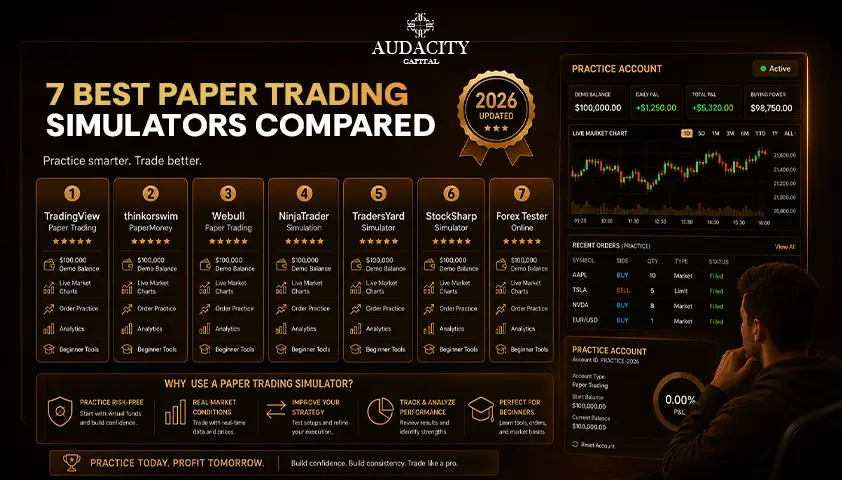
7 Best Paper Trading Simulators for 2026
Compare the best paper trading simulator options for 2026, including features, costs, asset coverage, limitations, and who each platform suits best.

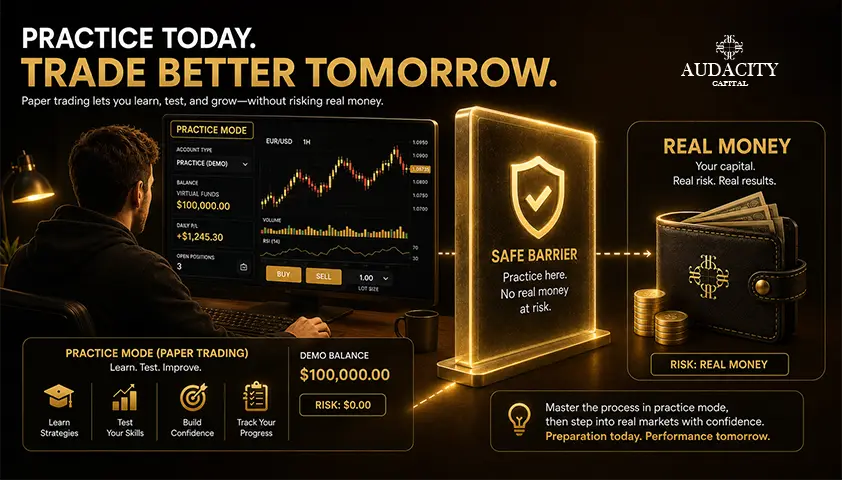
What Is Paper Trading
What is paper trading? Learn how simulated trading works, what you can practice, its benefits, limits, and when to move to live trading.