


How Much Money Do You Need to Start Day Trading? (Beginner’s Guide 2026)



Your starting capital doesn’t just determine how much you can make. It shapes your risk tolerance, your strategy, and your chances of survival.You can start day trading with $100–$500 in some markets, but realistically:
- Forex: $100
- Futures Trading: $500–$1,000
- Stock Trading: $25,000 due to PDT Rule
- $0 (via prop firms like Audacity Capital) → trade with funded capital
Day trading isn’t about starting big—it’s about managing risk consistently.
Starting Capital Comparison by Asset
Asset Class | Legal Minimum | Recommended Capital |
Forex | $100 | $1,000 – $2,000 |
Futures | Varies | $5,000 – $10,000 |
Stocks | $25,000 | $30,000+ |
Options | Varies | $2,000 – $5,000 |
So, How Much Should You Start With?
- $100 → Learning only
- $500 → Limited trading
- $1,000 → Strategy testing
- $5,000–$10,000 → Realistic trading
- $25,000+ → Full flexibility (required for stock day trading (PDT rule in the US)
- $0 (via funded trading with Audacity Capital) → trade with larger capital
How Much Money Do You Need to Start Day Trading
Day trading is often marketed as a quick way to get rich with just a laptop. But the reality is that your starting capital significantly influences your strategy and your survival rate.
Entering the market with too little money is one of the most common reasons beginners fail. And The truth is, you can technically start day trading with as little as $100 -- but the amount you need depends on your goals, strategy, and the market you choose.
How Much Money You Need Based on Your Starting Point

The amount of money you need to start day trading depends heavily on your goals, the market you choose, and your risk tolerance. Below is a realistic breakdown of what different starting amounts allow you to do:
Starting with $100
At this level, your focus should be learning, not earning.
- You can practice basic strategies
- You’ll be limited by position size
- Even small losses can significantly impact your account
Best use: Treat this as “tuition” for learning the markets.
Starting with $500
This gives you slightly more flexibility, but limitations remain.
- You can take small positions
- Risk management becomes critical
- Growth will be slow
Reality: You’re still in the practice phase, not full-time trading.
Starting with $1,000
Now you can begin applying structured strategies.
- Better position sizing
- More room for risk management
- Ability to test consistency
This is where trading starts becoming strategic rather than experimental.
The Legal Minimum: Day Trading Stocks
In the United States, the Financial Industry Regulatory Authority (FINRA) enforces strict rules for frequent stock traders. These rules are designed to protect investors from high-risk patterns.
The Pattern Day Trader (PDT) Rule
If you execute four or more-day trades within five business days, you are classified as a Pattern Day Trader. To maintain this status, you must always keep a minimum of $25,000 in your brokerage account.
What Happens if You Fall Below the Minimum?
If your account balance drops below $25,000 due to a loss, your trading privileges will be restricted. You will likely be limited to closing only trades until the balance is restored. This makes starting with exactly $25,000 very risky for beginners.
Trading Without $25k: The Futures Market
Futures trading offers a more accessible entry point for those without large amounts of capital. In Futures trading, it means that you are essentially trading contracts for the future price of an asset rather than owning the asset itself.
Low Barrier to Entry
Unlike stocks, there is no federal minimum balance required to day trade futures. And many brokers allow you to open an account with as little as $500 to $1,000 making it an attractive option for those testing the waters.
Day Trading Margins
Margins in futures are the good faith deposits required to hold a position. For popular indices like the S&P 500 (E-mini), day trading margins can be as low as $500 per contract. However, you should always have a cushion to handle price fluctuations.
The Most Accessible Option: Forex Trading
The Foreign Exchange (Forex) market is the most liquid financial market in the world. It operates 24 hours a day and offers the lowest capital requirements for new traders.
Starting Small with Micro Lots
Most Forex brokers allow you to trade in "micro lots," which represent 1,000 units of currency. This allows you to risk very small amounts of money: often less than $1 per trade. You can technically start with as little as $100.
The Double-Edged Sword of Leverage
Forex trading relies heavily on leverage, allowing you to control large positions with small amounts of money. While this boosts potential profits, it also accelerates your potential losses. Beginners should, therefore, use leverage with extreme caution.
Example of a Day Trade: Risk vs Reward
To understand how starting capital affects your trading, let’s look at a simple example.
Imagine you have a $1,000 account and follow a common rule:
Risk only 1% per trade
- Risk per trade = $10
- Target reward (2:1 ratio) = $20
Scenario:
- You take a trade risking $10
- If the trade wins → you make $20
- If it loses → you lose $10
What This Means:
- You need consistent wins to grow your account
- Even a good strategy takes time to scale
- Small accounts require patience and discipline
Key takeaway: It’s not just about how much you start with: it’s about how you manage risk.
At Audacity Capital, traders can:
- Access larger capital
- Trade without risking personal savings
- Scale based on performance
This is a structured alternative to starting day trading with limited funds.
The Reality Check Most Beginners Ignore
Many new traders believe that starting with a small account will quickly lead to large profits. In reality, day trading is far more challenging.
- Most beginners lose money in the early stages
- Small accounts are harder to grow due to limited position sizes
- Emotional decision-making often leads to losses
What Actually Matters More Than Capital:
- Risk management skills
- Trading discipline
- Consistency over time
Even with $25,000, a trader without a solid strategy can lose money quickly.
The truth is simple: Money doesn’t make a successful trader -- skill does.
Hidden Costs: Equipment and Software
Your trading capital isn't just for the trades themselves. You must also account for the professional tools required to compete with institutional traders.
Essential Trading Tools
Some of the tools you’ll need as a trader, include:
- High-Speed Internet: A stable, fast connection is mandatory to avoid slippage during executions.
- Trading Platform: Some platforms are free, but professional-grade software often carries a monthly subscription fee.
- Data Feeds: Real-time market data for stocks or futures usually costs between $10 and $100 per month.
Educational Expenses
Investing in your own knowledge is a recurring cost of doing business. This includes books, specialized courses, or memberships to trading communities. Factor these business overhead costs into your total starting budget.
Why "Minimum" Isn't Always Enough
There is a massive difference between the legal minimum and a recommended starting balance. Having more capital gives you the psychological space to make mistakes without blowing your account.
The Power of Risk Management
Professional traders rarely risk more than 1% of their total account on a single trade. If you start with $1,000, a 1% risk is only $10. This small amount makes it difficult to generate meaningful income quickly.
Surviving the Learning Curve
It’s common for most traders to lose money during their first few months of active trading. A larger capital base acts as a safety net during this educational phase. It allows you to stay in the game long enough to actually learn the skill.
Below is a quick look at how much you’ll need to get started with day trading:
- $100 → learning only (not sustainable)
- $500 → limited trading (high risk)
- $1,000 → small strategy testing
- $25,000 → full PDT flexibility
Let’s use a comparison table to help you gain a better idea of what it is that we are talking about here:
Capital | What You Can Do | Limitations |
|---|---|---|
$100 | Learn basics | No real income |
$500 | Small trades | High risk |
$1,000 | Strategy testing | Slow growth |
$25,000 | Full trading | PDT compliant |
Building a Trading Plan for Any Budget

Regardless of how much money you have, a disciplined approach is the only way to find success. And this means that you should never trade money that you cannot afford to lose entirely.
Daily Workflow of a Day Trader
Successful day trading isn’t random: it follows a structured routine. Here’s what a typical trading day looks like:
- Pre-Market Preparation
- Analyze market news and trends
- Identify potential trading opportunities
- Mark key support and resistance levels
This step sets the foundation for your trades.
- Trade Execution
- Enter trades based on your strategy
- Stick to your predefined risk levels
- Avoid impulsive decisions
Discipline is critical during this phase.
- Risk Management
- Limit losses using stop-loss orders
- Avoid overtrading
- Protect your capital at all costs
Survival in trading is more important than quick profits.
- Post-Market Review
- Analyze your trades
- Identify mistakes and improvements
- Track performance over time
This is where real growth happens.
Why traders choose firms like Audacity Capital:
- Trade larger capital without personal risk
- Focus on performance, not deposits
- Scale based on consistency, not luck
This is why many day traders move from:
$500 personal account → funded trading model
Conclusion
The amount of money you need to start day trading depends heavily on your goals and your chosen market. While you can start with $100 in Forex, your path will be significantly different than someone starting with $30,000 in stocks.
Remember, whether you start day trading with $100 or scale through a funded program at a prop firm like Audacity Capital, your success depends on: how you trade: and not the amount of money you start with.
Don't let limited capital hold you back. Discover how Instant Funding can help you access larger trading capital and focus on your performance.
Related Articles
Check our latest guide about Can You Start Day Trading With $100?
Learn about Best 6 Day Trading Strategies
Check about Best prop firms for Day traders
Read more about our guide How Much Money Do You Need to Start Trading?
Learn more about our latest guide How Much Money Do You Need to Start Forex Trading?
Read more about our guide How Much Money Do You Need to Start Trading Stocks?
Leran more about our latest guide How Much Money Do You Need to Start Crypto Trading?
Read more about our latest guide How Much Money Do You Need to Start Options Trading?
Learn more about our guide How Much Money Do You Need to Start Swing Trading?
Read more about our guide How Much Money Do You Need to Start Trading Futures?
Frequently Asked Questions
Yes, but it’s mainly for learning and limited trading.
Only for stock day trading in the US (PDT rule).
Yes, through funded trading models like Audacity Capital.
Under FINRA rules, equity traders must maintain a minimum of $25,000 in their account to be designated as a "Pattern Day Trader" (PDT).
Yes, by trading markets that are not subject to the PDT rule. Forex and Cryptocurrency markets often have no legal minimums, allowing traders to start with as little as $100 to $500.
While legal minimums exist, many professionals suggest starting with at least $5,000 to $10,000 for non-equity markets.
The 1% rule dictates that a trader should never risk more than 1% of their total account balance on a single trade.
Proprietary (prop) trading firms allow traders to manage the firm's capital in exchange for a profit split. Traders usually pay a small evaluation fee (ranging from $50 to $500).

هل أنت مستعد لتطبيق مخاطر منضبطة على العملات المشفرة؟ استكشف أدوات التشفير الجديدة من Audacity Capital واجلب استراتيجية التداول الخاصة بك.
اعرف المزيدالنشرة الإخبارية
انضم إلى نشرتنا الإخبارية.
انضم إلى مجتمعنا الاجتماعي

ابدأ رحلتك اليوم مع تجربتنا المجانية
اعرض مهاراتك وإنجازاتك بفخر من خلال الشهادات واحصل على تقدير لعملك الجاد وتفانيك من المستثمرين المحتملين والأقران.
تجربة مجانيةمقالات ذات صلة

Averaging Down: Explained
What averaging down does to your breakeven and your exposure, the one question that settles whether to do it, and why leverage changes the answer entirely.


Micro Futures Contracts Explained
What micro futures contracts are, why a smaller size does not mean lower risk, the margin trap that catches small accounts, and what they actually cost.
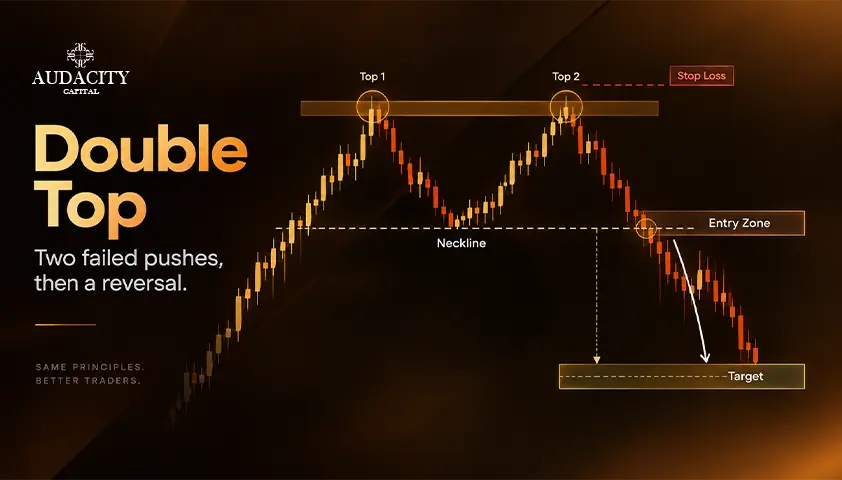
Double Top Pattern: How to Trade It
Learn how to identify, confirm, and trade a valid double top pattern with precise targets and stops.

What Is BOS in Trading? A Complete Guide to Break of Structure (2026)
Learn what BOS in trading means, how Break of Structure works, how to identify bullish and bearish BOS, and how traders use it in market analysis.