



How Much Money Do You Need to Start Forex Trading?


The honest answer is that how much money you need to start forex trading is really three different numbers wearing one question. There is the amount a broker needs before you can open a single trade, the amount you need to trade with real risk control, and the amount you need before the profit is worth your time. Most guides only mention one of them, which is why so many beginners fund an account, lose it inside a month, and walk away.
This guide separates those three numbers, shows the simple math that turns the question into a figure you can calculate yourself, and explains the route that lets you trade larger size without putting that size on the table from your own pocket.
Quick answer: You can open a forex account for as little as $10 to $100, but $500 to $1,000 is the realistic minimum to trade with proper risk management. Earning a meaningful income from your own capital usually takes several thousand dollars or more. Your results depend far more on risk control than on the size of your deposit. |
- $10 to $100 - learning the platform and getting used to live execution
- $500 to $1,000 - the practical floor for real risk management
- $5,000 or more - room to size positions and aim for steadier growth
How much money do you need to start forex trading?
There is no single fixed amount. Brokers let you begin from around $10 to $100, but most experienced traders treat $500 to $1,000 as the practical minimum, because that is the point where risking 1% per trade still leaves enough room to survive a losing streak. The clean way to think about it is to split the question into three separate minimums.
What you are paying for | Realistic amount | Why this amount |
|---|---|---|
Open a single trade (margin) | A few dollars to about $50 | Leverage means your broker only locks a small deposit to hold the position |
Trade with proper risk control | $500 to $1,000 | Enough that 1% risk per trade is meaningful and a normal losing streak will not wipe you out |
Aim for a meaningful income | $5,000+ or funded capital | Small accounts grow in small dollars, no matter how strong the percentage return |
What is the real minimum to open a forex trade?

The true minimum to place a trade is the margin, not your whole deposit. Margin is the slice of the full position value your broker locks while a trade is open. On a major pair at 30:1 leverage, that slice is roughly 3.3%, so a small micro position can be opened with tens of dollars.
Some brokers advertise no minimum deposit at all. That does not mean you can trade on nothing. It means you need enough to cover the m
Some brokers advertise no minimum deposit at all. That does not mean you can trade on nothing. It means you need enough to cover the margin plus a buffer for the trade to move against you before your stop is hit. As an illustration, one micro lot of EUR/USD is about 1,000 units, roughly $1,100 of notional value near current prices, and at 30:1 leverage the margin is around $37. Leverage caps vary by regulator, about 30:1 on majors under FCA, ASIC and ESMA rules and higher at some offshore brokers, so check the cap that applies where you live.
How do leverage and margin change how much you need?
Leverage lets a small deposit control a much larger position, which lowers the cash needed to open a trade but raises the speed at which you can lose it. A 30:1 ratio means $100 can control about $3,000 of currency; a 100:1 ratio means the same $100 controls $10,000.
Leverage is borrowed exposure, not free money. The move that doubles a gain doubles the loss just as fast, and on a small account a normal swing can trigger a margin call. So leverage reduces the deposit you need, but it does nothing to reduce the discipline you need. Size every position from your risk per trade, never from the maximum leverage your broker happens to allow.
What are pips and lot sizes, and why do they set your capital?
A pip is the smallest standard price move in a pair, 0.0001 for most pairs and 0.01 for yen pairs. Your lot size decides how many dollars each pip is worth. Those two numbers, not your account balance, control how much you actually risk on a trade.
Lot type | Units | Approx. value per pip (USD pairs) |
|---|---|---|
Micro | 1,000 | $0.10 |
Mini | 10,000 | $1.00 |
Standard | 100,000 | $10.00 |
A 20-pip stop on a micro lot risks about $2; the same stop on a standard lot risks about $200. That is exactly why small accounts trade micro lots. They keep the dollar risk sensible while you are still learning.
How to calculate the capital you actually need
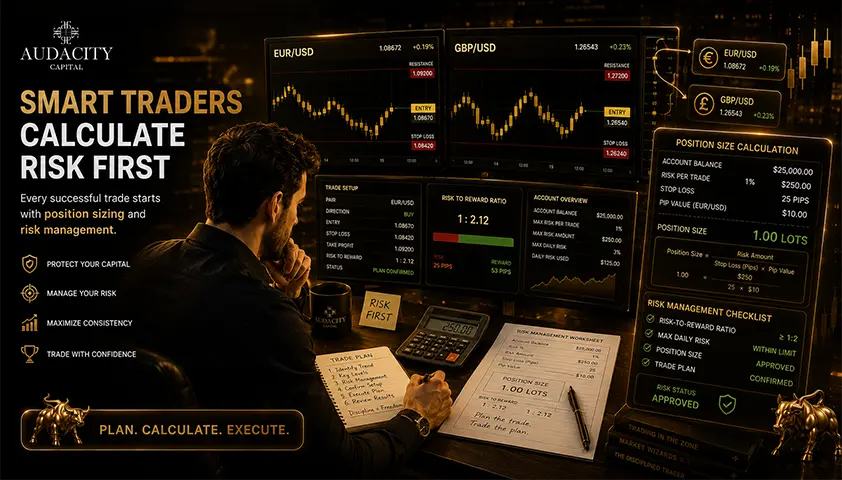
Work backwards from risk, not forwards from your balance. Decide the percent you will risk per trade, 1% is the standard, pick a realistic stop in pips, and the position-sizing formula gives you the lot size. That, in turn, tells you the account size that makes the trade sensible.
Formula: Position size (lots) = Risk in dollars / (Stop in pips x Pip value per lot) |
Worked example. Take a $1,000 account risking 1%, which is $10 per trade, with a 25-pip stop on EUR/USD and a pip value of $0.10 per micro lot:
- $10 / (25 x $0.10) = 4 micro lots
So a $1,000 account comfortably trades four micro lots on a 25-pip stop while risking exactly 1%. Run the same math at $100 and your 1% is only $1, which forces a stop so tight that ordinary market noise closes you out. That single calculation, not a round number from an advert, is the real answer to how much money you need to start forex trading.
How much do you need based on your trading style?
Scalpers and day traders use tight stops and can start smaller; swing and position traders hold through wider moves, so they need more capital to risk the same 1% safely. A day trader can work with $500 to $1,000; a swing trader usually wants $2,000 or more.
Style | Typical hold | Typical stop | Practical starting capital |
|---|---|---|---|
Scalping / day trading | Minutes to hours | 5 to 20 pips | $500 to $1,000 |
Swing trading | Days to weeks | 30 to 100 pips | $2,000+ |
Position trading | Weeks to months | 100+ pips | $5,000+ |
Wider stops are not worse, they simply need a bigger account so that the dollar value of 1% still covers the stop. A swing trader risking 1% on a 60-pip stop needs roughly six times the capital of a day trader risking 1% on a 10-pip stop for the same lot size.
Can you start forex trading with $10, $100, $500 or $1,000?
Can you start with $10?
Yes, but treat it as a simulator with real emotions. At $10 you can only trade the smallest micro positions, your 1% risk is ten cents, and the account exists to teach you execution, not to grow your money.
Can you start with $100?
Yes, and it is a fine learning balance, but the math is unforgiving. Risking 1% means $1 per trade, which caps your stop at roughly 10 pips on a micro lot. You can practice the process. You cannot expect income.
Can you start with $500 to $1,000?
Yes, and this is where trading becomes practical. You can risk 1% on a sensible stop, absorb a run of 10 to 20 losses, and size positions without your account hanging on a single trade. For most beginners, $500 to $1,000 is the honest starting point.
Why $100 rarely works
$100 is not too little to trade, it is too little to absorb mistakes. With 1% risk at a dollar a trade, profits stay tiny, costs take a bigger share of every trade, and one oversized position can undo weeks of slow progress.
- Tiny dollar profits even when your analysis is right.
- Spreads and commissions take a larger bite out of a small trade.
- The pull to overleverage and speed things up is strongest here.
- There is no buffer left for a normal losing streak.
Why $500 to $1,000 is the realistic sweet spot
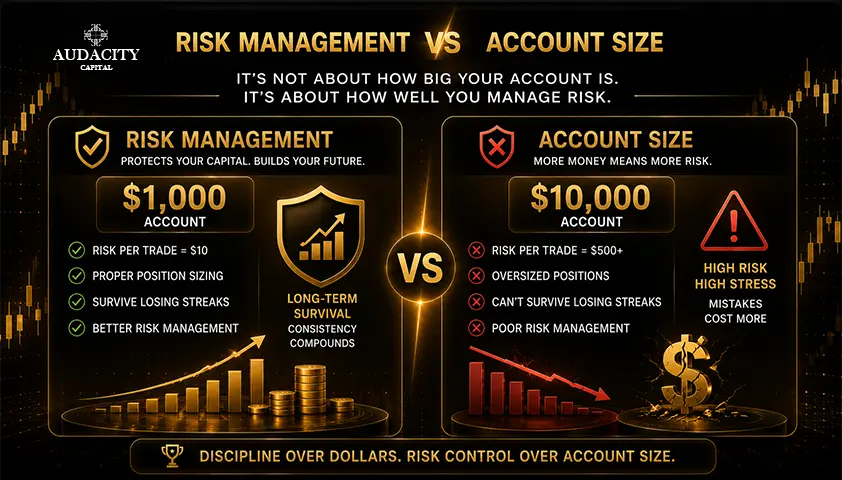
This range is the first point where proper risk management and real trading line up. It funds a 1% risk that actually means something, survives a losing streak, and leaves enough flexibility to size positions instead of betting the whole account on one idea.
- True 1% to 2% risk per trade without a stop so tight it is useless.
- Enough cushion to survive 10 to 20 losing trades in a row.
- Flexible position sizing across different setups.
- Far less emotional pressure than trading a near-zero balance.
What does it actually cost to start forex trading?
Your deposit is only part of the cost. Every trade carries a spread and sometimes a commission, positions held overnight pay or receive swap, and fast markets can add slippage. None are large on their own, but they hit small accounts hardest.
- Broker deposit - your trading capital.
- Spreads and commissions - the cost baked into every trade.
- Overnight swap - financing paid or earned on positions held past the daily rollover.
- Slippage - the gap between your stop price and the actual fill in fast markets.
- Tools, data and a reliable connection - mostly optional while you are small.
On a $5 trade, a wide spread can be the difference between an edge and a slow bleed, so favor major pairs with tight spreads while your account is small.
How much can you realistically make trading forex?
Far less than the adverts suggest, especially at the start. Disciplined traders often target 1% to 5% a month, not per day, and most retail traders lose money overall. On a $1,000 account, a good month might be $10 to $50, which is real progress but not a living.
The honest math. Risk 1%, which is $10, at a 1:2 reward-to-risk, take 100 trades in a month, and win half of them. Fifty winners at $20 and fifty losers at $10 nets about $500 before costs, in theory. That assumes a 50% win rate you have to actually achieve and hold, after spreads, swaps and the occasional mistake. Drop the win rate to 40% and the exact same plan loses money.
Regulated brokers are required to publish how many of their clients lose money, and those figures usually sit somewhere around 70% to 80% of accounts. Your starting capital does not move that number. Risk discipline does.
Can you make a living trading forex?
It is possible but uncommon, and it depends on capital and consistency, not on a starting balance you can simply deposit. Replacing a salary generally needs a large, stable account or outside funding, plus a proven, repeatable edge you can hold through drawdowns.
The math makes the point. A steady 3% a month is strong, but 3% of $2,000 is $60, while 3% of $100,000 is $3,000. Traders who do this for a living almost always trade size their own savings could not safely cover, which is exactly the problem a funded account is built to solve.
Can you start forex trading without your own money?
Yes. Through a proprietary trading firm you trade the firm's capital after passing a skills evaluation, then keep a share of the profits instead of risking a large deposit of your own. It removes the capital barrier, not the skill barrier.
A funded account gives you capital and a risk structure. It does not give you an edge, and most people who attempt an evaluation do not pass. Used well, it is the most realistic way to trade meaningful size without a five-figure deposit. Used as a shortcut, it fails for the same reasons a small personal account does. You still trade in a simulated, rule-based environment, and you still have to manage risk to keep the account.
How to start forex trading the right way
- Learn the mechanics: pips, lots, leverage, margin and spreads, until the numbers above feel like second nature.
- Practice on a demo account until one simple strategy is consistent across different market conditions.
- Fund a small live account, because real money changes how you handle a losing trade.
- Risk no more than 1% to 2% per trade, and size every position with the formula above.
- Keep a trade journal, review it weekly, and scale up only as your results and your balance grow.
How to trade a small forex account well
Small accounts survive by doing less, not more. Trade fewer, higher-quality setups, stick to one strategy and to liquid major pairs, keep leverage low, and let the account grow before you grow your risk.
- Trade major pairs for tighter spreads and lower costs.
- Risk a fixed small percent and size every trade with the formula.
- Keep leverage well below the maximum on offer.
- Avoid overtrading to force results faster.
- Add capital as you prove a repeatable edge, not before.
Trade real size without a real-size deposit
The honest takeaway is that how much you need to start forex trading matters far less than how well you manage the capital you trade. If a small personal account is limiting your position size, funded trading can provide an alternative.
At Audacity Capital, you can choose the funding option that best matches your trading experience and goals:
- Funded Trader Program – Complete our evaluation and qualify for a funded trading account with transparent risk rules, up to 90% profit share, and the opportunity to scale your account over time.
- Instant Funding – Prefer to skip the evaluation? Our Instant Funding program gives eligible traders access to instant funded accounts, allowing them to start trading firm capital immediately without completing a traditional challenge.
- Scaling Plan – Consistent traders can grow their funded account over time, with access to funding of up to $2 million.
Whether you choose a traditional evaluation or Instant Funding, long-term success still depends on disciplined risk management, consistent execution, and following the firm's trading rules. Funded trading removes the capital barrier—it doesn't remove the need for skill.
Think of it as access to larger trading capital within a structured environment, not a shortcut to profitability. The same discipline that helps you grow a small personal account is what allows you to succeed with a funded account.
Final thoughts
You do not need a big balance to start forex trading. You need enough to manage risk properly, the patience to grow it slowly, and the discipline to protect it. Open small, size every trade off your risk and not your hopes, and let the account earn the right to get bigger. Capital helps. Control is what keeps you in the game.
Related Articles
Complete Guide - forex for beginners
Read more about our guide How Much Money Do You Need to Start Trading?
Learn more about our latest guide How Much Money Do You Need to Start Day Trading
Read more about our guide How Much Money Do You Need to Start Trading Stocks?
Leran more about our latest guide How Much Money Do You Need to Start Crypto Trading?
Read more about our latest guide How Much Money Do You Need to Start Options Trading?
Learn more about our guide How Much Money Do You Need to Start Swing Trading?
Read more about our guide How Much Money Do You Need to Start Trading Futures?
Frequently Asked Questions
It can be, but slowly. A small account limits the dollars you make even with a strong percentage return, so early on it is healthier to treat profitability as proof of skill rather than as income.
Most professionals either trade well into five or six figures or trade firm capital. Size matters because a living wage comes from dollars, and dollars come from a large, well-managed balance.
Yes. Leverage multiplies a deposit you already hold; it never replaces it. You still fund the margin and the buffer your trade needs to breathe.
It is your broker's warning, or automatic close-out, when losses push your account below the margin needed to hold a position. Small, overleveraged accounts reach it fastest.
It is enough to open trades and keep learning, but at 1% risk you are working with about $2 a trade, so plan for education rather than income.
There is no set timeline, and honest growth is slow. Compounding a small balance can take months or years, and trying to rush it with extra risk is the most common way accounts are lost.
No. The firm provides the trading capital, and your evaluation fee is a cost, not a deposit you can trade. You trade their balance under their rules and keep a share of the profit.

هل أنت مستعد لتطبيق مخاطر منضبطة على العملات المشفرة؟ استكشف أدوات التشفير الجديدة من Audacity Capital واجلب استراتيجية التداول الخاصة بك.
اعرف المزيدالنشرة الإخبارية
انضم إلى نشرتنا الإخبارية.
انضم إلى مجتمعنا الاجتماعي

ابدأ رحلتك اليوم مع تجربتنا المجانية
اعرض مهاراتك وإنجازاتك بفخر من خلال الشهادات واحصل على تقدير لعملك الجاد وتفانيك من المستثمرين المحتملين والأقران.
تجربة مجانيةمقالات ذات صلة
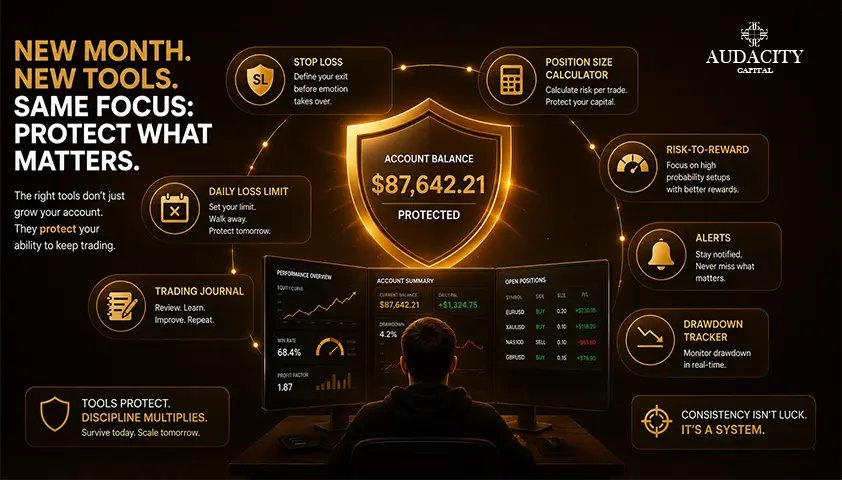
12 Trading Risk Management Tools Every Trader Needs
Explore 12 trading risk management tools for position sizing, trade planning, drawdown control, journaling, and smarter trading decisions.

Why Every Trader Sees The Chart Differently ?
Unlock the secrets of trader chart interpretation. Understand why different traders see the same chart differently and how it affects trading.

Funded Forex Trader : How To Trade During A Recession ?
Funded Forex Trader : how to Trade During a Recession. Start trading with a funded account now!

What Are The Risks Of Forex Trading For Beginners?
Understand the risks of forex trading for beginners. Learn about the potential pitfalls and challenges involved in the forex market.