


What Is Swing Trading? Strategies, Risks & Examples



Swing trading is a trading style that aims to capture price movements over several days or weeks. Instead of opening and closing every position within the same trading day, swing traders hold trades for longer periods while looking for opportunities to benefit from short- to medium-term market movements.
This approach can suit traders who want to analyse the markets and plan their trades without monitoring price charts throughout the entire day. However, swing trading still requires a clear strategy, patience and disciplined risk management. Positions held overnight can also be exposed to market gaps, economic announcements and additional trading costs.
In this guide, we explain what swing trading is, how it works, the strategies traders use, and the risks to understand before getting started.
Quick Answer: Swing Trading
Swing trading is a trading approach in which traders aim to capture price movements that develop over several days or weeks. They use market analysis to identify potential entry and exit points, then hold positions until their targets are reached, their trading setup becomes invalid, or their exit rules are triggered.
Swing traders typically:
- Hold positions for several days or, in some cases, several weeks.
- Look for opportunities in trending or range-bound markets.
- Use technical analysis, price action and, where appropriate, fundamental analysis.
- Plan entry prices, stop-loss levels and profit targets before entering a trade.
- Manage exposure through position sizing and risk limits.
- Account for overnight holding costs and the possibility of price gaps.
Swing trading does not guarantee profits. Results depend on market conditions, the trader’s strategy, execution, costs and risk management.
What Is Swing Trading?
Swing trading focuses on capturing a portion of a market’s price movement rather than attempting to profit from every small fluctuation. A trader may look for a pullback within an established uptrend, a breakdown in a downtrend, or a move between support and resistance levels.
For example, if EUR/USD is moving upwards, a swing trader may wait for the price to pull back towards a support area before looking for a potential buying opportunity. The trader would then define the conditions for entering, managing and closing the position.
The aim is not necessarily to buy at the lowest price or sell at the highest price. Instead, swing traders look for setups that offer a reasonable balance between potential reward and the amount they are prepared to risk.
Swing trading is used across markets such as forex, shares, stock indices and commodities. Whether a particular market or instrument is suitable depends on its liquidity, volatility, trading costs and the conditions offered by the broker or trading provider.
How Does Swing Trading Work?
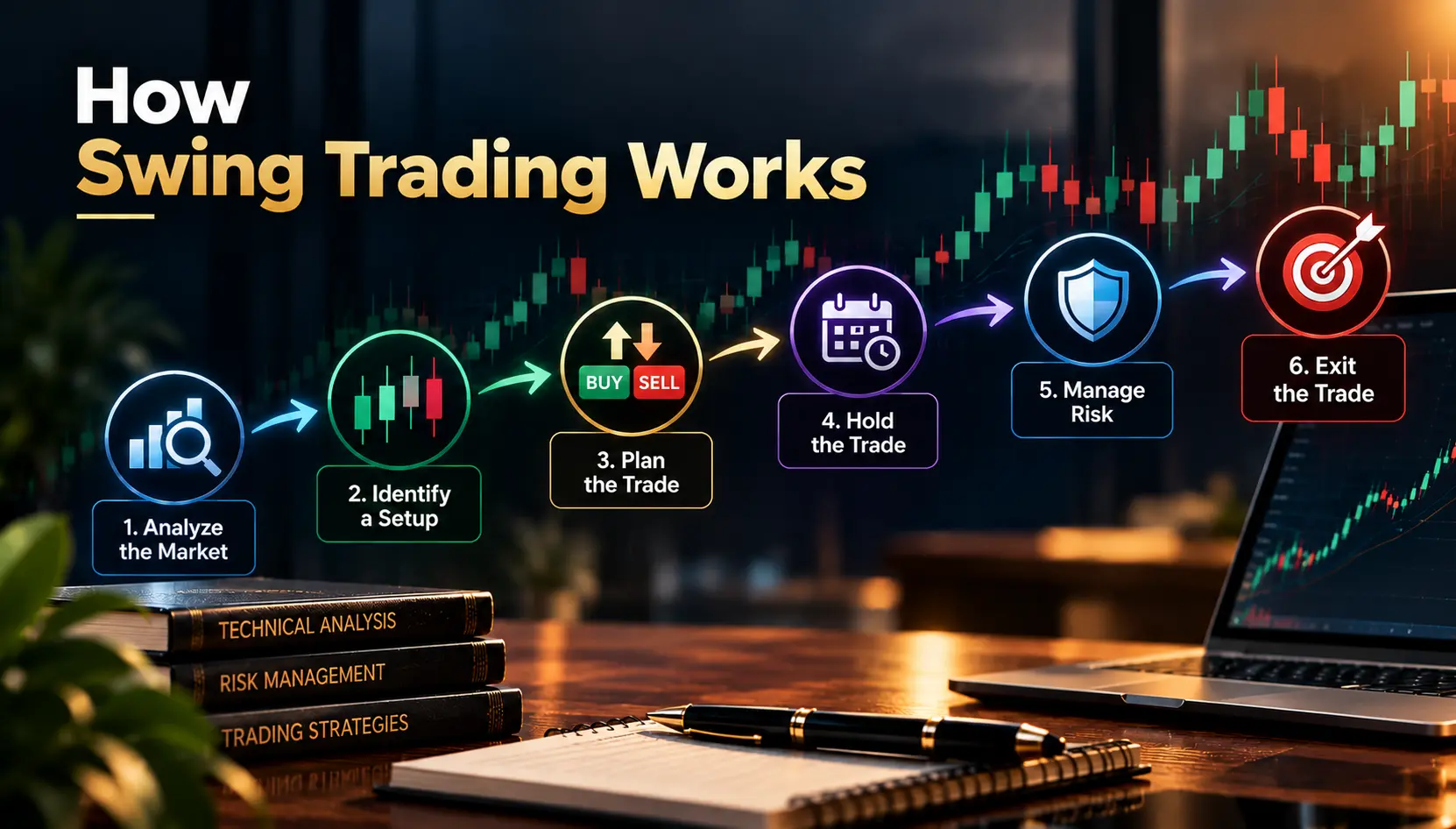
Swing trading generally follows a structured process. Although individual strategies differ, the main steps are similar.
1. Analyse the Market
Start by assessing the broader market direction. Determine whether the instrument is trending upwards, trending downwards or moving within a range.
Traders may use daily and weekly charts to understand the broader context before examining shorter timeframes for potential setups.
2. Identify a Trading Setup
Look for a specific condition that fits your strategy. This might include a pullback towards support, a breakout above resistance, a reversal pattern or a moving-average signal.
A setup should have clear criteria. Relying on a vague impression that the price is about to move can lead to inconsistent decisions.
3. Plan the Entry and Exit
Before entering a trade, identify the entry level, the price at which the setup would no longer be valid, and the intended profit target.
A stop-loss order can help manage downside risk, although the final execution price may differ from the stop level during gaps or periods of market volatility.
4. Calculate the Position Size
Position size determines how much exposure you take on a trade. It should reflect the distance between the entry price and stop-loss level, the instrument’s value per point or pip, and the amount of capital you are willing to risk.
A wider stop generally requires a smaller position if the intended monetary risk is to remain unchanged.
5. Monitor the Trade
Swing traders do not necessarily need to watch charts all day, but they still need to monitor open positions and relevant market events. Price alerts and a written trading plan can help, provided they do not replace appropriate risk controls.
6. Exit According to the Plan
A trade may close when the target is reached, the stop-loss is triggered, or the original setup is no longer valid. Review the result against the trading plan rather than judging a strategy solely by whether one trade made or lost money.
A Swing Trading Example
Consider a hypothetical EUR/USD trade. The numbers below are illustrative and exclude spread, commission, slippage and other costs.
A trader identifies an uptrend and waits for the price to pull back towards a support area. After the price meets the trader’s entry conditions, the trader plans the following trade:
Trade detail | Example |
|---|---|
Entry price | 1.1200 |
Stop-loss price | 1.1100 |
Risk per unit of EUR/USD | 100 pips |
Profit target | 1.1400 |
Potential reward | 200 pips |
Risk-to-reward ratio | 1:2 |
The distance from the entry to the stop-loss is 100 pips. The target is 200 pips away from the entry, giving the trade a planned risk-to-reward ratio of 1:2.
This does not mean the trader will earn twice as much as they risk. The target may never be reached, and the position could close at a loss. The actual monetary result also depends on position size and trading costs.
The example illustrates why swing traders should plan the trade before entering rather than choosing the stop-loss and target after the market begins moving.
Best Timeframes for Swing Trading
Swing traders often combine several timeframes to understand the broader trend and identify a potential entry.
Weekly Chart
The weekly chart helps traders assess longer-term market direction and major price levels. It can provide context for trades that may remain open for several days or weeks.
Daily Chart
The daily chart is commonly used to identify trends, support and resistance, and potential swing setups.
Four-Hour Chart
The four-hour chart can help traders examine price structure and refine entry conditions. Whether it is appropriate depends on the strategy and instrument.
One-Hour Chart
Some traders use the one-hour chart to refine entries, although relying too heavily on lower timeframes can introduce noise and encourage unnecessary trading.
A common approach is called top-down analysis: start with a higher timeframe to understand the broader market, then move to a lower timeframe to assess a potential entry. No timeframe is automatically best for every trader or market.
Popular Swing Trading Strategies
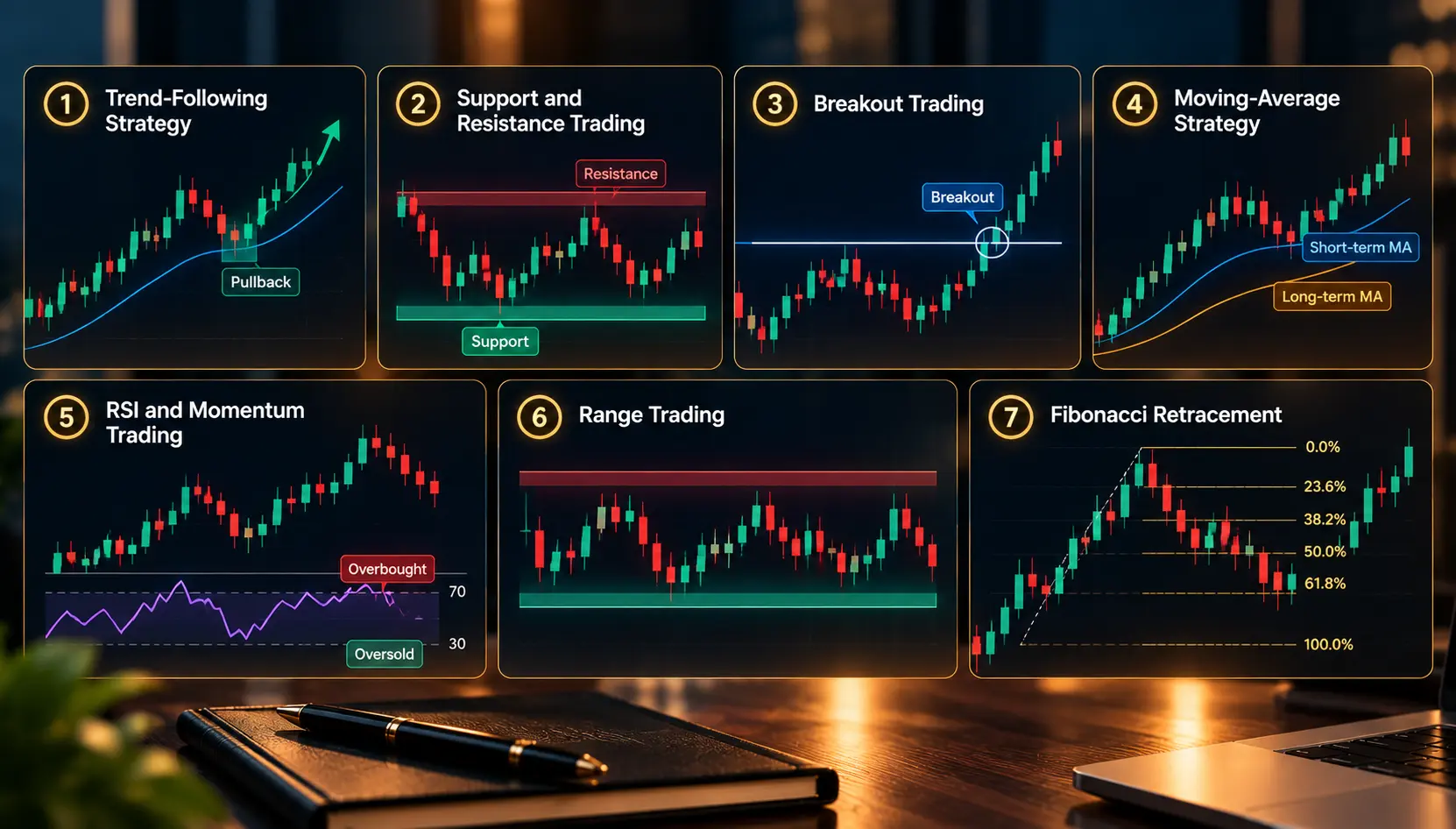
There is no single swing trading strategy that works in every market condition. The following approaches are commonly used, but each requires clear entry, exit and risk management rules.
1. Trend-Following Strategy
Trend-following traders look for opportunities in the direction of an established trend. In an uptrend, a trader may wait for a pullback before considering a long position. In a downtrend, the trader may look for a temporary recovery before considering a short position.
The main challenge is distinguishing a normal pullback from a genuine change in trend.
2. Support and Resistance Trading
Support is an area where buying interest has previously helped limit a decline. Resistance is an area where selling pressure has previously limited a rise.
A swing trader may look for a buying opportunity near support or a selling opportunity near resistance. These levels are areas of interest, not guarantees that the price will reverse.
Read more about Support and Resistance in Trading
3. Breakout Trading
A breakout occurs when price moves beyond an established support or resistance area. Some traders wait for a confirmed breakout before entering, while others wait for the price to return to the broken level.
Breakouts can fail. A move beyond a level should therefore be assessed against the trader’s criteria and risk limits.
Read more about Breakout Trading
4. Moving-Average Strategy
Moving averages smooth price data and help traders assess direction. Some strategies use the relationship between a shorter-term and a longer-term moving average to identify possible changes in momentum or trend.
Moving averages are based on past prices and may react slowly when market conditions change. They are best assessed within a broader trading plan.
5. RSI and Momentum Trading
The Relative Strength Index (RSI) measures the speed and magnitude of recent price changes. Traders may use it to assess momentum, potential overbought or oversold conditions, or divergence between price and the indicator.
An overbought reading does not automatically mean the price will fall, and an oversold reading does not guarantee a recovery. Strong trends can remain overbought or oversold for extended periods.
6. Range Trading
When a market moves sideways between identifiable boundaries, a trader may look for opportunities near the lower or upper part of the range.
This approach becomes more difficult when price breaks out and the previous range no longer holds. Traders need clear criteria for identifying when the setup has failed.
Read more about Range Trading
7. Fibonacci Retracement
Some traders use Fibonacci retracement levels to identify areas where a pullback may pause before the broader trend resumes. These levels are calculated from a selected price move.
They are reference points rather than reliable predictions. Traders should define what additional evidence they require before taking a position.
How to Choose a Swing Trading Strategy
When assessing a strategy, consider:
- Whether its rules are clear enough to apply consistently.
- Which market conditions it is designed for.
- How the entry, stop-loss and target are determined.
- Whether the potential reward justifies the risk.
- How trading costs affect its results.
- How it performs when tested across different market conditions.
Backtesting and keeping a trading journal can help you assess a strategy, but past performance does not guarantee future results.
Swing Trading vs Day Trading vs Scalping
Swing trading, day trading and scalping differ mainly in their typical holding periods, trading frequency and time commitment. Actual practices vary by trader and strategy.
Feature | Swing Trading | Day Trading | Scalping |
|---|---|---|---|
Typical holding period | Days to weeks | Seconds to hours, usually closed the same day | Seconds to minutes |
Trading frequency | Often lower | Varies by strategy | Often high |
Overnight positions | Common | Generally avoided | Generally avoided |
Common chart timeframes | Daily, four-hour, weekly | Intraday charts | Very short intraday charts |
Main focus | Short- to medium-term moves | Intraday price moves | Small, short-term price changes |
Key consideration | Overnight risk and patience | Active monitoring and quick decisions | Execution, spreads and costs |
Swing trading may suit someone who cannot monitor the market continuously during the day. Day trading and scalping may demand more frequent monitoring and faster execution. None is inherently more profitable or suitable for every trader.
Read more about Swing Trading vs Day Trading: Which Is Right for You?
Read more about Scalping vs Swing Trading: Which Strategy Is Right for You?
Swing Trading vs Position Trading
Swing trading and position trading both involve holding positions beyond a single trading session, but their typical objectives differ.
Feature | Swing Trading | Position Trading |
|---|---|---|
Typical holding period | Days to weeks | Weeks to months, sometimes longer |
Main focus | Short- to medium-term price swings | Broader market trends |
Typical analysis | Daily and four-hour charts, with higher-timeframe context | Weekly and monthly charts, often with fundamental analysis |
Trade frequency | Usually more frequent | Usually less frequent |
Key consideration | Shorter-term changes and overnight risk | Longer exposure to market and fundamental changes |
Position trading does not automatically produce larger returns. Outcomes depend on the market move, position size, timing, costs and risk taken.
Advantages of Swing Trading
Swing trading has several features that may appeal to certain traders.
Less Need for Continuous Screen Time
Because positions can remain open for days or weeks, traders may not need to monitor every short-term price movement. However, they still need to check open positions and relevant market events.
More Time to Plan Decisions
Swing trading can allow more time to assess a setup and define the trade before entering. This may reduce the pressure associated with very short-term decisions, but it does not remove emotional challenges.
Applicable Across Different Markets
Swing trading principles can be applied to a range of markets, provided the instruments offer suitable liquidity, trading conditions and opportunities.
Fewer Trades May Mean Lower Transaction Costs
A strategy that generates fewer trades may incur fewer transaction charges. However, overnight financing, spreads, commissions and other costs can offset this advantage.
Flexible Scheduling
Some traders can fit swing trading around other responsibilities because it does not necessarily require constant intraday monitoring. The time commitment still depends on the strategy, market and position management requirements.
Risks and Disadvantages of Swing Trading
Swing trading carries significant risks. Understanding them is essential before risking capital.
Overnight and Weekend Risk
Markets can move while a trader is away from the screen. Economic announcements, political developments and unexpected events may cause prices to open at a different level from the previous close.
A stop-loss order may not guarantee execution at the exact requested price if the market gaps.
Trading Costs
Depending on the instrument and provider, holding a position overnight may incur swap or financing charges. Spreads and commissions also affect the final result.
False Breakouts and Reversals
A price may break through a support or resistance level before reversing. A trend can also weaken or change direction before the target is reached.
Capital and Exposure
An open position uses available margin and creates exposure to market movements. Several positions in highly correlated instruments can increase overall risk, even if each individual trade appears small.
Emotional Pressure
Waiting for a setup to develop can be difficult. Traders may exit too early, move stop-losses further away, or increase position sizes after a loss. A written plan and consistent review can help address these behaviours.
No Guaranteed Profit
A strategy can experience losing trades and periods of poor performance. Even a favourable risk-to-reward ratio does not guarantee positive results, because the outcome also depends on the proportion of winning trades and trading costs.
Risk Management for Swing Trading
Risk management helps traders limit exposure and make decisions more consistently. It cannot eliminate losses, but it can help prevent a single trade from creating disproportionate damage.
1. Set a Risk Limit Before Entering
Decide how much you are prepared to lose if the trade reaches its planned stop-loss. Some traders use a small percentage of their account as a starting reference, but the appropriate limit depends on their circumstances, trading rules and overall exposure.
2. Calculate Position Size
Position size should be based on the intended monetary risk and the distance to the stop-loss. Do not select a position size simply because it allows for a larger potential profit.
For example, if a trader has a £10,000 account and chooses to risk 0.5% on a trade, the planned risk is £50. The position size must then be calculated using the stop distance and the instrument’s value per point or pip. The example is illustrative, not a recommendation to risk a specific amount.
3. Use a Stop-Loss Plan
A stop-loss level should reflect the point at which the trading setup is invalidated and the trader’s risk limit. Avoid moving a stop farther away simply to prevent a loss from being realised.
Remember that stop-loss execution can differ from the requested price during volatile conditions or market gaps.
4. Assess the Risk-to-Reward Ratio
Compare the potential loss with the planned profit target before entering. A 1:2 risk-to-reward ratio means the target is twice as far away in monetary terms as the planned risk, assuming the position is sized accordingly.
This ratio alone does not make a strategy profitable. The win rate, execution quality and trading costs also matter.
5. Account for Correlated Positions
Opening several trades in similar instruments can create more exposure to the same market factor. Consider total portfolio risk rather than assessing each position in isolation.
6. Review Economic Events
Before holding a position overnight or over the weekend, consider scheduled economic announcements, central bank decisions and other events that may affect the instrument.
7. Keep a Trading Journal
Record the reason for each trade, entry and exit levels, position size, outcome and any deviation from the plan. Review the results over a meaningful sample of trades rather than drawing conclusions from one or two outcomes.
Is Swing Trading Suitable for Beginners?
Swing trading may be worth exploring for beginners who prefer to analyse a setup before entering rather than make frequent intraday decisions. However, it is not automatically easier or safer than other trading styles.
New traders should first learn how orders work, how leverage and margin affect exposure, how to calculate position size, and how trading costs affect results. They should also understand the possibility of overnight price gaps.
A sensible learning process includes:
- Learning basic market structure and order types.
- Choosing one strategy with clearly defined rules.
- Testing it on historical data while recognising the limitations of backtesting.
- Practising in a demo environment, where available.
- Keeping records and reviewing performance.
- Using conservative risk limits if moving to live trading.
Avoid increasing position sizes simply because a few trades have been successful. A repeatable process matters more than any single outcome.
Can You Swing Trade with a Prop Firm?
Whether you can swing trade with a proprietary trading firm depends on the firm's specific rules and programme conditions. Some programmes may permit overnight or weekend positions, while others may impose restrictions on holding periods, news events, instruments or trade management.
Before joining a programme, review the current terms carefully.
What to Check Before Choosing a Prop Firm for Swing Trading
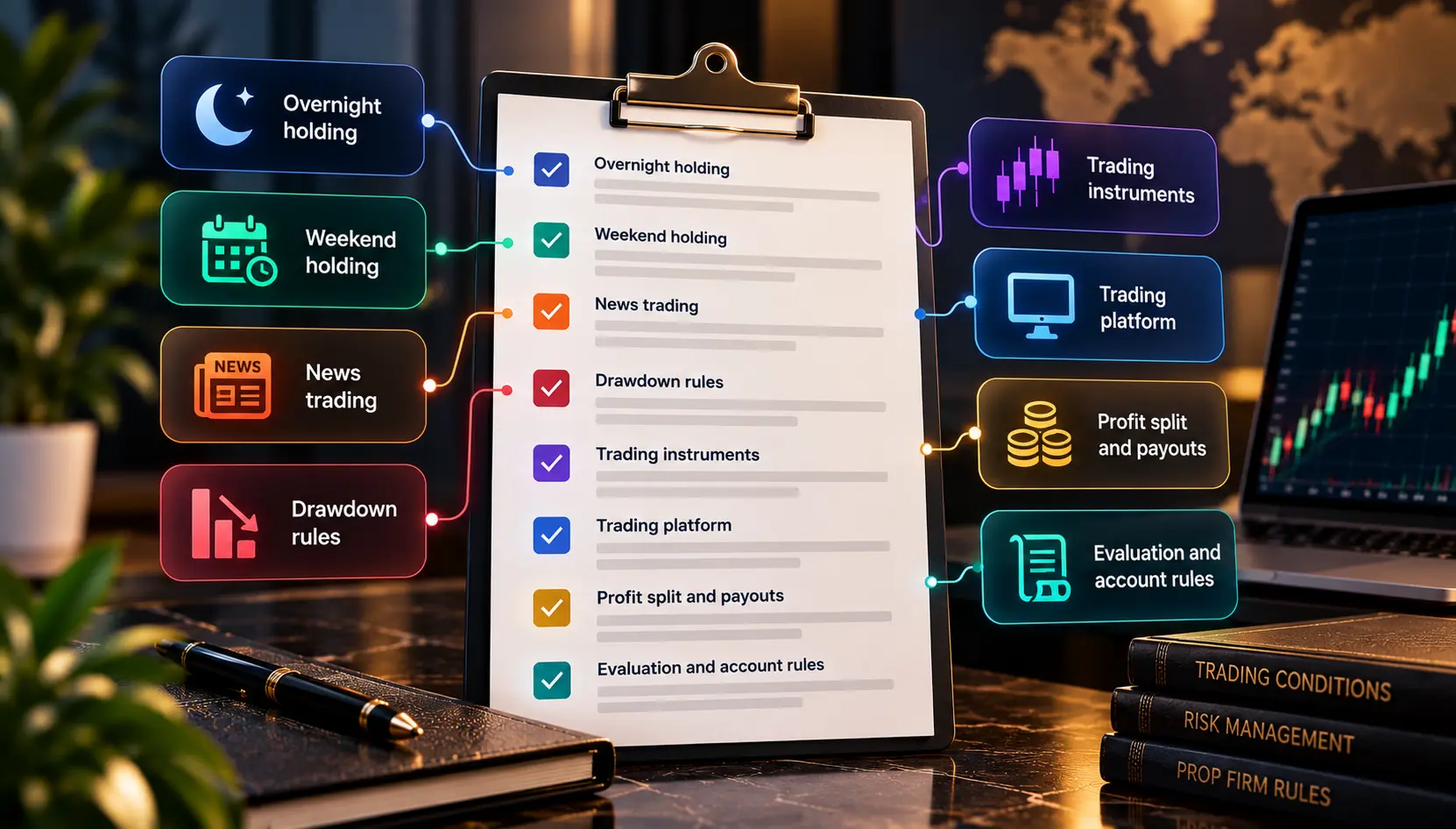
Overnight holding: Confirm whether positions can remain open after the trading day ends.
Weekend holding: Check whether positions may remain open over weekends and public holidays.
News trading: Review restrictions relating to major economic announcements, including whether positions can be held through specified events.
Drawdown rules: Understand daily and overall loss limits, how drawdown is calculated, and whether it is static or trailing.
Trading instruments: Confirm that the markets you intend to trade are available under the programme.
Trading platform: Check platform availability, order functionality and any relevant execution conditions.
Profit split and payouts: Read the current payout terms, eligibility requirements and any conditions that apply.
Evaluation and account rules: Review profit targets, minimum trading days, prohibited strategies and other requirements before paying for a programme.
Do not assume that every prop firm has the same rules. A programme that is suitable for one trading style may not suit another.
Traders considering Audacity Capital should review the firm's current programme information and applicable terms before deciding whether its trading conditions fit their strategy. Programme rules can change, so verify the latest official information rather than relying on outdated third-party summaries.
Read more about Features to Look for in the Prop Trading Firms for Swing Traders
Common Swing Trading Mistakes
Several avoidable mistakes can undermine a swing trading plan.
- Entering without a defined setup: A trade should meet the conditions of a strategy rather than being based on impulse.
- Risking too much on one position: A single loss should not put the trading account at disproportionate risk.
- Ignoring overnight events: Unexpected news can move the market while the position is open.
- Moving stop-losses without a valid reason: Widening a stop to avoid closing a losing trade can increase the planned loss.
- Chasing price after a large move: Entering late can leave limited potential reward relative to the risk.
- Overtrading after a loss: Trying to recover money quickly can lead to poor decisions.
- Using too many indicators: Multiple indicators may provide conflicting signals rather than clearer decisions.
- Failing to review results: Without records, it is difficult to identify recurring errors or assess whether a strategy is working as intended.
- Ignoring costs: Spreads, commissions and overnight financing can materially affect results, especially over longer holding periods.
A trading journal, a clear plan and regular review can help traders identify and address these issues over time.
Final Thoughts
Swing trading is a trading style that aims to capture price movements over several days or weeks. It offers an alternative to strategies that require trades to be opened and closed within the same day, but it still requires market analysis, planning and disciplined risk management.
The most important skills include identifying suitable setups, calculating position sizes, defining exits and accounting for overnight exposure and trading costs. No indicator or strategy can guarantee a successful outcome, and losses remain a normal possibility.
If you are considering swing trading through a prop firm, make sure its current holding rules, drawdown limits and other programme conditions align with your approach. Understanding the rules before committing to a programme can help you make a more informed decision.
Related Guides
Read more about our latest guide Is swing trading profitable?
10 Best Prop Firms For Swing Trading : Rules & Strategies
How Much Money to Start Swing Trading?
10 Best Futures Prop Firms for Swing Trading
Forex Swing Trading: Complete Beginner to Advanced Guide
6 Best Forex Swing Trading Strategies
Frequently Asked Questions
Swing trading is a trading style in which traders hold positions for several days or weeks to try to benefit from short- to medium-term price movements.
Positions commonly remain open for several days to a few weeks, although the duration depends on the strategy, instrument and market conditions.
Swing trading can produce profits, but it can also result in losses. Results depend on the strategy, market conditions, position sizing, execution and trading costs. No approach guarantees profitability.
Read more about our latest guide Is swing trading profitable?
There is no universally best indicator. Traders may use moving averages, RSI, MACD, Bollinger Bands or other tools, depending on their strategy. Indicators should be evaluated in context rather than treated as guaranteed buy or sell signals.
Neither is inherently better. Swing trading generally involves longer holding periods and exposure to overnight market movements, while day trading typically involves closing positions within the same trading day. The appropriate style depends on a trader's schedule, risk tolerance and strategy.
It may be possible because swing trading does not always require constant screen time. However, traders still need to monitor open positions, manage risk and account for important market events.
That depends on the programme's rules. Check its overnight, weekend and news-trading conditions before opening positions.
Some traders look for setups with a potential reward that is greater than the planned risk, such as 1:2. However, a ratio alone does not determine profitability. The strategy's win rate, execution and costs also matter.
Swing trading can be applied to markets such as forex, shares, indices and commodities. Suitability depends on liquidity, volatility, costs and the trader's strategy.
Beginners can study market structure, learn position sizing and stop-loss management, test a strategy on historical data, practise in a demo environment where available, and maintain a trading journal before considering live trading.

هل أنت مستعد لتطبيق مخاطر منضبطة على العملات المشفرة؟ استكشف أدوات التشفير الجديدة من Audacity Capital واجلب استراتيجية التداول الخاصة بك.
اعرف المزيدالنشرة الإخبارية
انضم إلى نشرتنا الإخبارية.
انضم إلى مجتمعنا الاجتماعي

ابدأ رحلتك اليوم مع تجربتنا المجانية
اعرض مهاراتك وإنجازاتك بفخر من خلال الشهادات واحصل على تقدير لعملك الجاد وتفانيك من المستثمرين المحتملين والأقران.
تجربة مجانيةمقالات ذات صلة
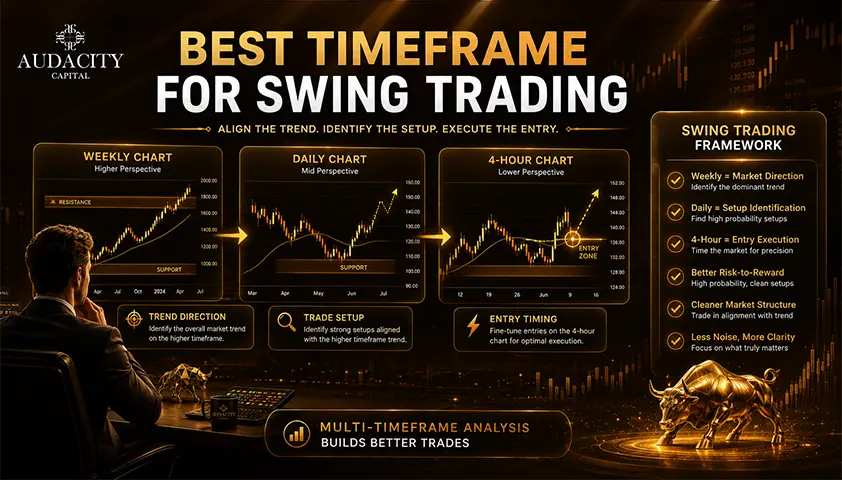
Best Timeframe for Swing Trading: Daily vs 4-Hour vs Weekly (2026 Guide)
Discover the best timeframe for swing trading in stocks, forex, crypto, and futures. Learn why the Daily chart is ideal, how to use the Weekly trend, and when to enter with the 4-Hour chart.


Is Swing Trading Profitable?
Is swing trading profitable? Learn realistic returns, common risks, why traders lose money, and practical ways to improve your chances of success.