


What Is Trading?



Key Highlights
Trading typically occurs electronically through financial markets, though it originates from traditional exchange of assets.
In a nutshell,
Financial assets form the foundation of trading, as they represent instruments whose prices fluctuate in the market.
Introduction
Trading refers to the buying and selling of diverse financial assets such as crypto, stocks, commodities, and forex, primarily for the purpose of earning a profit. Prices constantly fluctuate, providing traders with an opportunity to speculate and act decisively.
Successful traders spend the bulk of their time studying emerging market trends, analyzing charts, and using various strategies based on present and historical data. Read on to learn more about what trading is and what it entails!
What Is Trading?
Trading in the financial markets is no different from any other form of trading: it involves the buying and selling of different assets to make a profit. Assets are, therefore, the foundation of trading and investing.
From stocks to crypto, commodities, forex, and beyond, every trading opportunity starts with understanding what an asset is and how it works. Here’s a more detailed look at the trading world.
Buying and Selling Financial Assets
Any item that has a value can be called an asset. The reason you own it is because of the potential it holds for economic benefit. In trading, assets refer to shares in companies like Amazon and Apple, and in commodities like Gold and other precious metals.
Your objective in any trade will be to make a profit from the price movements that will happen either in the short or long term. But for this to happen, you first need to understand the different asset classes that exist, to get an idea of how you can profit from the opportunities they present.
Financial Assets that You Can See and Those That You Can’t
The trading world includes different types of assets, with every asset having a unique characteristic. Common assets in trading include:
- Tangible Assets: These are physical assets that hold an intrinsic value and can be seen and touched. Examples of tangible assets are physical cash, agricultural products, commodities like gold, and real estate. Commodities are one of the most popular tangible assets in trading and are generally traded through futures contracts.
- Intangible Assets: They have no physical form and come in varied shapes and sizes. Intangible assets can include goodwill, patents, brand recognition, and copyrights. And while these cannot be directly traded on an exchange, they have the potential to make a firm more valuable. For someone considering trading stocks, you may want to increase your knowledge of intangible assets to understand prospects.
- Digital Assets: These are the latest entrants into the market, and as their name suggests, they only exist in a digital form and are usually secured using cryptography. Prime examples of digital assets include ether, bitcoin, and NFTs (NON-FUNGIBLE TOKENS). Unlike stocks and commodities, such assets are traded on their own specialized exchanges.
- Fixed Assets: Financial experts use these in the context of a company’s balance sheet and refer to tangible assets that can’t easily be converted into cash. Examples of fixed assets include land, machinery, and buildings. And while they aren’t traded directly like stocks, the health and value of a firm’s fixed assets have a direct effect on its long-term viability and financial stability.
- Liquid Assets: They’re the direct opposite of fixed assets and can easily be converted into cash, without a substantial loss in value. Cash has traditionally been the most liquid asset. Other examples include financial instruments such as highly traded stocks and short-term government bonds. Traders need to have enough liquid assets to seize new opportunities and manage risk.
- Risk Assets: As suggested by their name, these assets carry a high degree of risk but may also offer higher returns. Examples of risk assets include emerging market currencies, corporate bonds, and stocks. Risk assets can be traded directly or via derivatives such as CFDs, futures, or options.
- Non-tradeable Assets: Assets come in many forms, and not all are traded, e.g., personal possessions like art collections, certain types of intellectual property, and private company equity. While non-tradeable assets aren’t directly relevant to daily trading, learning how they work and the value they hold helps offer a holistic view of financial wealth.
The Importance of Assets in Trading
As seen above, assets are the financial instruments that traders buy and sell with the goal of making a profit. These assets are important for the following reasons:
- Risk Management: Every financial asset you’ll encounter will carry with it a different level of risk. When you understand the risk associated with each asset, you get a chance to modify your trading strategies to help reduce your potential for loss. For example, you can use low-risk assets to try to offset the danger posed by the high-risk assets.
- Opportunity for Profit: The primary reason for engaging in any type of trade is to earn a return on your investment. Often, you’ll purchase an asset at a given price and then attempt to sell it at a higher price, hoping to profit from the resulting price difference. It’s a concept that applies across all types of assets, from cryptocurrencies to commodities and bonds to stocks.
- Capital Growth and Income Generation: Assets have the potential to appreciate in value as time goes by, e.g., when a share price increases (capital growth). In the same breadth, they can also help you earn an income, such as interest from bonds or dividends from stocks. It’s this dual potential that makes them an attractive option for all active traders.
- Diversification: A properly diversified portfolio helps in spreading your investment risk and can also boost your returns. Learning about the different asset classes enables you to build a robust trading portfolio that can withstand market volatility.
Profit from Price Movement
Price action involves studying the price movements happening in the financial markets. Various technical and fundamental analysis tools derive their values from price, so as a trader, why not take the time to study, analyze, and learn from the price movements themselves?
By learning how a price behaves when it approaches certain key levels, you’ll be trying to understand the concept of supply and demand.
What Is Price Action?
It refers to an approach that seeks to analyze price movements instead of derived indicators. Price action trading can also refer to the process of making decisions based on price movements. Therefore, instead of relying on an indicator, you get to ask yourself what other buyers and sellers are doing at that time.
Price is a primary source of information used by many traders.
Why Some Traders Focus on Price Movements Alone?
Indicators are derived from price and may lag depending on their calculation method.
- Directly observe the prices
- Reduce indicator clutter
- Avoid delayed signals
- Try to stay as close as possible to real-time market behavior
The objective here is clarity, not complexity.
Understanding How a Price Action Strategy Works
The price action strategy looks at past behavior to learn how price movements happen:
- Market Structure as the Foundation
A market structure references how a price leads to the formation of higher highs, higher lows, lower highs, and lower lows. Learning and understanding this market structure can help you to determine:
- Trend direction
- Expected reversals
- Potential areas of continuation
The market structure helps provide context for every decision that you make.
- Support and Resistance in Price Movements
You need to pay close attention to the levels at which a price has reacted in the past. Such areas can represent:
- Psychological levels
- Past buying or selling interest
- Areas where orders may have become clustered
The price movements around these three areas matter more than the level to which they may have risen.
- Entry and Exit Points Through Price Movements
Traders make a trade entry when a price movement has shown signs of acceptance or rejection at various key areas. Please note that this can include:
- Clean continuation moves
- Failed level breaks
- Strong rejection wicks
Use market structure instead of fixed indicator signals to manage your exits.
- Common Price Action Patterns
Price movement patterns refer to recurring formations that help showcase crowd behavior. Examples of these include:
- Rejection and Exhaustion Patterns: Sharp reversals or long wicks can indicate rejection. Such patterns suggest that a price may have attempted to move lower or higher but failed due to opposing pressure.
- Break and Retest Behavior: Price will typically return to retest a level after having broken it in the past. A successful retest shows acceptance and potential continuation. It’s a pattern commonly used in breakout and trend contexts.
- Expansion and Consolidation: Price will generally alternate between strong movement and tight consolidation. As a trader reliant on price movements, you should be on the lookout for: clear resolution from ranges and compression preceding expansion.
Benefits of Price Movement Trading
Relying on the price movements to trade will provide flexibility, but this is not always effortless. Some of the benefits linked to this strategy include:
- Works in ranging and trending conditions
- Encourages a good understanding of market behavior
- Reduces overdependence on trading indicators
- Adapts across varied markets and timeframes
It can help you develop a strong market awareness over time.
Speculation Vs Investing
The main difference between speculation and investing lies in the degree of risk and time frame involved. Investing is a long-term strategy that comes with less risk compared to speculation. Speculation is a short, high-risk approach to profiting from fast price movements.
You should note that the psychology of a typical investor is much different from that of the speculative investor. Their trading psychology will once again revolve around everyone’s tolerance for risk as they attempt to earn a bigger reward in the shortest time possible.
The table below helps in differentiating the psychology of investing and speculating.
Speculation | Long-Term Investing |
Willing to take on potentially high-risk endeavors | Prone to taking minimal or calculated risks |
Pursuit of high returns | In pursuit of more reasonable returns |
More willing to make short-term investments | Open to making long-term investments |
Frequent use of margin and leverage | Infrequent use of leverage and margin |
How Does Trading Work?
Online trading revolves around the buying and selling of instruments such as cryptocurrencies, commodities, currency pairs, and stocks through a mobile app or trading platform. The objective is to generate returns, though outcomes vary and do not always outperform long-term investing.
Some of the terms you’ll encounter when trading includes:
- Buyer & seller: Used to denote the person acquiring the asset and the individual offloading the instrument in question.
- Supply & demand: They’re the two factors that drive price movements. When supply outweighs demand, the prices fall, and vice versa.
- Price movement: It refers to the change in an asset’s value over time and is visualized through charts.
- Bid/ask: The bid refers to the highest price that a buyer is willing to pay, and the ask implies the lowest offer a seller will accept.
- Spread: It is the difference between the bid and ask price.
Real-World Example of a Trade
Imagine you’re a vintage shoe collector who has come across a pair of vintage Jordan sneakers selling at $60 at the local thrift store. As a collector, you know that this model has been trending and can fetch as high as $120 if you were to sell it at a specialized market.
So, what do you do?
- Spotting a money-making opportunity (analysis), you realize that it has been undervalued, so you buy it at $60 (opening position)
- You take the pair home and wait for a few days for the value to rise (holding)
- After a few days, you offload the pair at $120 (close your position) and walk away with a profit of $60.
Financial trading operates using the same principle, but instead of selling vintage Jordan sneakers, you’ll be buying and flipping Gold, Bitcoin, and Apple shares.
Check here to learn more about how does trading work
Types of Trading
The trading world is rather large and can at times seem overly complex. For this reason, it has been divided into various categories as follows:
Based on Asset Class:
Traders can use a variety of financial assets and securities to trade. Common assets used in trading include:
- Stocks
- Forex
- Commodities
- Cryptocurrencies
- indices
By Trading Style
The trading style refers to the methodology you’ll use when executing your trades. The types of trading that fall under this category include:
- Day trading
- Swing trading
- Scalping
- Position trading
What Assets and Markets Can You Trade?
You can trade a variety of financial instruments across the global markets, many of which fall under the categories of shares, cryptos, ETFs, indices, and commodities.
These are markets that allow for short-term speculation. Key tradeable assets and markets to consider include:
- Derivatives
- Bonds
- Forex
- Shares
How Financial Markets Work
Financial markets refer to online platforms where traders get to trade instruments such as currencies, stocks, bonds and commodities. These markets help connect asset buyers to sellers, thus ensuring efficient capital allocation and price discovery.
There are two main types of financial markets:
- Money Markets: They deal with short-term lending and borrowing, and involve the buying and selling of highly liquid assets such as commercial paper and treasury bills.
- Capital Markets: These markets include the bond and stock markets, and it’s where companies raise capital to fund their operations and expansions.
Trading vs Investing
Trading and investing are two terms individuals use interchangeably, but which when applied precisely, they tend to represent two distinct approaches to the financial markets.
Investing uses strategic acquisition and holding of financial assets to build wealth over time. Trading, on the other hand, is the active buying and selling of bonds and commodities for fast profits.
Below is a comparison table to help you understand the differences between the two:
Trading | Investing |
Short-term | Long-term |
Frequent trades | Buy and hold |
Technical focus | Fundamental focus |
What Do You Need to Start Trading?
For you to get started with trading, you’ll need the following:
- Broker / platform (MT4, MT5):
- Capital Strategy: A prop trading. A company can provide you with the capital needed to trade large positions.
- Risk management: Prop Funded Trader Programs come with strict risk management policies that a trader must abide by. Click here to learn more about How Traders Get Funded.
- Psychology
Sales and Trading Vs Investment Banking
Sales and trading involve making fast-paced daily transactions for institutional clients, while investment banking takes on a more corporate advisory role that requires creating pitchbooks.
Risks of Trading
Trading risks refer to the potential for financial loss involving leverage, market volatility, and emotional decision-making. The most common risks of trading include:
- Volatility
- Leverage risk
- Emotional mistakes
- drawdown
Can Beginners Trade?
Yes. Anyone interested in becoming a funded trader can start trading today. However, there’s a need to first learn about what trading entails, which will involve using a demo account to practice. You may also need to follow a structured learning path to help make your trading journey smoother.
How Professional Traders Approach Trading
Professional traders’ partner with prop trading firms to obtain the capital they need to trade large positions. In most cases, these firms will require them to participate in structured funded programs where they get to prove their skills and show that they have the discipline needed to succeed.
Their success in the funded programs will be dependent on:
- Self-discipline
- Risk control measures
- Consistency
- Ability to approach trading as a business
Examples of trading
Trading is the buying and selling of financial assets for the purpose of making a profit. Here are two examples to show trading in action:
- Day Trading: You buy 100 Apple shares at 9.00 A.M for $150 and sell them at 4.00 P.M for $175 to gain $25.
- Swing Trading: A trader buys Microsoft shares on Monday morning, expecting a breakout and sells them the following Friday after a price increase.
How to Start Trading with The Help of a Prop Firm?
Trading with a prop firm will involve taking a simulated challenge where you’re required to prove your skills, trading discipline, and consistent profitability. You must do all this while adhering to the risk management rules, e.g., drawdown limits put in place by the prop firm. Audacity Capital is an ideal example of a prop trading firm that has been around for a while, and which provides both instant funding and a multi-step evaluation program.
Conclusion
Trading is both an opportunity and a risk: an opportunity in that you can earn profits from your investments with the right approach, but a risk in that the wrong strategy can lead to losses. To succeed, you’ll need to commit to continuous learning and to develop a long-term mindset. Without this, your trading journey may end before it has even started.
FAQs
Financial trading involves the buying and selling of financial assets with the sole objective of earning a profit. Commonly traded assets include stocks, commodities, crypto, and indices.
These are long-term tangible assets owned by a firm that are not easily convertible into cash. Businesses use them to generate revenue over multiple account periods. Ideal examples include equipment, land, and buildings.
Traders can trade on a variety of financial markets, such as global currencies, themes, bonds, ETFs, and more.
Price action can work for you, but it demands a high degree of patience on your end if you’re to successfully trade the markets using price movements.
Trading financial instruments can be profitable, but it does come with some risk. Volatility and poor risk management practices can cause you to lose your capital, hence the need to approach trading with caution.

هل أنت مستعد لتطبيق مخاطر منضبطة على العملات المشفرة؟ استكشف أدوات التشفير الجديدة من Audacity Capital واجلب استراتيجية التداول الخاصة بك.
اعرف المزيدالنشرة الإخبارية
انضم إلى نشرتنا الإخبارية.
انضم إلى مجتمعنا الاجتماعي

ابدأ رحلتك اليوم مع تجربتنا المجانية
اعرض مهاراتك وإنجازاتك بفخر من خلال الشهادات واحصل على تقدير لعملك الجاد وتفانيك من المستثمرين المحتملين والأقران.
تجربة مجانيةمقالات ذات صلة
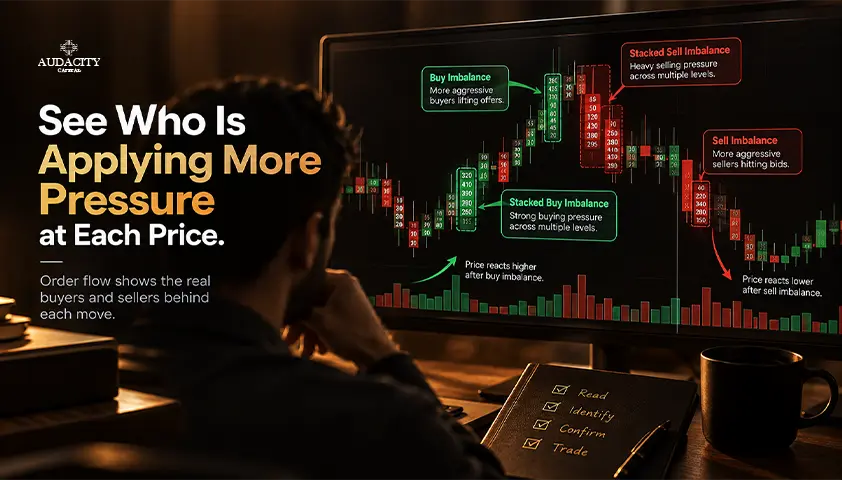
Order Flow Imbalance: How to Read Buy and Sell Pressure
Learn what order flow imbalance means, how footprint and order book readings differ, and how traders assess buy and sell pressure with context.

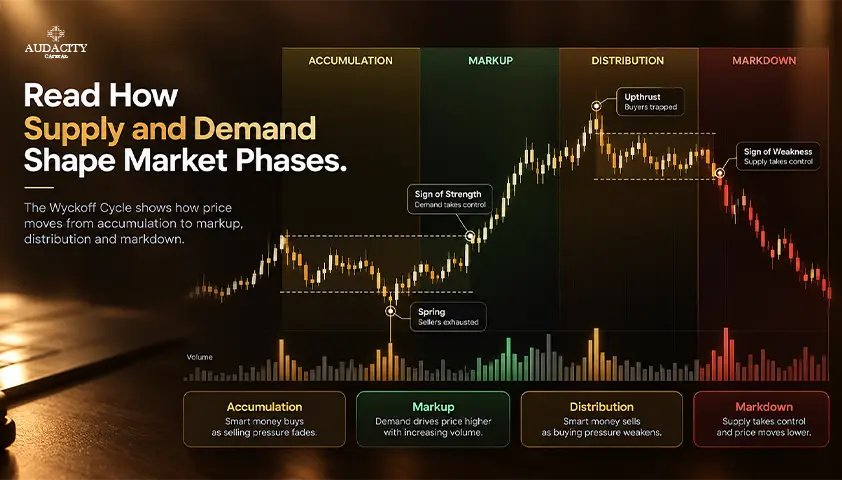
Wyckoff Method Explained: Phases, Rules and Examples
Learn the Wyckoff Method, its three laws, accumulation and distribution phases, trade examples, and the limits of price and volume analysis.
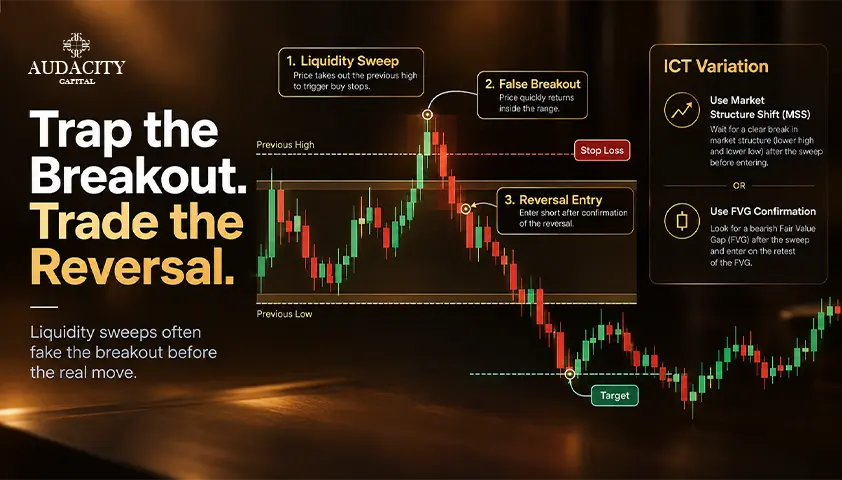
Turtle Soup Trading: Rules, Examples and ICT Variations
Learn turtle soup trading with original rules, ICT variations, bullish and bearish examples, risk controls, and a practical backtesting checklist.
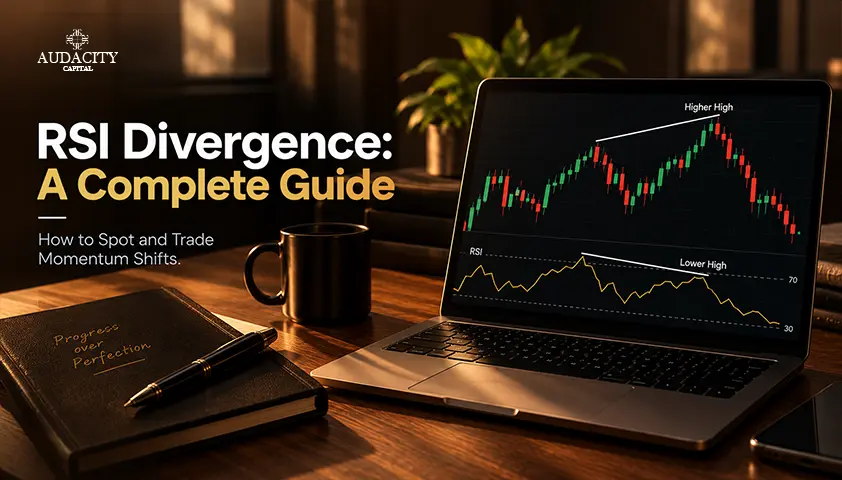
RSI Divergence: A Complete Guide to Spotting and Trading Momentum Shifts
Learn what RSI divergence is, explore bullish, bearish and hidden divergence, and discover how to identify, confirm and trade RSI divergence.