


What Is Trading? Meaning, How It Works and Types


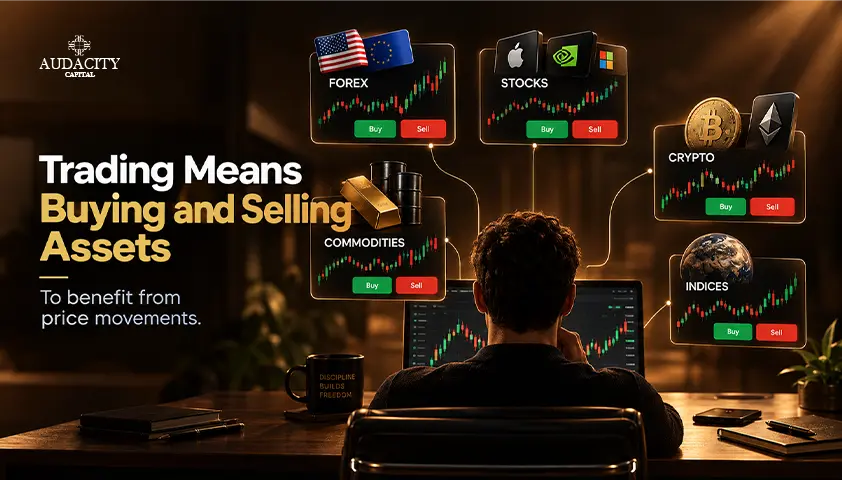
Trading is the process of purchasing and selling financial instruments such as stocks, currency and other commodities in the hopes of profiting from price movements.
While it may seem rather simple at first, it should be known from the beginning that trading could be just as likely to result in losses as profits.
In this article, you will find out more about how trading works, what can be traded, different types of trading, how profit or losses are generated by trading, differences between trading and investing, risks involved and how to start trading as a beginner.
What Is Trading?
If you are searching for a trading definition in one sentence, consider it an act of exchanging a financial asset at a certain price, with the anticipation that its price will be different at the time of returning the asset.
A trade occurs when a buyer and a seller agree to exchange a financial asset at a certain price agreed upon in the market. Depending on the market and financial product used in the trade, a trader may seek to gain from rising prices, falling prices or both.
Trading can occur in several types of financial markets, including stock exchanges, foreign exchange markets and commodity markets. It can also occur in different time periods. Some traders hold positions for a few seconds while others do so for weeks and months.
Short example: suppose you purchase 10 shares of a company at $20 each. After a couple of days, the price increases to $22 and you sell them.
You made $2 per share or $20 in total without considering costs. Had the price fallen to $18, you would have lost $20. This potential of profit or loss is the essence of trading.
How Does Trading Work?
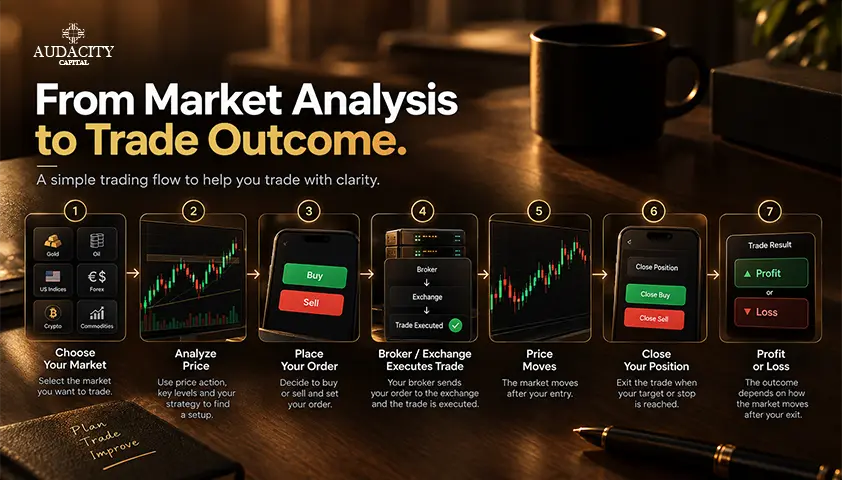
When thinking about how does trading work in practice, the procedure is rather consistent in any market:
- Select a market. You choose which asset to trade, such as stocks, currency pairs or commodities.
- Place an order. With the help of a broker or trading platform, you inform the market of your intention to buy or sell.
- Open a position. As soon as your order is executed, you have a position in that asset.
- Price moves. As the market changes, your position becomes profitable or unprofitable.
- Close the position. You close it doing the opposite of what you did to open, and the result becomes final.
Price moves upwards if the buyers become more eager to pay higher prices to carry out transactions, while it goes downwards if sellers agree to receive progressively lower prices to find buyers.
When you are observing prices from your platform, you will usually see two figures. The bid, which is the maximum price that buyers are willing to pay, and the ask, the minimum price that sellers are willing to accept.
The difference between these two is known as the spread.
If the bid price is 99.90 and the ask price is 100.10, then the spread is equal to 0.20. The spread is actually the cost of trading because normally you will buy at the ask price and sell at the bid price
Your gain or loss will depend on four factors: the direction of the price change, the magnitude of the price change, the size of your position and trading cost.
Buyers and Sellers
Any trade requires the involvement of both a buyer and a seller. Buyers are ready to buy an asset at a certain price, while sellers are ready to sell at an acceptable price.
The price they agree upon becomes the current market price. With changes in the willingness to buy and sell, the price constantly changes throughout the trading session.
Supply and Demand
Market prices are influenced by the law of supply and demand.
For example, if the demand for a stock increases faster than the supply of its shares, say after good results, the price will increase. If many owners want to sell their shares and there is a small number of buyers, the price will decrease.
The same is true about currencies; if more people want to buy euros than sell them, the euro will be strengthened.
Opening and Closing a Trade
Opening a trade involves entering a position by buying or selling. The closing of a trade involves exiting that position. While placing an order, a market order gets executed at the best available price, whereas a limit order is executed only at the price you set.
Your entry price and exit price differences, adjusted for your position size and other charges, will determine if the trade is profitable or not.
What Can You Trade?
Trading can be done in various financial markets and instruments. Below is a list of the different types of financial instruments that you can trade.
Market | What Is Traded | Example |
Stocks | Ownership stakes in listed companies | Apple, Tesla |
Forex | Currencies, traded in pairs | EUR/USD, USD/JPY |
Commodities | Basic raw materials such as energy, metals, and agricultural products | Gold, crude oil |
Indices | Group of stocks representing a market or sector | S&P 500, FTSE 100 |
Futures | Contracts to buy or sell an asset at a set price on a future date | Oil futures, E-mini S&P 500 futures |
Options | Contracts giving the right, but not the obligation, to buy or sell an asset at a set price before a set date | Options on a company’s shares |
ETFs | Funds that trade on an exchange like a share and track an index, sector or asset | An S&P 500 ETF |
Cryptocurrencies | Digital assets traded on crypto exchanges | Bitcoin, Ethereum |
Every market is unique in its own way. Stocks are easier to understand because you can relate them to the companies that you are familiar with. Forex trading occurs almost all day during weekdays and it is highly liquid.
Commodities respond to changes in supply and demand throughout the world. Futures and options are more complicated and they are recommended to traders who already have knowledge about the markets.
ETFs give you access to a basket of assets using one exchange-traded fund. Their diversification and risks are dependent on their contents. Cryptocurrencies are highly volatile because of price swings in short periods.
Some financial instruments allow you to trade the price movements without actually owning the asset itself. Not every instrument is available everywhere because it depends on your location, broker and regulations.
How Do Traders Make Money?
Usually, traders enter a long or short position, depending on their expectations about the price changes. The strategies operate differently.
Long position: When a trader expects an upward price move, they open a long position by purchasing that instrument. If the price goes up and they sell it at a higher price level, they earn a profit after expenses. In case of price decrease, they suffer losses.
Short position: When a trader expects the price of an instrument to fall, they open a short position. The mechanism varies based on the type of instrument and trading platform.
For example, in the case of shares, it could be borrowing and selling the shares first, and then buying them back later. With derivatives, such as CFDs and futures, one can directly open a short position.
- Example of Profit: You buy 100 shares at $50 each. If you sell them at $54, then your gross profit will be ($54 − $50) × 100 = $400.
- Example of Loss: You buy 100 shares at $50 each. If you sell them at $47, then your gross loss will be ($47 − $50) × 100 = −$300.
These examples do not include any spreads, commissions, overnight financing costs on leveraged positions and applicable taxes, which can influence the final result. Profits are never easy or guaranteed, and many beginners lose money in the process of learning.
What Makes Market Prices Move?
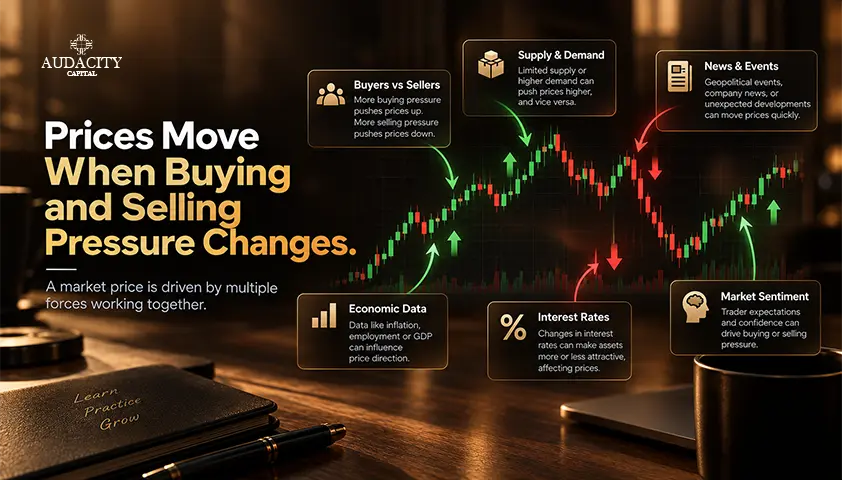
Market prices react to changes in expectations, economic situation, and trading volume. The following factors can influence the changes:
- Supply and demand: the basic relationship between buyers and sellers.
- Economic data: reports about inflation, employment or economic growth can alter the expectations about the economy. For instance, a very good report about the labor market may drive up the currency of that country.
- Interest rates: high interest rates might make borrowing more costly while savings more attractive, and hence affect stocks, bonds, and currencies. Announcements of reductions in interest rates by the central bank can move the market in minutes.
- Earnings and news: in case a firm reports better-than-expected profits, its stock price will rise. A product recall and profit warnings can have the opposite impact.
- Geopolitical events: conflicts, elections, and trade disputes may lead to price movements, especially in oil, gold, and currency markets.
- Market sentiment: this refers to the general attitude of the traders, whether optimistic or pessimistic, which may cause prices to move even further than the news suggests.
- Liquidity: liquidity is a condition where there are plenty of buyers and sellers, hence enabling large orders to be placed without causing price movements. In thinner markets, a single large order can cause bigger swings.
- Volatility: this refers to the speed at which prices fluctuate. Higher volatility will mean more opportunity, but it also means more risk.
The main concept here is that the markets respond to the expectations and not just events. If investors expect some increase in interest rates and it arrives as expected, the impact will be minimal on prices. However, when it turns out to be unexpected, the impact could be quite big.
What Are the Main Types of Trading?
The types of trading are often categorized depending upon the period that a trader holds the position or trade and how often they buy and sell the market. There are four major strategies that people use in trading.
Style | Typical Holding Period | Activity Level |
Scalping | Seconds to minutes | Very high |
Day trading | Minutes to hours, within one day | High |
Swing trading | Days to weeks | Moderate |
Position trading | Weeks, months or longer | Low |
Day Trading
A day trader opens and closes trades on the same day and does not hold any positions overnight. They are interested in shorter-term price changes and need to spend some time observing the market.
This may be suitable for people who have time to pay attention during the market session and are comfortable making quick decisions.
Swing Trading
A swing trader holds trades for several days or even weeks with the objective of profiting from price swings within a certain trend. It takes less screen time than day trading.
This may be suitable for people with other engagements, though it is important to keep in mind the risk of overnight and weekend price gaps.
Position Trading
A position trader holds trades for weeks or even months with the basis of broader market trends or fundamentals. They trade less frequently and are less bothered by the daily market noises.
This may suit patient traders who prefer a big-picture approach.
Scalping
In scalping, there is an attempt to make many short-duration trades to capture small price movements. Since profits from each trade are low, costs become extremely important. The strategy requires fast execution as well as effective risk management. It is usually seen as one of the more difficult strategies for novices.
Trading vs Investing: What Is the Difference?
The main point of trading vs investing is that trading usually deals with shorter-term price changes, while investing usually revolves around the concept of longer-term holding and growth. However, neither can be viewed as better than the other and some individuals engage in both.
Factor | Trading | Investing |
Timeframe | Seconds to months | Years to decades |
Frequency of transactions | Frequent | Infrequent |
Main goal | Profiting from price changes | Building wealth through growth, interest or dividends |
Analysis approach | Technical, sometimes combined with fundamental | Often fundamental, focused on long-term value |
Use of leverage | More common | Less common |
Risk management | Active, use of stop-loss orders and proper position sizing | Often through diversification and long holding periods |
Traders make money from both falling and rising stock prices and they usually pay attention to the markets more often. The investors purchase stocks and hold onto them through the short-term dips and jumps in the hope that the asset grows over the long run.
The choice of the strategy depends on your goals, time horizon, amount of available time and risk tolerance.
A person who invests for retirement within 30 years will have different requirements from the person who wants to be involved in the market actively. There are many investors who have a long-term investment portfolio and also use a part of their portfolio for trading.
How Do Traders Analyse the Markets?
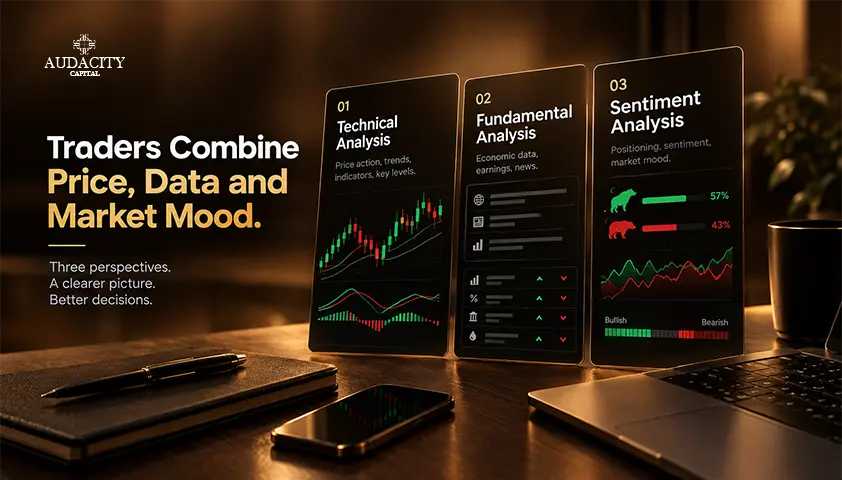
The traders use various analysis methods in order to determine what to trade, what is the entry point and exit point. For newcomers, there are two types of analysis which are used: technical and fundamental. Usually, traders combine them rather than relying on just one.
For example, a person can apply fundamental analysis to determine what to trade and technical analysis to determine when to trade.
This section deals only with the basics. Indicators, chart patterns, and financial statements all need their own dedicated guides.
Technical Analysis
Technical analysis involves analyzing price charts, trading volumes, trends, and other market data to identify potential trading opportunities. This method is used by traders to analyze how prices have moved and find patterns that could help them with entries and exits.
Some of the most common tools are moving averages, momentum indicators, support and resistance levels, and trend lines. For example, a trader can analyze whether a stock has exceeded some previously existing resistance level and if there was trading volume to back this movement up.
Technical analysis does not make any predictions about the future but helps traders to organize their decisions.
Fundamental Analysis
Fundamental analysis considers various economic, financial and business elements which may affect the price of an asset.
Stock traders could evaluate the profitability, growth rate, debts and business outlooks of companies. Forex traders could consider interest rates, inflation, employment data and economic growth. Commodity traders could look at the production levels, inventories, weather and global demand.
For instance, a trader who conducts fundamental analysis of a currency pair could consider the economic outlook and interest-rate projections for both countries involved.
Fundamental analysis could give you the reasons for price changes, but the way markets react to news could be different depending on expectations and other developments.
What Are the Risks of Trading?
Trading could lead to partial or total loss of your funds, and profits are not guaranteed. You should know about the risks associated with trading before starting.
The main risks are:
- Market risk: The price may go against your position due to economic news, company announcements, changes in expectations or general market conditions.
- Leverage risk: The use of leverage allows you to trade a bigger position size with less money but increases the risks of losses as well as gains. In certain situations, your loss may be greater than your deposit.
- Volatility risk: Volatility makes it hard to close positions at the expected price level. Stop-loss orders can be executed at another price level when the market moves quickly or in illiquid conditions.
- Incorrect position sizing: A large risk on one trade can result in wiping out an entire trading account.
- Emotional trading: Fear, overconfidence, and desire to recuperate losses can lead to impulsive trades or departures from a trading plan.
- Trading costs: Spreads, commissions, overnight financing, exchange fees, and taxes can decrease profits. Trading often may make these costs particularly significant.
- Surprising events: News regarding economics, geopolitics, and companies can cause sharp price movement even after the market hours.
That is why risk management is so important. The common ways of risk management are:
- Risk management: determining in advance how much you can afford to lose overall and per trade.
- Position sizing: many traders only risk a fraction of their capital on any given trade.
- Placing stop-loss orders where suitable: intended to exit the trade automatically at the selected price, but in volatile markets this may not execute exactly at that level.
Effective risk management does not eliminate risk but allows you to remain in the game long enough to learn.
How Can Beginners Start Trading?
If you want to know how to start trading, here is a logical starting point:
- Learn the basics. Learn important definitions such as bid, ask, spread, leverage, long and short prior to risking money.
- Select the market to trade in. Begin with one market, whether it be stocks or forex, rather than attempting multiple markets.
- Understand the instrument traded. Know what you are trading, what drives its price and how much does it cost to trade?
- Select a regulated broker or trading platform. Ensure the broker or trading platform is regulated in your area, and compare fees, tools and ease of use.
- Get acquainted with technical and fundamental analysis. It is important to have knowledge about both of them prior to using any of them.
- Develop a trading strategy. Write down what you are going to trade, when you are going to buy and sell, and the amount of risk involved.
- Establish your risks. Determine your maximum losses on a per-trade basis, a per-day basis and a general one.
- Test your strategy in a demo mode. The demo or simulated mode allows testing your strategy using virtual funds.
- Start trading live carefully (if appropriate). If you decide to do live trading, start gradually and consider your initial trades as the learning period.
Use a trading journal for analyzing your actions and noticing trends in your results. Before doing live trading make sure that your strategy is effective in reality and that you understand your losses.
Trading With Your Own Capital vs a Prop Firm
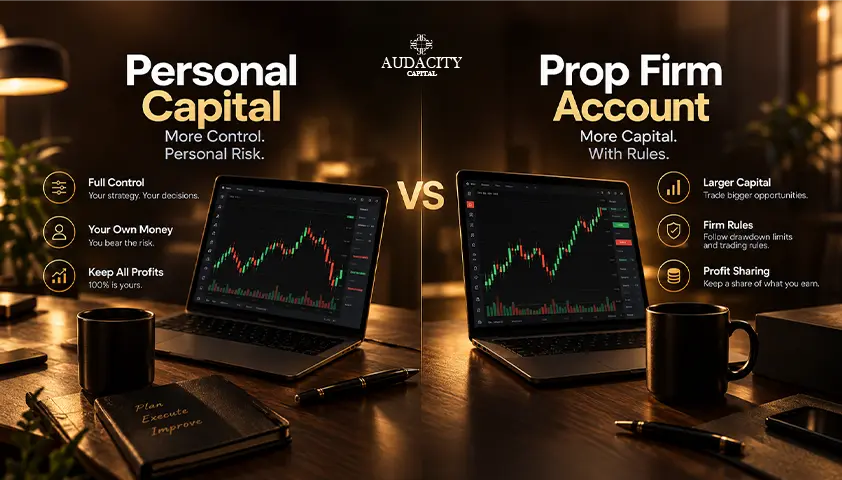
There are two common routes into trading. First is trading with your own capital through a broker. Second is trading with a proprietary (prop) trading firm model.
Trading with your money means that you open a trading account with a broker and fund it according to your own terms.
Trading with a prop firm means that they will give you access to a bigger trading capital after passing some assessment or criteria. In return, they will take some part of your profit and put some limits on risks, for example, maximum daily loss or maximum drawdown.
Factor | Own Capital | Prop Firm |
Capital source | Your personal funds | Capital provided by the firm usually after some assessment |
Trading rules | Set by you according to the broker’s terms | Set by the firm and must be adhered to |
Risk limits | Self-imposed | Are set by the firm, violations can close down your account |
Profit ownership | You keep 100% of profits | Profit is usually split between yourself and the firm |
Account restrictions | Few, beyond broker and regulatory rules | Can limit trading instruments, time or type of strategies |
None of the options is necessarily the better one. Trading your own capital will give you maximum freedom but you will risk your own money.
Prop firms can lower the amount of your own funds invested in the trade, but it comes with rules and sometimes with evaluation fees. Be sure to read the conditions before making any commitments.
Final thoughts
Successful trading requires knowledge of the financial market, solid strategy and realistic expectations. Start with the basics, test your skills prior to committing real money, and then decide whether trading is right for your goals, available time and tolerance for risk.
Frequently Asked Questions
Trading is the process of buying and selling financial instruments, such as stocks, currencies or commodities with the intention of profiting from the movement of prices.
A trader might buy an instrument with the hope that its price will go up, or take a trade that profits when its price goes down. Because prices can move either way, trading carries the risk of loss as well as the chance of gain.
The four basic ones are scalping, day trading, swing trading and position trading. Mainly, they vary in terms of how long your position is held, from seconds or minutes for scalping to weeks, months or longer for position trading.
No. Trading and investing have a range of differences. Usually, trading focuses on shorter-term price movement, whereas investing aims at long-term growth or income. These two approaches can also be used together.
Some brokers allow you to start with a small amount, while others set minimum deposits. More important than the amount is that you only use money you can afford to lose. Starting in a demo account lets you practise without risking any capital.
Yes, beginners are capable of learning the basics of trading by studying, practicing in a demo account and managing their risks carefully. It takes time and patience and many people make mistakes at first, but starting small and keeping a journal of each trade will definitely help you improve.
It is possible, but there are no guarantees whatsoever. Some traders are making money, others lose money, especially during the early stages. It all depends on your skills, discipline, risk management, costs and market conditions. Be careful about those who promise quick and guaranteed returns.
A trader is the one who buys and sells financial instruments in order to make money from the movements in prices. A broker is the company which gives you the possibility to trade through its platform, and it makes its money from commissions, spreads and fees.

Ready to apply disciplined risk to crypto? Explore Audacity Capital's new crypto instruments and bring your trading strategy.
Learn MoreNewsletter
Join our newsletter to stay up to date on features and releases.
Join Our Social & Community

Start Your Journey Today With Our Free Trial
Proudly showcase your skills and accomplishments through certificates and get recognition for your hard work and dedication from potential investors and peers.
Free TrialRelated Articles
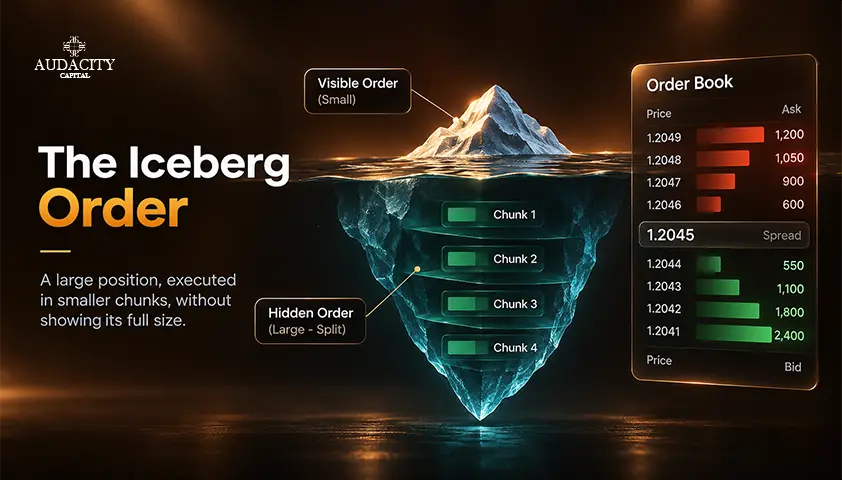
Iceberg Orders Explained: How Hidden Large Orders Work
Learn what iceberg orders are, how they work, why traders use them, how to spot possible iceberg activity, and how execution varies by platform.

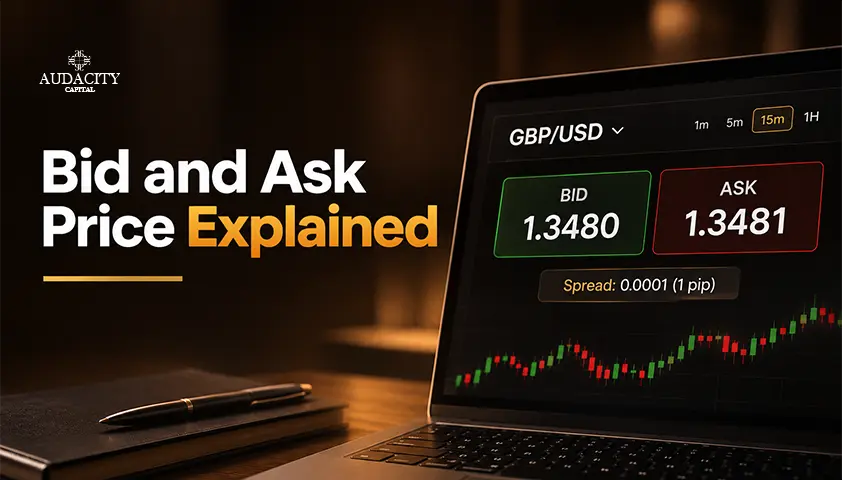
Bid and Ask Price Explained: What Every Trader Needs to Know
Learn what bid and ask prices mean, how spreads affect trading costs, why spreads widen, and how to manage them when trading forex and other markets.
NQ in Trading – What is NQ in Trading?
Learn what NQ means in trading, how E-mini Nasdaq-100 futures work, their contract specifications, trading hours, strategies and risks.
What Is Full Porting in Trading?
Learn what full porting in trading means, how traders use maximum buying power, the risks of going all-in, and how to manage trading risk.