


Forex Trading for Beginners: How to Start Step by Step


Currency pairs, pips, spreads, lots, leverage, margin. You open your first trading platform and here comes all this vocabulary. You do not even know what a single trade involves yet.
That is what makes forex trading for beginners a difficult process when it should not be. It is learnable, but often presented in the wrong order.
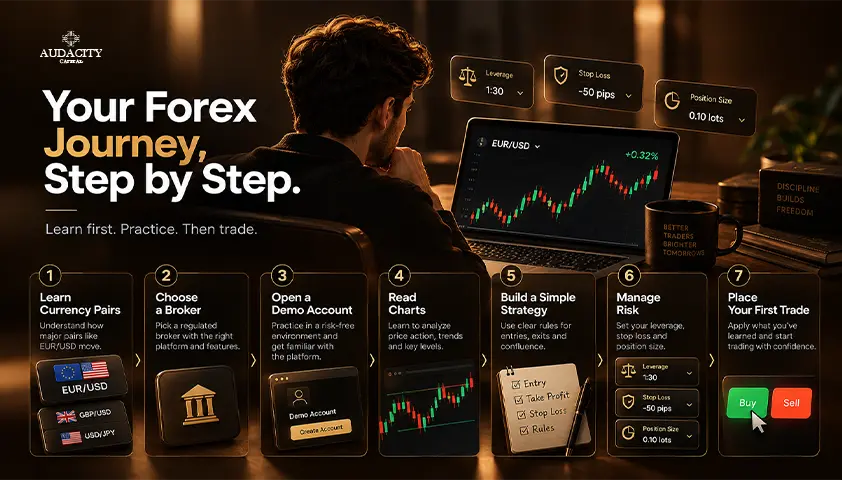
The following guide arranges them in the proper order. To learn forex trading correctly, you need to accumulate your knowledge gradually:
- What forex is
- How a trade works
- The essential terminology
- A practical way to get started
- How to protect yourself from a loss that will undo weeks of progress
Strategy is important, but we will talk about it later. This forex for beginners guide begins with the mechanics.
What Is Forex Trading?
Forex is short for foreign exchange. It's a global market where one currency is traded for another.
Anyone who has ever exchanged pounds for euros before traveling abroad has engaged in foreign exchange. Forex trading applies the same idea to speculation. A trader's decision to buy or sell a currency is based on their prediction of the exchange rate between two currencies.
So, what does forex trading imply? Currencies are always quoted in pairs, like EUR/USD or GBP/JPY, because they are always priced against one another.
Forex trading isn't just about "buying money". You are taking a view on the relationship between two currencies. That view is reflected in the exchange rate.
There is one important aspect to consider from day one of forex trading for beginners. Correctly anticipating direction can result in a profitable trade, but the outcome also depends on entry, exit, costs and risk management. No matter what preparations you have made.
Why Are Currencies Traded?
- International business: Companies purchase foreign currency for paying overseas suppliers as well as to return foreign income to the home country.
- Travel: Individuals exchange money for trips abroad, in small amounts but huge numbers.
- Investing: Foreign stocks, bonds, or real estate are typically purchased with the local currency.
- Hedging: Companies and investors use currency transactions to safeguard against adverse exchange-rate changes.
- Speculation: Traders aim to profit from changes in exchange rates and accept the risk of loss in return.
How Does Forex Trading Work?
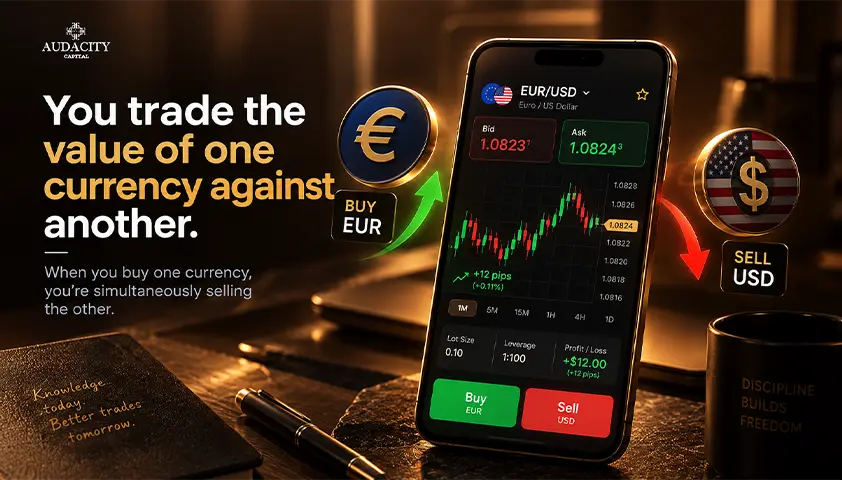
To better understand how forex trading works, it is best to trade one pair at a time. Throughout this section, EUR/USD is used.
Understanding Currency Pairs
Component | In EUR/USD | What it means |
Base currency | EUR | The currency being priced |
Quote currency | USD | The currency used to price it |
Exchange rate | 1.1000 | Amount of the quote currency that can buy one unit of base currency |
If EUR/USD is quoted at 1.1000, €1 is priced at $1.10. When the rate goes up to 1.1100, the euro has been strengthened against the dollar. If it falls to 1.0900, the euro has weakened.
In each instance the base currency's value is being tracked in terms of the quote currency.
Buying and Selling Forex
- Going long (buying): You expect the base currency to strengthen relative to the quote currency. When a trader buys EUR/USD, they believe the EUR will appreciate against the USD.
- Going short (selling): You believe that the base currency will depreciate in value against the quote currency. When you sell EUR/USD, you believe that the euro will decline.
It is helpful to trade either way, but not certain that it will make money. Two directions also imply two ways to be wrong.
Bid, Ask and Spread
On your platform you will typically see two prices on each pair:
- Bid: the price available if you want to sell.
- Ask: the price available if you want to buy. It is normally slightly higher than the bid.
The spread is the difference between the two. It's a part of your trading expense, and it implies that every single trade begins slightly behind.
What Moves Forex Prices?
Exchange rates move as the balance between buyers and sellers shifts. Common drivers include:
- Interest rates: An increase in the interest rate can make a currency more attractive to hold.
- Inflation: When the price of goods increases, it impacts the buying power and influences central bank policies.
- Employment and economic data: Jobs reports and GDP releases alter expectations about an economy.
- Central Bank decisions: An announcement about monetary policy can be a big shift.
- Political and geopolitical events: Events such as elections, conflicts, or trade disputes can impact confidence.
- Market sentiment: Traders prefer to buy or sell particular currencies according to how risk-tolerant they feel.
- Supply and demand: All of the above factors ultimately affect the flow of orders.
Forex Trading Terms Every Beginner Should Know
This glossary provides forex trading basics for you to follow a trade. Each term is explained just enough so that you understand how it works.
1. Pip
A pip is the change in an exchange rate. The standard pip size for most pairs, including EUR/USD, is 0.0001 or the fourth decimal place. If EUR/USD moves from 1.1000 to 1.1025, it has risen 25 pips.
Forex pips provide a common terminology for traders to use in discussing the movement, stop distances and targets. There is no fixed Pip value, it varies based on the pair and position size.
A dedicated calculation guide covers that once the basic concept feels comfortable.
2. Lot Size
Forex lot size is a measure of the size of the position. The three commonly used units are:
- Standard lot: 100,000 units of the base currency
- Mini lot: 10,000 units
- Micro lot: 1,000 units
A larger lot equates to a greater impact on your account for each pip. Smaller lots provide you with more control of exposure while you are learning.
3. Spread
The forex spread is the difference between bid and ask price, and it is a cost of trading that exists for all trades. Spreads do not have a set price. They can grow during periods of low liquidity, huge releases of economic data, or during periods of market turbulence.
4. Leverage
Forex leverage refers to the amount of money you can control in a transaction beyond the money you have deposited as margin. The important thing about leverage is that it amplifies both profits and losses.
A small movement will make a large impact in a leveraged trade.
5. Margin
Forex margin is the amount of money required for maintaining and opening a leveraged position. This amount remains locked up as long as the trade is still open.
The two concepts, namely margin and leverage, are interrelated but different.
Leverage indicates the ratio between your exposure and margin used whereas margin indicates the actual amount held. When your losses bring your available funds into shortfall, a provider may ask for more margin or close out positions.
6. Stop Loss
A stop loss is a stop order meant to exit a trade when the price hits a specified level when it trends in a losing direction. Stops don't always fill at the bid price. In fast markets or in the case of gaps, slippage may result in poor execution price.
7. Take Profit
A take profit order ensures that trades are closed as soon as they reach a desired price level, allowing you to stick to your strategy and avoid impulsive decision-making.
8. Position Size
Position size is how much exposure your trade has to the market. Position size should not be determined by account balance alone.
It should have to do with the stop distance, how much risk you are willing to take in case the stop level is triggered and any other rule that applies to your account. The wider the stop, the smaller your position should be if you want to keep the same planned risk.
Major, Minor and Exotic Currency Pairs
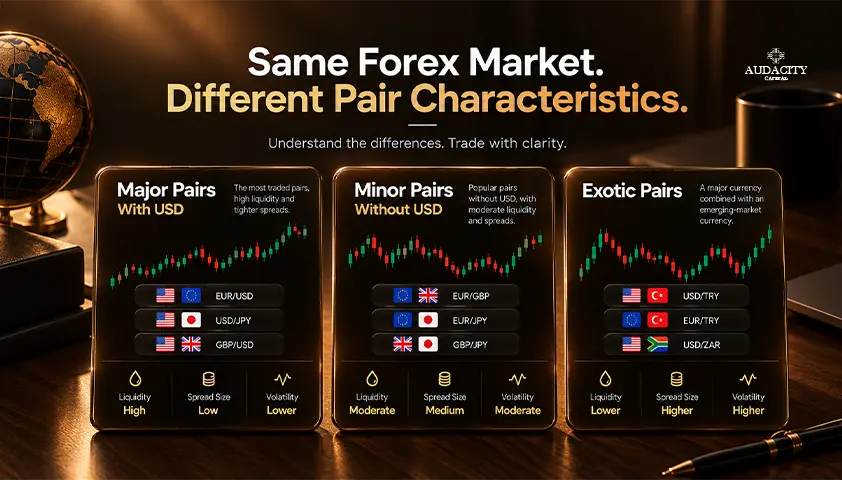
Categorizing the pairs helps to understand how much liquidity, cost and volatility you can expect from them. There is no such thing as the best type, but only different types of behavior.
Major Currency Pairs
Major currency pairs are those that feature the US dollar with other major and well-traded currencies, including EUR/USD, GBP/USD and USD/JPY.
High trading volume usually indicates good liquidity and tight spreads when market conditions are normal. It is for this reason that many beginners start learning about them first.
Minor or Cross Currency Pairs
Minor pairs, or crosses, are the pairings of major currencies, excluding the USD. Examples include EUR/GBP, EUR/JPY and GBP/JPY. Spreads might be broader than majors. Some crosses, like GBP/JPY, are also famous for their high volatility.
Exotic Currency Pairs
Exotic pairs are usually a combination of the major currency with a smaller or emerging-market economy, like the US dollar/Turkish lira or the South African rand.
There will be low liquidity, larger spreads, and different behavior in terms of volatility from what you see with major currency pairs. Minor and exotic pairs are separate.
A cross composed of two major currencies is not identical to a pair involving an emerging-market currency.
When Is the Forex Market Open?
There is no central exchange for Forex. Trading runs through a network of banks, institutions and providers in financial centres worldwide.
Forex market hours are throughout the working week as one region closes, another opens, typically from Sunday evening to Friday evening European time.
The trading day is typically divided into four trading periods:
- Sydney: Opens the trading week, tends to be quieter.
- Tokyo: Drives activity in Asian markets and yen pairs.
- London: One of the busiest sessions, because of London's role as a hub for currency trading.
- New York: Adds significant volume, particularly for dollar pairs and around US data releases.
Liquid and volatile levels change constantly during the day. They tend to rise during the overlapping period of days when London and New York are both open.
Activity can decrease during quieter periods as spreads can widen.
Find out the times your selected pair is active and know the server time on your platform (because sessions may move forward or backward with the changing of daylight saving time).
How to Start Forex Trading for Beginners
The steps below show how to start forex trading for beginners in a logical sequence. Each one builds on the step before it.
Step 1. Learn the Forex Basics
Ensure you have a clear grasp of the concepts mentioned above: currency pairs, long and short positions, pips, lot size, spread, leverage and margin.
You should be able to describe what occurs with a position if the price changed 20 pips in favor or against you. If there is still something that you don't understand, look back at it before continuing.
Step 2. Understand the Risks
In any serious trading forex, risk must precede reward. Accept that:
- Leverage can cause losses to escalate rapidly.
- Losing trades is a normal part of trading.
- Declines from an account's previous high (also known as “drawdowns”) occur with veteran traders as well.
- Spreads and commissions reduce results over time.
- Volatility may push prices further and faster than anticipated, particularly on the news.
Only after that can you contemplate any potential returns.
Step 3. Choose a Suitable Forex Provider and Platform
Whoever you trade with, check the essentials:
- Regulatory status: Is the provider appropriately regulated?
- Jurisdiction: Can it legally serve residents of your country?
- Costs: What are the normal spreads, commissions and overnight costs?
- Available pairs: Does it offer the markets you want to study?
- Platform functionality: Are you able to set stops and targets with ease, read clear charts and manage positions reliably? A wide range of platforms are used for this, including MetaTrader 5 and DXTrade.
- Risk disclosures: Do the risks have a clear explanation?
Step 4. Start With a Demo Account
A forex demo account enables you to practice trading in a simulated setting using virtual funds. Learn the platform controls and practice placing orders using it.
You can also test stops, targets and position sizing without putting capital at risk. Do not exceed its limits. The conditions of the demo execution might differ from those in live environments around slippage and fills.
The loss of virtual money is often not the same as the loss of real money. A smooth demo run doesn't mean the same behaviour in the real run.
Step 5. Choose What You Will Trade
Start with one or two pairs and get to know them well. Learn each pair's typical spread, most active hours, normal volatility and main economic drivers. Many beginners start with a liquid major pair, but familiarity matters more than popularity.
Step 6. Learn One Trading Approach
You need repeatable rules for identifying opportunities, entering, managing risk and exiting. Pick one approach and learn it properly..
Step 7. Create a Basic Trading Plan
At minimum, your plan should define:
- Market: Which pair or pairs you will trade.
- Setup: The conditions required before you consider a trade.
- Entry: Exactly how and where you will enter.
- Stop or invalidation: The point at which your idea is proven wrong.
- Position size: How you calculate exposure from stop distance and planned risk.
- Exit: Where you take profit or close the trade.
- No-trade conditions: Situations you avoid, such as major releases, unusually wide spreads or trading while frustrated.
Step 8. Practise and Review Your Trades
Practice on demo and keep a trading journal. Make sure for each trade you write down the entry, stop and target levels, why you made the trade, and whether you followed your rules.
Measure success in terms of the quality of the process, not profit. A losing trade that followed the plan is more educational than a winning trade that broke the plan.

Are You Looking For A Demo Trading Account?
Try Demo Account NowHow Much Money Do You Need to Start Forex Trading?
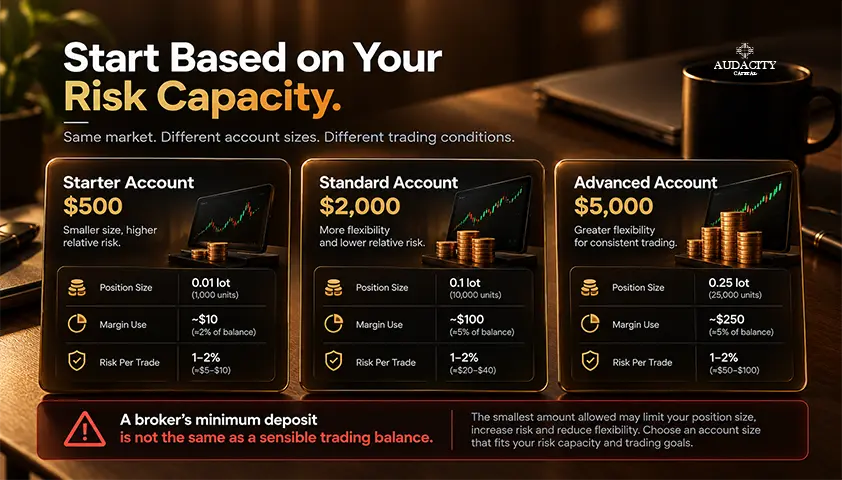
No fixed sum. It will depend on your needs, such as:
- Provider or account requirements
- Position size you intend to trade
- Leverage available and how much you use
- Risk limits per trade and overall
- Trading costs such as spreads and commissions
Beware of any claim that a small amount is "enough. To get a detailed overview, read our guide of how much money you need to start trading.
Some traders also look into prop-firm opportunities, like Audacity Capital's Ability Challenge (2 Step) or Ability One (1 Step) or FTP (Instant Funding).
These types of programs offer company funding under their own conditions.
What Forex Trading Strategy Should a Beginner Use?
There is no universally best beginner strategy. A suitable starting approach usually has:
- Clear rules
- Clear invalidation
- Limited variables
- Manageable trading frequency
- Enough opportunities to practise and evaluate
Styles are often grouped by holding period, from scalping and day trading to swing trading and position trading. The right fit depends on your schedule, temperament and any account rules you trade under.
For a full comparison of approaches, read our complete forex trading strategies guide.

Trade with confidence using funded accounts
Start your trading journey with Audacity CapitalRisk Management for Forex Beginners
Risk management in forex is where the terminology above becomes practical. It keeps your learning phase alive long enough to build real skill.
1. Use Position Sizing
Size each trade based on your stop distance and the amount you are prepared to lose. Also account for any rules or evaluation constraints.
Many traders limit risk per trade to a small fraction of their account, but no single percentage suits everyone. What matters is deciding in advance and sticking to it.
2. Define the Stop Before Entering
Decide where your idea is wrong before you open the trade. Stops set after entry tend to drift with hope. Planned first, they turn risk into a known number.
3. Be Careful With Leverage
Leverage magnifies positive and negative outcomes equally. Treat available leverage as a ceiling, not a target.
4. Understand Correlated Positions
Several trades can add up to one bet. Long EUR/USD and long GBP/USD both involve selling the US dollar. A broad dollar rally could therefore hit both positions at once. Count combined exposure, not just individual trades.
5. Know Your Maximum Loss Limits
Many accounts, especially funded and evaluation accounts, set daily or overall loss limits. Breaching them can end the account regardless of how well other trades went.
Read your account rules before your first trade, and see our drawdown rules guide to understand how these limits work at Audacity Capital.
Common Forex Trading Mistakes Beginners Make
Most early losses come from process errors rather than bad luck. These are the ones to watch for.
1. Using Too Much Leverage
With high leverage, a small price move becomes a large account move. A normal fluctuation can erase weeks of progress.
2. Trading Without a Stop
A stop turns risk into a planned, known amount. Without one, a loss has no defined limit. Holding on in hope can turn a small mistake into a serious one.
3. Risking Too Much on One Trade
Concentrating risk means a single outcome can decide your week or month. Keeping each loss survivable protects your ability to keep learning.
4. Overtrading
More trades do not mean more opportunity. Each one adds cost and decisions, and trades taken out of boredom or to recover losses rarely meet your setup criteria.
5. Changing Strategies Constantly
A method needs enough observations before it can be judged. Switching after a few losses means you never find out whether it works. Our strategies guide can help you choose one to commit to.
6. Trading Without a Written Plan
Rules that live only in your head change under pressure. Return to Step 7 and write them down.
7. Ignoring Trading Costs
Spreads, commissions where applicable, slippage and overnight costs all reduce results. Frequent trading makes them add up faster.
8. Expecting Fast Profits
Forex is not an easy income source. Treat the early phase as skill development, where the goal is disciplined execution rather than quick returns.
Are You Looking For Instant Funding Trader Programs?
Get Funded NowConclusion
Forex trading for beginners makes sense when you learn it in order. Understand how currency pairs work, then how prices move. Learn how pips and lots measure that movement and how leverage magnifies it.
Build risk management around those mechanics, then use demo practice and a written trading plan to turn knowledge into habit.
Strategy comes after that foundation. When you are ready, our complete forex trading strategies guide is the natural next step, and Trader University can help you keep building your skills with structure and discipline.
This guide is for educational purposes only and is not financial advice. Trading involves a risk of loss.
Guides About Forex For Beginners
- The Guide About Forex Lot Size and Leverage
- The Best Forex Books for Beginners
- Best Forex Trading App for Beginners
- Leverage vs Margin in Forex Trading
- Forex Trading Strategies for Beginners
- Forex Trading Tax US
- Forex Trading Tax UK
- Best Forex Brokers for Beginners
- Best Leverage for forex
- Forex Trading Vs Stocks Trading
- Is Forex Trading Profitable?
- Prop Trading vs Hedge Funds
Frequently Asked Questions
It is the process of learning how currencies are exchanged and speculated on in pairs such as EUR/USD. A beginner learns how exchange rates move, how trades are placed, and how to manage risk before focusing on strategy.
Learn the basics and understand the risks first. Choose a suitable provider and platform, then practise on a demo account. Focus on one or two pairs.
Next, learn one approach, write a trading plan and review every trade. That is how to start forex trading for beginners with structure.
Currencies are priced in pairs. When you buy a pair, you expect the base currency to strengthen against the quote currency. When you sell, you expect it to weaken. Gains or losses depend on how the exchange rate moves.
There is no guaranteed timeline. The basics can be learned relatively quickly, but developing and testing a repeatable process takes much longer and varies from trader to trader.
There is no universal amount. It depends on account requirements, position size, leverage, risk limits and costs.
Yes. Leverage magnifies losses as well as gains, and prices can move quickly. Losses are a normal part of trading, which is why position sizing and stops matter from the start.
Many beginners study liquid major pairs such as EUR/USD because of their depth and relatively tight spreads in normal conditions. No pair is universally best. Familiarity matters most.
Leverage lets you control a larger position than the capital committed as margin. It amplifies both gains and losses, so a small adverse move can have a large effect on your account.
Yes. A demo account is useful for learning platform controls, placing orders and testing position sizing. Execution and psychology can differ from live trading, so demo results do not guarantee live performance.
Eventually, yes. You need repeatable rules for entries, exits and risk. Mechanics and risk management come first. When you are ready, see our complete forex trading strategies guide.

¿Listo para aplicar un riesgo disciplinado a las criptomonedas? Explore los nuevos instrumentos de cripto de Audacity Capital y traiga su estrategia de trading.
Aprender másBoletín
Únase a nuestro boletín para mantenerse al día.
Únete a Nuestra Comunidad Social

Comienza Tu Viaje Hoy Con Nuestra Prueba Gratuita
Muestra con orgullo tus habilidades y logros a través de certificados y obtén reconocimiento por tu arduo trabajo y dedicación de posibles inversores y compañeros.
Prueba GratuitaArtículos Relacionados

10 Best Futures Prop Firms for Swing Trading In 2026
Compare the best futures prop firms for swing trading in 2026 with overnight holding, flexible rules, fast payouts, and funded accounts.


Swing Trading vs Day Trading: Key Differences Explained
Compare swing trading vs day trading, including strategies, costs, risks, time commitment, and prop firm rules to choose the right trading style.

Introducing Ability One: One Step To Funding With Static Drawdown

The First 30 Days: What New Traders Should Focus On (And Ignore)