


Prop Firms That Allow News Trading



News trading policy is where prop firm marketing stretches the truth the most. A firm might advertise "news trading allowed" while quietly banning new entries for minutes around every high-impact release, or permitting it during the evaluation and shutting it down the moment an account goes live. Locating genuine Prop Firms That Allow News Trading, or ones close to it, means looking past that headline claim.
What actually varies firm to firm:
- Whether the rule applies during evaluation, funding, or both?
- Which specific instruments and events trigger it?
- How wide the restricted window actually runs?
This guide lines up real policies side by side, covering restricted windows, overnight and weekend holding, drawdown structure, platforms, and payout terms.
Which Prop Firms Allow News Trading?
These are the firms currently allowing news trading in some form, and how each one actually structures that freedom. A few permit it with no catch attached. Most restrict it in some specific way: a time window, an account tier, a named event. The table below names each one and lays out exactly where it lands.
Prop Firm | News Trading | Restricted Events & Windows | Overnight Holding | Weekend Holding | Profit Split | Markets |
Audacity Capital | Allowed across all three routes (Ability Challenge, Ability One, Instant Funding) | No specific blackout window | Allowed | Allowed | Up to 90% (Ability Challenge/One), up to 80% (Instant Funding) | Forex, Indices, Gold/Commodities, Crypto |
FXIFY | · Allowed on One Phase, 2-Phase Standard/Classic/Pro & 3-Phase · Restricted on Lightning & Instant Funding | Lightning & Instant Funding: 5 min before/after high-impact news | · Allowed on evaluation programs · Instant Funding restrictions apply | · Allowed on evaluation programs · Not allowed on Instant Funding | Up to 100% on certain configurations; standard published split is generally up to 90% | Forex, Indices, Commodities, Stocks, Crypto |
E8 Markets | · Signature/Pro: Allowed · E8 One: Allowed in Challenge, prohibited in Performance | E8 One Performance: 5 min before/after high-impact news (profits may be removed) | · Allowed on E8 One/Pro · Signature has forced daily closure | · Allowed on E8 One/Pro · Signature restrictions | 80–100%, depending on product/configuration | Forex, Crypto, Indices |
FundingPips | · Evaluation: No restriction on holding through news, but purposely trading news is prohibited · Master: restricted | · Master: 5 min before/after high-impact news · 10 min before/after speeches. 5-hour exception applies. · Zero: 10 min before/after, no holding | Allowed | Currently NOT allowed on Master accounts for the standard models | 85% / 95% / 100%, depending on model/reward configuration | Forex, Crypto, Indices, Metals |
FundedNext | Allowed, but funded accounts have a news-profit adjustment depending on program | Current Stellar 2-Step funded rule: 5 min before/after listed high-impact news (only 40% of profit in window counts) | Allowed | Allowed | 80% to 95% | Forex, Indices, Commodities |
The5ers | · Hyper Growth/Bootcamp: Allowed except bracket strategies · High Stakes: holding through news allowed | High Stakes: 2 min before/after high-impact news execution restricted (profits during window deducted) | Allowed | Allowed | Up to 100% through scaling | Forex, Indices |
FTMO | · Evaluation: Allowed · Standard funded: restricted · Swing: Allowed | · Standard: 2 min before/after selected news · Swing has no news restriction | · Allowed on Swing · Standard restricted | · Allowed on Swing · Standard restricted | Up to 90% | Forex, CFDs, Indices, Commodities, Stocks |
Topstep | Allowed subject to its trading rules | · No general fixed news blackout identified · Normal market/slippage and prohibited-strategy rules apply | Prohibited. Positions must be closed by 3:10 PM CT | Prohibited | 90/10 normally; certain legacy/new-dashboard conditions can provide 100% of first $10k | CME futures |
What Is News Trading in Forex and Prop Trading?
News trading in forex and prop trading means positioning around scheduled economic releases. When actual data diverges from what the market expected, prices can move hard and fast within seconds, since traders and institutions rush to reprice assets based on the surprise.
Some releases arrive on a known schedule. Non-Farm Payrolls, CPI, Federal Reserve rate decisions, FOMC statements, GDP figures, and broader employment reports all land on published calendars well in advance. Others hit without warning entirely, like an unexpected geopolitical event or a surprise policy announcement. Those likely move markets even harder because nobody had time to prepare.
Currencies, stock indices, gold, and other instruments all react, though not equally. A pair tied closely to the currency behind a given release usually moves the most, while indirectly related instruments still feel a smaller ripple. For traders considering prop firms that allow news trading, understanding this distinction between scheduled and surprise volatility matters as much as knowing which firm permits the strategy in the first place.
Why Do Traders Want to Trade During News Events?
News events compress a lot of opportunity into a short window, and that's the main draw for traders who build strategies around them.
Access to higher volatility. A single release can move a pair further in minutes than an entire quiet session might produce on its own.
Trading established catalysts. Scheduled events give a strategy something concrete to plan around.
More trading opportunities. A trader relying on short-term volatility loses real setups by sitting out every major release, especially if news windows overlap with their preferred session.
Flexibility. A firm with fewer restrictions lets a trader run their normal approach without reworking it around a blackout window, which matters most for anyone whose edge specifically depends on news-driven movement.
Choosing among funded accounts that allow news trading ultimately comes down to matching a firm's actual policy to a strategy that genuinely needs that freedom, not just wanting the option available.
How Do News Trading Rules Work at Prop Firms?
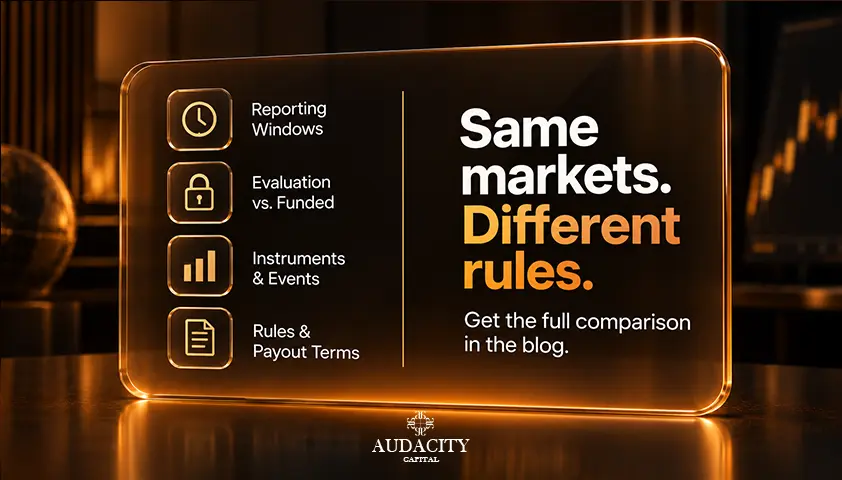
No two firms handle news the same way, and that inconsistency is exactly why reading the actual rulebook matters more than trusting a homepage claim. Most policies fall into one of four structures.
1. News Trading Fully Allowed
A handful of firms place no restrictions on news trading at all. Traders can open, adjust, and close positions straight through a release, taking on full exposure to live slippage and spread widening in exchange for complete freedom. This structure shows up more often on evaluation accounts than funded ones, and futures-focused firms tend to allow it more broadly than forex-focused firms do.
2. News Trading Allowed With Restrictions
This is the most common middle ground. A firm permits news trading in general but blocks specific actions around a release, typically a window of 2 to 10 minutes on either side of the event, during which opening a new position or placing a pending order isn't allowed. Some firms extend this to managing existing trades too, while others only restrict entries and leave adjustments untouched.
3. News Trading Restricted
On the stricter end, firms prohibit opening or closing trades entirely within a set window around major releases, usually on their standard account tier. Violating this can mean losing the profit earned during that window, or in some cases, a full account breach. This tier of restriction shows up most often on live funded accounts.
4. Holding Through News vs. Entering During News
This distinction trips up more traders than any other rule on this list. A position opened well before an announcement, often two or more hours ahead, is typically protected and can be held straight through the release without issue. A position opened close to that same release is a different story entirely. Audacity Capital sidesteps most of this complexity. News trading and weekend holding are allowed across all three of its funding routes, the Ability Challenge, Ability One and Instant Funding, so the timing question matters less there than it does at firms drawing a sharper line.
Before buying any challenge or funded account, checking exactly which of these four categories a firm actually falls into, and at which account stage, beats assuming every firm marketing itself among prop firms that allow news trading structures its rules the same way.
Which News Events Are Usually Covered by Prop Firm Rules?
Most firms build their news restrictions around a similar list of high-impact releases:
- Non-Farm Payrolls (NFP)
- CPI (Consumer Price Index)
- FOMC decisions
- Federal Reserve interest-rate announcements
- ECB decisions
- Bank of England decisions
- GDP releases
- Unemployment data
- Retail sales
- Central bank speeches
- Other high-impact economic releases flagged on an economic calendar
Not every firm restricts every event on this list, and not every event gets treated with the same severity. Some firms limit their rule to the biggest US releases alone, NFP and FOMC especially, while others extend it to any major central bank decision worldwide. Checking a firm's specific calendar of restricted events, without assuming it matches this general list exactly, avoids an unpleasant surprise right after a trade.
Is News Trading the Same as Overnight Trading?
No, and treating them as the same thing leads to real confusion. News trading covers positions taken around scheduled economic announcements, where the risk is liquidity gaps and slippage measured in seconds or minutes. Overnight trading covers positions held beyond the regular session close, where the risk shifts toward rollover swap fees and thinner liquidity during the Asian session.
A firm can combine these two rules in any direction:
- Allow news trading but prohibit overnight holding
- Allow overnight holding but restrict news trading
- Allow both
- Restrict both
Two firms can both claim to "allow news trading" and still land in completely different places once overnight holding enters the picture, which is exactly why each policy needs its own check.
Can You Hold News Trades Over the Weekend?
News trading and weekend holding are separate rules too, governed by separate risks. Weekend gaps come from unannounced geopolitical developments or surprise central bank comments landing while markets sit closed, a different exposure than the short volatility burst around a scheduled release.
Before assuming one policy covers the other, a trader should check:
- The firm's news trading policy
- Its overnight holding policy
- Its weekend holding policy specifically
- Any market-specific restrictions that apply on top of the general rules
None of these four automatically answer the others. A firm that allows news trading can still require you to close every position before Friday's close, so confirm directly.
What Should Traders Check Before Choosing a News Trading Prop Firm?
Finding prop firms for news traders takes more than a quick homepage scan. This checklist covers what actually decides whether a firm fits a news-based strategy.
1. News trading policy. Is it fully open, allowed with specific restrictions, or off-limits entirely? This single answer shapes everything else on the list.
2. Restricted news events. Does the firm publish a specific list of announcements it restricts, or does it apply a vague, catch-all rule that's hard to plan around?
3. Trading window. How many minutes before and after a release does the restriction actually run, if one exists at all? Two minutes and ten minutes are very different constraints.
4. Position management. Can a trader open, close, modify, and hold positions during a restricted window, or does the rule block some of those actions while allowing others?
5. Drawdown rules. Check the daily loss limit and maximum drawdown, and confirm whether each one is static or trailing. A trailing drawdown interacts with news volatility in ways a static one doesn't.
6. Platform. Confirm the firm's supported platforms, MT5, cTrader, or others, actually handle a news-based strategy's execution speed and order types.
7. Markets. Verify the firm covers the specific instruments a news strategy depends on, since not every firm supports the same range.
8. Payout rules. News trading access means little if payout conditions, minimum trading days, or profit-distribution rules quietly undercut it. Understanding the full account terms, not just the news policy, decides whether a firm actually works long-term.
Which Markets Are Popular for News Trading?
Four asset classes dominate news trading conversations, though none of them reacts to every release the same way.
- Forex: Major pairs move hardest around releases tied directly to their underlying currencies, especially interest rate decisions.
- Gold: Inflation data and shifts in real yields tend to move gold sharply, along with anything that changes safe-haven demand.
- Indices: Broad stock benchmarks react strongly to CPI prints, central bank decisions, and other releases that shift growth expectations.
- Commodities: Supply-focused data, weekly inventory reports for oil among them, can move commodity prices fast and hard.
The common thread: impact depends on the specific asset and the specific announcement, not some fixed hierarchy of "best" markets. USD data moves USD pairs most directly, US releases ripple into gold and indices too, and a central bank decision can shake an entire currency's worth of pairs at once. No single market wins across every release.
What Are the Risks of News Trading?
Being allowed to trade news isn't the same as trading it safely, and skipping this part of the conversation does readers a disservice.
Sudden price movements: A release can send price sharply in either direction within seconds, sometimes reversing just as fast right after.
Slippage: Execution prices can land well away from the intended entry once liquidity thins out during a fast move.
Wider spreads: Market conditions shift quickly around major releases, and a spread that normally sits tight can widen dramatically for a short stretch.
Drawdown breaches: One outsized move is sometimes enough to push a trader straight into a daily or maximum loss limit, especially on an account already close to its ceiling.
False breakouts: The first reaction to a release often reverses hard once the initial spike fades, trapping traders who chased the early move.
Over-leverage: Sizing up around a high-impact release multiplies every one of the risks above, turning a manageable move into an account-threatening one.
None of these risks disappear just because a firm permits the strategy. Prop firms that allow news trading during high-impact events are removing one obstacle, not guaranteeing a safe outcome. Traders still need to manage position size, leverage, and drawdown carefully, the same discipline that matters in any other market condition, just under faster, less forgiving circumstances.
Are Prop Firms With News Trading Allowed Better?
Not necessarily. Prop firms that allow news trading are more relevant for traders whose strategy actually depends on that flexibility, and plenty of profitable strategies never go near a scheduled release.
Traders who scalp momentum, trade news breakouts, or build macro-event strategies genuinely need a news-friendly firm, though that flexibility often comes paired with tighter drawdown limits, lower leverage, or stricter consistency requirements. Traders running technical swing setups or systematic day trading away from major releases may find less value in that same flexibility, and news-restricted firms sometimes offer real advantages in exchange: lower evaluation fees, higher scaling ceilings, or looser static drawdown terms among them.
The better question isn't which policy wins outright; it's which one actually matches the strategy already being traded.
For Example: Audacity Capital
Audacity Capital is a clean example of how far a prop firm's news flexibility can actually extend across an entire program lineup.
News trading and weekend holding are allowed on all three of its funding routes, the two-step Ability Challenge, the single-phase Ability One, and the Instant Funding program alike. None of that removes the underlying risk structure. Each route runs on a static daily loss and maximum drawdown limit, a fixed number instead of a floor that creeps up as an account earns, and managing size sensibly around a high-impact release still matters even where the rules explicitly allow the trade.
Anyone choosing between the three routes should still compare drawdown percentages and profit share directly, since those numbers differ by program even where the news policy itself doesn't.
How to Choose a Prop Firm That Allows News Trading?
A structured process beats guessing when so much rides on the details. Here's a practical sequence to work through.
Step 1: Check the news policy - Get a precise answer on what's actually allowed, fully open, allowed within limits, or off the table entirely.
Step 2: Check restricted events - Look specifically for how a firm treats NFP, CPI, FOMC, and central bank announcements, since coverage rarely matches across firms exactly.
Step 3: Check position rules - Confirm whether a trade can be opened, closed, or held during a news window, since some firms separate these permissions instead of treating them as one rule.
Step 4: Compare risk rules - Review the daily loss and maximum drawdown limits side by side, paying close attention to whether either one runs static or trailing.
Step 5: Check overnight and weekend rules - These matter most for any news strategy that runs longer than a single session.
Step 6: Compare payout and profit-split terms - A firm shouldn't be judged on its news policy alone. Payout frequency, minimum trading days, and profit split all shape whether the program pays out well over time.
Step 7: Choose the program that matches the strategy - The right answer depends entirely on how a trader actually trades, not on which firm ranks highest in a generic comparison.
Running through all seven steps takes a few extra minutes. Skipping one tends to cost a lot more than that later.
Recommended Comparison Criteria
A side-by-side comparison works best when it's built around the factors that actually decide outcomes, not just the ones easiest to market.
Factor | Why It Matters |
News trading | Determines whether the strategy is permitted at all |
Major news restrictions | Shows which specific events get excluded |
Pre/post-news window | Defines the buffer that matters most for event-based strategies |
Overnight holding | Relevant for any trade that runs past a single session |
Important for swing and news traders carrying positions further out | |
Daily loss limit | Controls how much risk a single day can absorb |
Maximum drawdown | Sets the overall boundary on account risk |
Profit split | Affects how much of the actual earnings reach the trader |
Shapes execution quality and available tools | |
Markets | Confirms whether the required instruments are even supported |
Account sizes | Helps match capital access to a trader's actual needs |
Payout rules | Matters most once a trader is already profitable and wants results. |
Treated together, these twelve factors give a far more honest picture than checking news policy in isolation ever could.
FAQs
These are proprietary trading firms that let traders open, adjust, or hold positions around major economic releases, without treating every announcement as an automatic account violation. Some firms open this up completely. Others allow it but only under specific conditions, which is honestly the more common setup once you dig into the fine print.
Often, yes, though the exact terms depend on which firm and which account you're looking at. Some firms want a trade already open before the release instead of a fresh entry right as the numbers drop, and a few enforce a tight window on either side where new orders simply won't go through.
Usually. Most firms that allow news trading in general extend that to CPI specifically, since it's one of the bigger monthly releases. Still check if your particular account tier applies an execution buffer or any profit-deduction rule around the print itself.
Many do, but FOMC deserves extra caution regardless of the firm's policy. Spreads can widen dramatically the moment the statement drops, so even a firm with a relaxed news policy still leaves a market moving fast enough to catch a trader off guard.
On plenty of them, yes, though the rules frequently shift once an account moves from evaluation to fully live. It's genuinely common for a firm to relax the news rule during the challenge stage and tighten it considerably the moment real capital is on the line.
There isn't one single answer here, and anyone claiming otherwise is oversimplifying. It comes down to what a trader actually needs: fully unrestricted execution suits one type of strategy, an instant funding model suits another, and a higher profit split matters more to someone else entirely. The right pick depends on matching a firm's actual terms to the strategy in question.
Yes, and that's true regardless of whether the firm technically allows it. Slippage, sudden spread widening, and fast reversals don't disappear just because a rule permits the trade.
Frequently, yes. A lot of firms apply a window, commonly somewhere between 2 and 10 minutes before and after a high-impact release, where new orders or adjustments simply aren't accepted. That window, along with everything else on the comparison list- daily loss limits, drawdown type, payout terms- is exactly the kind of detail you should check directly.

Pronto ad applicare un rischio disciplinato alle criptovalute? Esplora i nuovi strumenti crypto di Audacity Capital e porta la tua strategia di trading.
Scopri di PiùNewsletter
Iscriviti alla newsletter per restare aggiornato.
Unisciti Alla Nostra Community Social

Inizia Il Tuo Viaggio Oggi Con La Nostra Prova Gratuita
Mostra con orgoglio le tue abilità e i tuoi risultati attraverso certificati e ottieni riconoscimenti per il tuo duro lavoro e dedizione da potenziali investitori e colleghi.
Prova GratuitaArticoli Correlati
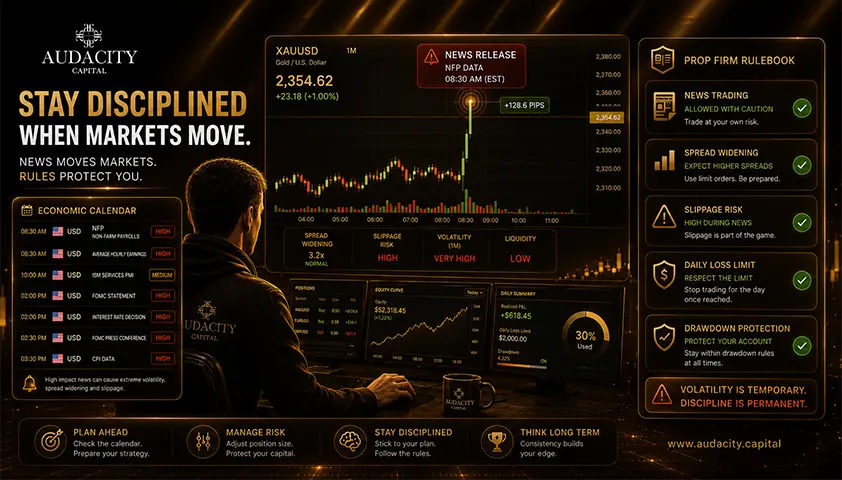
News Trading on Prop Firms: Rules, Risks and Strategy
A clear, honest guide to news trading on a prop firm: the rule models, the real slippage risks, and a responsible strategy. Learn what firms allow and how to trade news without breaching your limits.


10 Best News Trading Strategies in 2026
Discover 10 proven news trading strategies for Forex and financial markets. Learn how to trade major economic releases with confidence, discipline, and risk management.