


7 Best Paper Trading Simulators for 2026


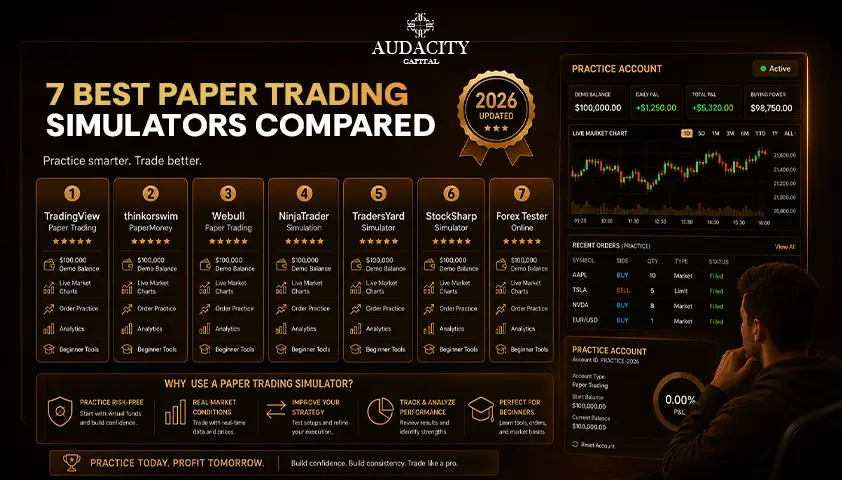
A paper trading simulator lets you practice buying and selling with virtual money and no real risk, which makes it the smartest place to start or to test a new strategy before real capital is on the line.
This guide covers the best paper trading simulators for 2026, how to choose one, and, honestly, where paper trading stops being enough.
Simulators are excellent for learning, but they cannot replicate the psychology of real trading. Consistent paper results do not guarantee real results, and most retail traders still lose money. Treat a simulator as a starting point, not proof you are ready. We will cover why to use one, what to look for, the best options, the limits, and the next step.
What is Paper Trading?
Paper trading is placing simulated trades with virtual money, using live or near-live market data, so you can practice without risking real capital. The name comes from the old habit of tracking hypothetical trades on paper, and the practice has been part of trading education for decades.
Modern tools have moved far beyond a notepad. Today's simulators add realistic order fills, charting, analytics, backtesting (testing a strategy against historical data to see how it would have performed), and even market replay, which lets you play back a past trading session bar by bar as if it were happening live.
There is one useful connection worth making early.
Paper trading is essentially the same idea as a forex demo account. Paper trading is just the more common term for stock and multi-asset simulators, while "demo account" is the standard label in the forex world.
The rest of this article covers why to use a simulator, how to choose, the best options for 2026, and the honest limits you need to understand.
Why Use a Paper Trading Simulator?
The core benefit is simple: everything you do is risk-free. Here is where that time pays off.
1. Learning the basics.
A simulator is a safe place to understand how orders, markets, spreads, and platforms actually work before real money is involved.
2. Mastering a platform's interface.
Every platform has its own layout and quirks. Practicing first means you are not learning the buttons while a live position moves against you.
3. Testing and refining strategies.
You can trial ideas, and on simulators that support it, run backtesting or replay past sessions to see how an approach behaves across different conditions.
4. Building confidence and routine.
Repetition without financial pressure helps you develop a consistent process, which is the foundation of disciplined trading.
Because all of this happens without any financial risk, time spent in a simulator is one of the smartest investments a developing trader can make before risking real capital.
The Best Paper Trading Simulators for 2026
Below are strong options for 2026, each with what it is best for, its standout features, and an honest limitation.
One important note before you commit to any of them: features, virtual balances, asset coverage, and pricing change often and vary by region. Verify the current terms on each platform's own site before signing up.
Option | Best for | Assets | Virtual balance | Standout | Cost |
Audacity Capital Free Trial | Testing a real prop-firm environment | Forex, CFDs | Selectable up to $200k (simulated) | No card or ID, no fixed expiry | Free |
Thinkorswim paperMoney | Best overall | Stocks, options, futures | Large simulated balance | Professional-grade realism | Free |
TradingView | All-in-one practice + backtesting | Stocks, forex | $100,000 | Paper trading, backtesting, replay | Free tier + paid |
Webull | Mobile and beginners | Stocks, ETFs, options, futures | Resettable virtual cash | Clean mobile experience | Free |
Interactive Brokers | Professional multi-asset | Global markets, futures, forex | Simulated balance | Pro tools, market breadth | Free |
Investopedia Simulator | Free educational | Stocks | Contest-style balance | Genuinely beginner-focused | Free |
Moomoo | Depth and market access | Stocks, options | ~$1 million | Deep analysis tools | Free |
TradeStation | Automation and backtesting | Stocks, options, futures | Simulated balance | Scriptable strategy testing | Free tier |
1. Audacity Capital Free Trial - Best for testing a real trading environment risk-free
Audacity Capital is a proprietary trading firm and their product Prop Firm Free Trial serves a similar purpose to paper trading. It is an open-ended simulated sandbox that lets you test the platform, servers, features, and rules risk-free before committing to anything.
The standout advantages are the low friction. You get a free, trader-sized simulated account that you size yourself at signup, with tiers up to $200,000, on both MT5 and DXTrade.
There is no fixed expiry, so it stays open as long as you keep using it, and signup takes just a name and email. No credit card, no ID.
The trial covers forex and CFDs, and when you are ready there is a clear upgrade path to Audacity's paid programs: the Ability Challenge, Ability One, and the Funded Trader Program.
What makes it different from a standalone practice chart is that you are testing a genuine trading environment, including real servers, execution, the platform, and the rule set, rather than an isolated simulation.
2. Thinkorswim paperMoney - Best overall
Thinkorswim paperMoney, from Charles Schwab, is full-featured, realistic paper trading with real-time market data, advanced charting, and support for options and futures, all free. That combination is why it is frequently ranked the best overall simulator.
Standout: professional-grade realism at no cost.
Point to note: the sheer depth can overwhelm a complete beginner. Verify current access terms, as availability can depend on your account setup.
3. TradingView - Best all-in-one (paper trading, backtesting, replay)
TradingView builds paper trading directly into its charts, with a $100,000 simulated balance, multi-asset practice across stocks and forex, Pine Script strategies, backtesting, and market replay, all backed by a large community. TradingView paper trading is popular precisely because everything lives in one place.
Standout: paper trading, backtesting, and replay together in one chart-centric platform.
Point to note: the most advanced features sit behind paid tiers, so verify what is available for free.
4. Webull - Best for mobile and beginners
Webull is a clean, mobile-first simulator that closely mirrors its live app, with stocks, ETFs, options, and futures, plus unlimited virtual cash resets.
Standout: a seamless, beginner-friendly mobile experience.
Point to note: there is no forex, and its community leaderboard can encourage excessive risk-taking that does not reflect sustainable, disciplined trading.
5. Interactive Brokers - Best professional/multi-asset
Interactive Brokers offers one of the most comprehensive, professional-grade paper accounts available, covering global markets, futures, and forex with advanced execution tools.
Standout: the breadth of markets and genuine pro-level tooling.
Point to note: the TWS platform is complex and can overwhelm beginners. It works best as a second simulator once you already know what you are doing.
6. Investopedia Simulator - Best free educational
The Investopedia Simulator is a free, beginner-friendly, contest-style stock market simulator designed around learning the fundamentals.
Standout: simple, approachable, and genuinely educational.
Point to note: it is more of a learning tool than a professional trading environment. Verify its current features before relying on it for detailed strategy work.
7. Moomoo and TradeStation - Best for depth and automation
Moomoo provides around $1 million in virtual funds, pre-market and post-market access, and powerful visual analysis tools. TradeStation offers a simulator built for automation, with customizable scripts and historical data for building and backtesting strategies.
Standout: Moomoo for depth and market access, TradeStation for automation and strategy testing.
Point to note: both are more powerful than most beginners need. Verify current terms and access for each.
Context on CFD and forex demos: if forex is your main interest, the MetaTrader 4 and 5 demo accounts are the industry standard, and platforms like eToro Demo and Plus500's demo are also widely used.
One reality worth remembering with leveraged CFD trading: a large share of retail accounts lose money, commonly cited as around 82%. A demo account does not change that underlying risk once you go live.
What to Look for in a Paper Trading Simulator
The best simulator for you depends on your goals and style, but the following criteria matter most.
1. Realism.
Look for real-time or near-real-time market data and realistic order fills. The closer the simulation is to live conditions, the better your practice transfers.
2. Asset coverage.
Make sure the platform supports what you actually want to trade, whether that is stocks, ETFs, options, futures, or forex.
3. The tools that matter.
If charting, backtesting, or market replay are important to your approach, confirm the platform offers them.
4. Ease of use.
Some professional platforms are powerful but complex. Match the tool to your experience level so you spend time learning to trade, not fighting the software.
5. Does it mirror your live platform?
If a simulator matches the platform you plan to trade on for real, the skills carry over directly.
6. Free versus paid.
Many strong simulators are free, while others gate advanced features behind paid tiers. Decide what you actually need.
The Limits of Paper Trading
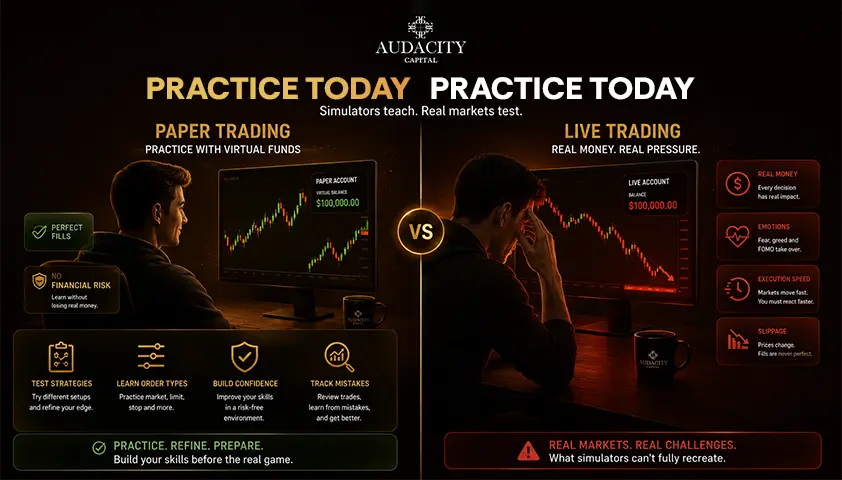
This is the part most roundups skip, so we will not soften it. Paper trading is genuinely useful, but it has a hard ceiling.
1. It does not replicate real trading psychology.
With no real money at stake, you do not feel the fear, greed, and pressure that cause real mistakes. Most people trade more boldly and, oddly, more calmly on a simulator than they ever would with their own capital, which is why paper results are frequently better than live ones.
Managing your own emotions is the hardest skill in trading, and a simulator cannot rehearse it. Our guide on Trading Psychology for Funded Traders goes deeper on this gap.
2. Unrealistic risk-taking.
Unlimited virtual cash and public leaderboards can reward behavior that would be reckless with real capital. Blowing up a simulated balance costs you nothing, so the incentives are wrong.
3. Too-favorable order fills.
Simulated fills can be cleaner than reality. Live markets involve slippage and liquidity constraints that a simulator often smooths over.
4. No stakes and no capital.
Paper trading earns you nothing and gives you no access to real capital. It is pure practice.
The takeaway is straightforward. Consistent paper results are a good sign and worth building toward, but they do not guarantee real success.
The hardest part of trading, managing yourself under real consequences, only shows up when there is something genuinely on the line. That is the core of the paper trading vs live trading gap.
Conclusion
In the end, stay honest with yourself about what a simulator can and cannot do. Paper trading is the smart place to start and to test strategies, but it does not replicate real psychology, its order fills can be too favorable, and it earns you nothing. Consistent paper results do not guarantee real results.
So what is the next step once you are trading consistently?
Practice with real consequences. Our free competition offers risk-free practice for a real prize, and our simulated funded accounts add real trading rules and real payout potential.
Related Articles
Best Free Paper Futures Trading Platforms
Frequently Asked Questions
Yes. For learning a platform and testing strategies risk-free, it is very useful. It has a ceiling, though, because it does not replicate the emotions of real trading, so treat it as a starting point rather than proof you are ready to trade live.
Because with no real money at stake, you do not feel the fear and greed that drive real decisions. Traders often take bolder, less disciplined trades on a simulator than they would, or should, with real capital, which inflates simulated performance.
They are essentially the same idea: simulated trading with virtual money that mirrors live conditions without financial risk. "Paper trading" is the more common term for stock simulators, while "demo account" is the usual term in forex.
There is no fixed rule. Many traders practice until they can follow a plan and manage risk consistently over a meaningful sample of trades, then transition gradually. Remember that live psychology is a separate hurdle you only clear with real stakes.
Most use live or near-live data to mirror real conditions, though some carry slight delays. Order fills can also be more favorable than in real markets, where slippage and liquidity affect how and when your orders actually execute.
No. Paper trading uses virtual money, so there is nothing to win or lose. Its value is skill-building. If you want real stakes, a funded-account route offers practice with real rules and real payout potential, though evaluations involve a fee and most traders do not pass.
Yes. Thinkorswim's paperMoney is free to use and offers full-featured paper trading with real-time data, which is part of why it is frequently ranked among the best simulators available.
It cannot teach you how you will handle real emotional pressure, and it cannot fully reproduce the effects of real slippage and liquidity. That is why consistent paper results do not guarantee the same outcome once real money and real consequences are involved.

暗号資産に規律あるリスクを適用する準備はできていますか?Audacity Capitalの新しい暗号資産商品を探索し、あなたの取引戦略を持ち込んでください。
詳細を見るニュースレター
ニュースレターに登録して最新情報を入手。
ソーシャルコミュニティに参加

関連記事

Paper Trading vs Live Trading: What's the Difference?
Paper trading vs live trading: Compare execution, psychology, risk, and performance to decide when you're ready to trade with real money.

What Is Paper Trading
What is paper trading? Learn how simulated trading works, what you can practice, its benefits, limits, and when to move to live trading.