



8 Best Forex Prop Trading Firms For Beginners in 2027



Forex prop trading firms give you a way to trade within a structured programme without having to put up the full amount of trading capital yourself. You normally pay an evaluation fee, follow a set of trading rules and meet specific objectives before becoming eligible for the firm's funded or reward structure.
For a beginner, the biggest account is not necessarily the best choice. You need to look at the drawdown rules, what you pay before reaching a payout and whether the firm's trading conditions actually suit your strategy. This comparison focuses on those points to help beginners worldwide make a more informed choice.
What Is a Forex Prop Trading Firm and How Does It Work?
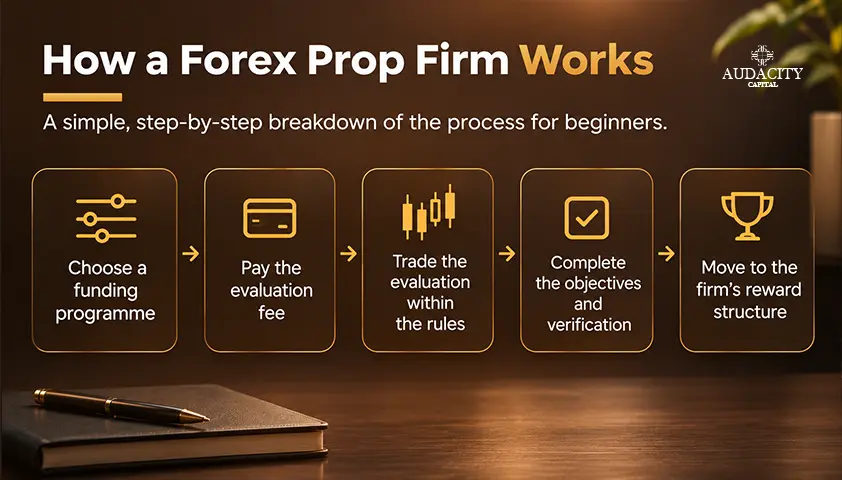
ou get a large account and the freedom to trade however you want – no, that's not how a forex prop trading firm operates. You enter a programme with its own objectives, loss limits and trading conditions. In most cases, you pay for an evaluation, trade within those conditions and try to reach the required target without breaching the firm's risk rules.
What happens after that depends on the firm. You may have to complete another evaluation stage before moving forward, or you may enter a reward-based account once the firm's checks are complete. This is where the terminology can become confusing. An account described as "funded" doesn't necessarily mean you can trade the firm's own money in a live market.
If you are a beginner, here is a simple breakdown of what actually happens:
- You choose a funding programme according to your trading style.
- You pay the evaluation fee and check exactly what the rules allow.
- You trade through the evaluation without breaching the firm's loss limits.
- You complete the required objectives and any verification stage.
- You move to the firm's reward structure if you meet its conditions.
Before joining, traders should also check whether the firm accepts clients from their country. Review the payment methods, applicable fees, withdrawal options and any regional restrictions. A firm's international presence or acceptance of traders from multiple countries does not automatically mean it is regulated in every jurisdiction.
Read more about our guide Forex trading for beginners
What Should Beginners Know Before Choosing a Forex Prop Firm?
The first question you should ask is not, "Which prop firm gives me the biggest account?" It is, "Which firm's rules give my trading style enough room to operate without creating unnecessary ways to breach?"
That difference matters because the account size is only one part of the arrangement. Before comparing the best forex prop trading firms, you need to understand how the firm treats your risk and what happens when you start making money.
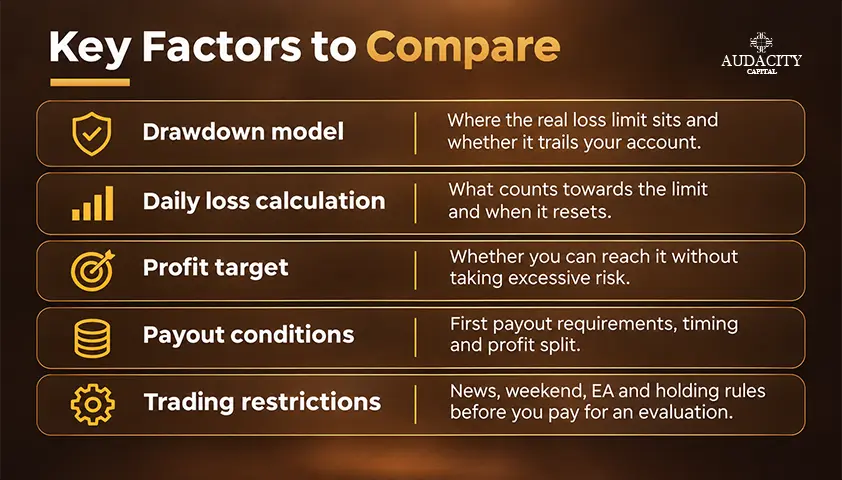
Start with five areas:
- Drawdown model: Find out where the real loss limit sits and whether it trails your account.
- Daily loss calculation: Check what counts towards the limit and when the figure resets.
- Profit target: Ask whether you can reach it without taking more risk than your normal strategy allows.
- Payout conditions: Check the first payout requirements, timing and profit split.
- Trading restrictions: Look at news, weekend, EA and holding rules before you pay for an evaluation.
These points give us a much better basis for ranking firms than the size of the advertised account alone.
Our Top 8 Forex Prop Trading Firms
There is no single firm that will suit every trader. A strategy that works comfortably under one drawdown model may become difficult to manage under another, so the ranking below starts with the rules rather than the advertised account size.
Our forex prop trading firms shortlist is:
- Audacity Capital: Best overall option for beginners
- FTMO: Best for established rules and platform choice
- The Funded Trader: Best for comparing evaluation formats
- FundingPips: Best for flexible programme options
- TradeDay: Best as a futures-focused alternative
- The5ers: Best for alternative funding structures
- FundedNext: Best for broad programme choice
- DayTraders: Best for traders considering futures funding
For traders worldwide, we also consider programme availability, pricing, payment considerations and the firm's published terms before making the comparison.
How We Ranked These Forex Prop Trading Firms?
The easiest way to rank the best forex prop trading firms is to look at the account size, profit split and entry price. But we don't think that tells a beginner enough.
What matters is what happens after you start trading. A $100,000 or $200,000 account can become difficult to use if the drawdown moves with your equity, the daily loss limit resets at an inconvenient time or a consistency rule changes how you need to trade. The same applies to a cheap evaluation. A low fee means very little if you keep paying it after failed attempts.
That is why our ranking gives more weight to the rules than the headline offer.
Criterion | Suggested weight |
|---|---|
Drawdown clarity and risk mechanics | 25% |
Rule transparency | 20% |
Total cost to first payout | 15% |
Profit target realism | 15% |
Payout terms | 10% |
Trading flexibility | 10% |
Platform and asset availability | 5% |
These weights are a working framework and can be adjusted once the current terms for every programme have been checked.
We also leave several popular marketing measures out of the calculation. Advertised pass rates are one of them. The problem is not that every published figure is necessarily wrong. It is that firms can count different things over different periods, making a direct comparison difficult. Many firms publish no pass rate at all, while those that do may use their own definitions.
The same principle applies to affiliate claims, social media popularity and the cheapest challenge fee. None tells you enough about the actual trading conditions.
Instead, we check the details that can affect your account directly, including the drawdown formula, daily reset, floating P&L, consistency requirements, prohibited strategies, payout conditions and the cost of getting through the programme.
That also explains why cheap challenges and reset fees are not treated as an advantage on their own. The question is not how little you pay to start. It is how much you may have to spend before you reach a payout.
Editorial Note: Our scores reflect published terms, not a promise of trading performance. Rules, pricing and payout conditions can change, so we verify the programmes before publication and note the date of the comparison.
Best Forex Prop Trading Firms for Beginners
If you are comparing forex prop trading firms, the account size is an easy place to start, but it is not the part that tells you whether a programme will actually suit you. The drawdown, trading rules and route to a payout matter much more once you start putting the account through its paces.
So, rather than ranking firms by the biggest account or the highest advertised profit share, we have looked at what the programme actually asks you to do.
Rank | Firm | Why it made the list | What to check first |
|---|---|---|---|
1 | Audacity Capital | Several funding routes and static drawdown on Ability | Which programme fits your risk style |
2 | FTMO | Clear evaluation structure and platform choice | The rules change between account types |
3 | The Funded Trader | Several evaluation formats | The conditions differ by programme |
4 | FundingPips | Broad choice of programmes | Compare the rules, not just the profit split |
5 | TradeDay | Straightforward futures evaluation | It is built around futures, not spot forex |
6 | The5ers | Different routes into funding | Drawdown rules vary between programmes |
7 | FundedNext | Several ways to approach an evaluation | Check the exact programme before comparing rewards |
8 | DayTraders | Several futures funding routes | It is futures-focused, not conventional forex |
1. Audacity Capital
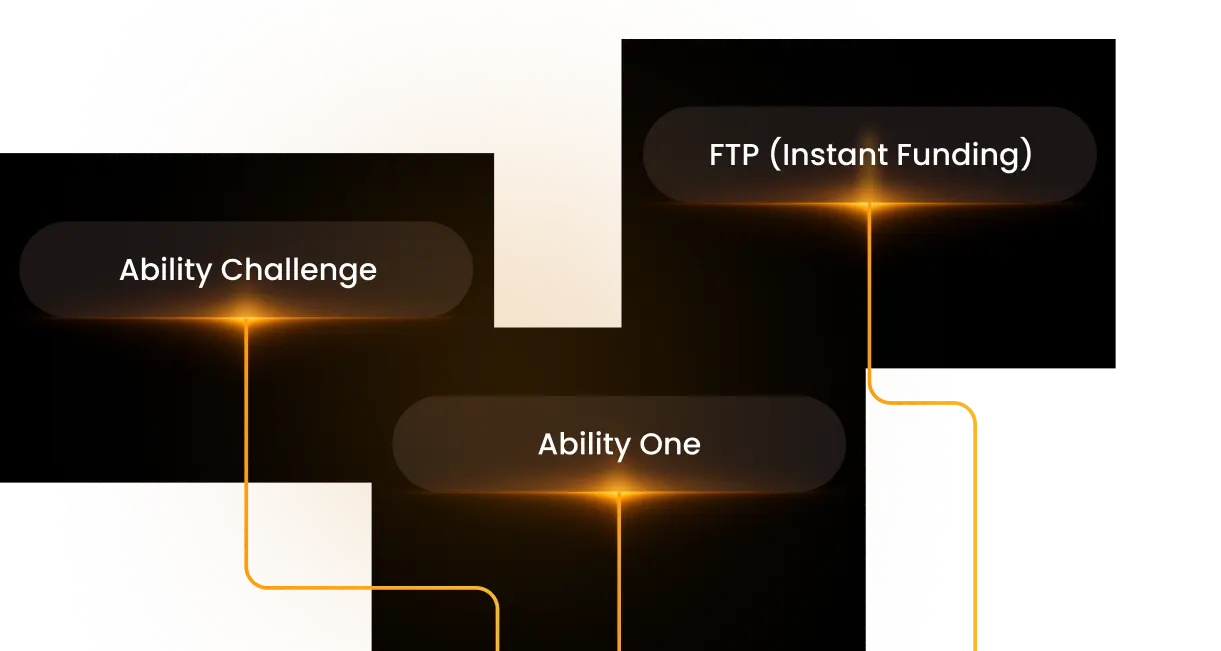
Audacity Capital gets the top spot because its programmes give beginners some room to choose how they want to enter prop trading. You can take the two-step Ability Challenge, the one-step Ability One route, or look at FTP (Instant Funding) if you do not want the standard evaluation process.
The Ability Challenge is particularly interesting for a beginner because the drawdown is static. Phase 1 has a 10% profit target, 7.5% daily drawdown and 15% maximum drawdown. Verification moves to a 5% target, 5% daily drawdown and 10% maximum drawdown. Both phases have no time limit and require four trading days.
That structure is easier to understand than a drawdown that keeps moving with the account. Audacity also has no consistency rule on its Ability programmes, so one strong trading day does not automatically create another hurdle that you have to work around.
The firm supports forex, alongside other markets, through MT5 and DXtrade. The maximum starting Ability account is $200,000, with a published scaling route beyond $2 million.
Before joining, check the programme's current availability in your country, payment terms and pricing. Also, make sure you understand the specific rules attached to the funding route you choose.
Why it's great for beginners: You can choose a route that fits your trading style instead of changing your trading simply to fit the evaluation.
2. FTMO
FTMO is a good fit for traders who want a clearly documented evaluation rather than having to work out the rules from scattered information. Its current 2-Step Challenge uses a 10% Phase 1 target, 5% Verification target, 5% maximum daily loss and 10% maximum loss. You also need at least four trading days in each phase, while the overall trading period is unlimited.
It also gives traders a choice of MT4, MT5, cTrader and DXtrade.
Why it's great for beginners: The structure is easy to follow, which leaves less room for confusion before you start the evaluation.
3. The Funded Trader
The Funded Trader takes a more varied approach, with several programme formats rather than one standard evaluation. That can work well if you already know what type of trading structure suits you, but it also means you need to read the rules for the specific programme rather than relying on the firm's headline offer.
The available models include different targets, drawdown structures and payout conditions, so the account name matters here.
Why it's great for beginners: There is more than one route to compare, which can be useful if the standard two-step model does not suit the way you trade.
4. FundingPips
FundingPips gives traders several evaluation routes, so the appeal is mainly in the choice. Its programmes differ in areas such as profit targets, drawdown limits, minimum trading days and payout structures. That makes it useful for comparison, but it also means the cheapest or highest-paying option is not automatically the best one.
The firm supports platforms including MT5, cTrader and Match-Trader.
Why it's great for beginners: You have more scope to find a programme that fits your trading approach, as long as you take the time to compare the rules.
5. TradeDay
TradeDay needs a slightly different explanation because it is built around exchange-traded futures rather than conventional forex trading. Its current programmes are designed for futures traders, with routes using intraday or end-of-day trailing drawdown models. TradeDay also supports platforms including Tradovate, NinjaTrader, TradingView and Jigsaw.
The main point for a beginner is that the risk model works differently from most forex-focused prop firms. You need to understand how the trailing drawdown is calculated before choosing an account.
Why it's great for beginners: It makes sense if you specifically want to trade futures. If your aim is conventional forex trading, however, TradeDay is not a like-for-like alternative to the other firms on this list.
6. The5ers
The5ers gives traders several ways into its funding programmes, including High Stakes, Hyper Growth and Bootcamp. The important point is that the risk rules change between these routes, so choosing the firm is only half the decision. You also need to choose the right programme within it.
High Stakes, for example, uses a static maximum loss and a separate daily loss rule, while other programmes use different structures.
Why it's great for beginners: The different routes give you some control over the type of evaluation you want to take rather than forcing one model on every trader.
7. FundedNext
FundedNext gives you several ways to approach its evaluation, but the Stellar 2-Step is the one worth looking at first if you want a conventional two-phase route. The current structure uses 8% and 5% profit targets, a 5% daily loss limit and a 10% maximum loss, with five minimum trading days in each phase.
News trading and weekend holding are also permitted on this programme, which removes two restrictions that can otherwise interfere with a trading strategy.
Why it's great for beginners: You get a fairly straightforward two-phase structure without having to avoid news or weekend positions on the Stellar 2-Step.
8. DayTraders
DayTraders is another futures-focused firm, with programmes built around CME, CBOT, COMEX and NYMEX markets rather than conventional forex trading. Its different account routes use trailing, end-of-day or static drawdown, depending on the programme.
The firm also offers Pro, Straight to Funded and Straight to Live structures, so the payout arrangement changes with the route you choose.
Why it's great for beginners: It gives futures traders several risk structures to compare, which is useful if you already know that futures are the market you want to trade.
How Do You Choose the Best Forex Prop Trading Firm as a Beginner?
As a beginner, choosing the best forex prop trading firms is obviously confusing. Firms that have the largest account or the most attractive profit split are surely attractive. But it is still better to ask whether the firm's rules leave enough room for how you already trade.
- Pick according to your trading style: If you scalp, hold trades overnight, trade around economic releases or use an EA, the trading conditions matter before the account size does. A strategy that works well on one programme can become difficult to run on another because of its restrictions.
- Then look at drawdown: A 10% maximum loss sounds generous at first. Then you read how the firm calculates it, and it changes everything. Is it static or trailing? Do floating losses count? When does the daily limit reset? Find that out first. And never treat the full drawdown as your trading risk.
- Next, work out what the evaluation can really cost: The fee is only the starting point. Resets, another failed attempt, commissions, spreads and other charges can change the number considerably.
Before joining, go through the rules. News trading, weekend holding, overnight positions, EAs, copy trading, maximum positions, consistency. If several of those rules get in the way of your normal strategy, the cheaper challenge may not be the better choice.
Why Entry Fee Is the Wrong Number to Optimise
A beginner comparing prop firms can easily get stuck on the entry fee. A lower advertised price looks better than a higher one. The problem is that neither number tells you what it may cost to reach the first payout.
A more useful question is:
How much could this programme realistically cost me before I reach my first payout?
That means looking beyond the initial evaluation fee and considering:
- The cost of another attempt if the first one fails.
- Reset fees, where applicable.
- Commissions and spreads.
- Platform or data costs, if charged separately.
- Currency conversion and payment processing fees, where applicable.
- How long it takes for the account to become eligible for a payout.
If its rules lead to repeated failures, a cheap evaluation can become expensive. A higher entry fee at a forex prop trading firm can make more sense if the programme gives your strategy enough room to operate and its rules are easier to understand.
Starting Forex Prop Trading as a Beginner: Honest Pros and Cons
Prop trading can be a good structured way for a beginner to practise trading with defined risk limits. But the model needs proper understanding before you pay for an evaluation.
The potential advantages are fairly straightforward:
- You don't need to provide the full advertised account size as your own trading capital.
- Defined loss limits can encourage better risk discipline.
- Some firms provide access to larger simulated account sizes than a beginner might otherwise trade.
- Many programmes cover multiple markets.
- Evaluations help expose weaknesses in a trading plan.
- Once traders meet specific conditions, many firms offer scaling and profit-sharing arrangements.
However, there are disadvantages too:
- Evaluation fees can add up when a trader keeps failing and buying another attempt.
- Tight drawdown rules can also turn an otherwise normal losing period into a breach, particularly when the trader has not understood how the limit is calculated.
A $100,000 or $200,000 account does look like a lot of money, but it is not money you own. The account size shown on the screen is different from your personal capital, and that amount is not available for you to withdraw.
Before joining, traders should also check the firm's legal and regulatory information, eligibility requirements and terms applicable in their own jurisdiction. Do not assume that a firm's acceptance of international clients means it is authorised or regulated in every country.
7 Mistakes Beginners Should Avoid
A prop challenge can expose weaknesses in your trading that are easy to miss when you are only looking at whether the strategy makes money. The problem is that most of those weaknesses show up as rule breaches rather than obvious bad trades.
1. Thinking the Account Size Tells You How Much You Can Risk
A $100,000 account size does fool many into thinking it is their own trading capital. It is better to begin with the maximum drawdown. Then work backwards to decide how much risk your strategy can take on one position.
2. Increasing Risk Because the Target Looks Far Away
Some traders see a 10% target and decide they need to make money faster. That usually changes the strategy before it changes the account. Larger positions, marginal setups and revenge trades can push the account towards its loss limit much faster.
3. Not Understanding the Drawdown Calculation
First, learn what happens to the loss limit when the account makes money. Verify whether the limit is static or trailing, whether it is calculated using balance or equity, whether floating losses count, and when the daily calculation resets.
4. Changing a Strategy to Suit the Challenge
If your normal system produces a few good setups a week, there is no reason to turn it into a high-frequency strategy just because the evaluation is running.
5. Assuming Every Trading Method Is Permitted
Check the rules before using news strategies, EAs or copy trading because a profitable method is of little use if the programme does not permit it.
6. Treating the First Failed Attempt as a Reason to Buy Another Immediately
First, find the cause. Whether it was a drawdown breach, a rushed target, a misunderstood rule or a poor position, identifying the problem can help you decide your next step.
7. Comparing Firms Only by the Payout Percentage
A 90% reward split looks better than an 80% split at first glance, but it does not tell you the entire story. You also need to look at the route to the payout, the drawdown and the restrictions around the account. They matter just as much.


Prop Trading Challenges & Rules
Free Prop Firm ChallengeHow Many Trades Should a Beginner Take Each Day?
Well, no fixed number will suit every beginner trader. The right number depends on the strategy and the market conditions, not on the fact that you have an evaluation account open.
If your setup appears twice, two trades may be enough. But if there's nothing meeting your rules in the market, keeping it a no-trading day is valid.
Beginners who decide the number first and then find a reason to trade make the biggest mistake. Instead, before the trading session starts, define your setup and then take it once you see the required conditions are available. This also helps protect the account from unnecessary exposure to the firm's daily drawdown limit.
The aim is not to finish the day with a certain number of trades. It is to finish the day without taking trades that your strategy never asked for.
Do Beginners Need a Stop Loss on Every Trade?
Yes, using a stop loss is generally a sensible risk-management practice. Knowing the maximum loss you can handle can reduce the uncertainties of the market. But the stop should have a reason behind it.
If the strategy says the trade idea becomes invalid below a particular market structure, that area may make more sense than placing the stop at an arbitrary percentage simply because the account has a daily loss rule.
This distinction matters with prop firms because the firm's drawdown limit is already working in the background. A trader who lets losing positions run can use up that room surprisingly quickly, especially where floating losses are included in the calculation.
How Long Should a Beginner Practise Before Buying an Evaluation?
First, forget the calendar. There is no useful rule saying every beginner needs three months, six months or a year. Readiness matters more.
Second, check yourself. Before paying, you should be able to explain your strategy without changing the rules halfway through a losing streak, and have enough recorded trades to see how it behaves in both good and bad periods.
At a minimum, know:
- The setups you trade.
- How much you risk on each trade.
- Your maximum daily loss.
- When you stop trading for the day.
- How you record your results.
- How the firm's drawdown is calculated.
If losses make you raise risk or rewrite your system, you are not ready for another evaluation – you need more practice and better records.
What Happens If You Fail a Prop Firm Challenge?
When a trader fails a prop evaluation, the account is normally closed or otherwise treated as failed under the firm's rules. The trader does not usually become personally liable for the headline account balance simply because the programme displayed a $100,000 account size.
The more practical issue is the evaluation fee. If you decide to try again, you may have to pay for another attempt, depending on the firm's terms.
A failed challenge is information, not a reason to double the next position size.
Beginners should take away this part: if the same mistake caused the first failure, another evaluation will not make the underlying problem disappear.

DO You Want To Become A Prop Trader?
Trade Now With Audacity CapitalShould Beginners Choose a 1-Step or 2-Step Prop Firm?
A one-step evaluation requires traders to pass a single evaluation stage to qualify for a funded programme, while a two-step evaluation involves passing two separate stages. But two stages don't necessarily mean the programme is harder. What matters more than the number of stages are the targets, drawdown limits, trading period and other rules.
Comparison | 1-Step | 2-Step |
|---|---|---|
Evaluation stages | One | Two |
Main attraction | Fewer stages | More time to prove consistency |
What to compare | Target and drawdown | Both stages and their separate limits |
Beginner question | Can my strategy meet the target without rushing? | Can I trade the same way through both stages? |
The better option depends on your trading experience, risk management and ability to meet the programme's requirements. Always compare the complete rules rather than choosing based only on the number of evaluation stages.
What Should International Traders Check Before Choosing a Forex Prop Trading Firm?
If you are trading from anywhere in the world, the firm's headline price is not the only number worth checking.
- Regional availability: First, make sure the firm accepts traders from your country. Some firms may restrict registrations or specific payment methods in certain regions.
- Payment and currency conversion: Check the currency you will actually be charged in and whether your bank, card or payment provider will add conversion or processing fees.
- Regulatory information: Review the firm's legal entity, published terms and any regulatory information relevant to your jurisdiction. Do not assume that accepting international clients means the firm is regulated everywhere.
- Trading hours: Consider the trading sessions that suit your strategy. If you rely on the London session, New York session, Asian session or market overlaps, check whether the firm's trading conditions work around those hours.
- Payout access: Check the available withdrawal methods, processing times, minimum withdrawal requirements and any regional restrictions.
- Tax considerations: Do not assume that every trader worldwide will receive or report prop-firm rewards in exactly the same way. Your local tax rules may apply, so check the requirements in your jurisdiction.
These checks can help you avoid unexpected costs or restrictions after paying for an evaluation.
Are You Looking For A Funded Trader Program?
Funded Trader ProgramConclusion
Your choice for the best forex prop trading firm for beginners should not be based solely on the biggest account or the highest reward percentage. When you are just starting out, choose a programme whose drawdown, targets and trading restrictions make sense for the way you actually trade.
Audacity Capital ranks first in this comparison because its Ability Challenge currently combines an unlimited trading period with defined drawdown rules, no consistency requirement during the evaluation and flexibility around news and weekend positions.
However, the best choice ultimately depends on your trading strategy, experience, risk tolerance and the programme's availability in your country. Take the time to understand the rules before paying for an evaluation.
FAQs
While there are many forex prop trading firms worth considering, Audacity Capital ranks first in this comparison for beginners. It earns this position for the structure and flexibility of its current programmes, while FTMO, The5ers and the other firms may suit traders with different preferences.
Not automatically. A firm's regulatory status depends on its business model, legal entity and the jurisdictions in which it operates. Traders should review the firm's legal information and check the relevant regulator's official register where applicable.
There is no single answer that applies to every country. The rules can differ depending on the jurisdiction, the firm's business model and the type of arrangement offered. Traders should check the applicable local requirements and the firm's eligibility terms before joining.
They can, but there is no guaranteed income. A trader still has to pass the evaluation where applicable, stay within the firm's risk rules and satisfy the conditions attached to any payout. The evaluation fee should therefore be treated as money that can be lost.
Not necessarily. Some programmes use simulated trading environments during evaluation and funded stages, while others may have different arrangements for later allocations. The word "funded" should therefore not be treated as meaning that every programme gives the trader ownership of the headline account balance.
No. Some firms restrict registrations or access to particular programmes based on a trader's country of residence. Always check the firm's current restricted-country list and eligibility requirements before paying an evaluation fee.
A forex prop firm generally provides programmes for trading currency pairs, often through forex or CFD platforms. A futures prop firm focuses on exchange-traded futures contracts. The instruments, trading hours, contract specifications, platforms and risk rules can differ significantly, so the two types of firms are not always directly comparable.

Ready to apply disciplined risk to crypto? Explore Audacity Capital's new crypto instruments and bring your trading strategy.
Learn MoreNewsletter
Join our newsletter to stay up to date on features and releases.
Join Our Social & Community

Start Your Journey Today With Our Free Trial
Proudly showcase your skills and accomplishments through certificates and get recognition for your hard work and dedication from potential investors and peers.
Free TrialRelated Articles

From Demo To Live: When Are You Ready To Go Live?

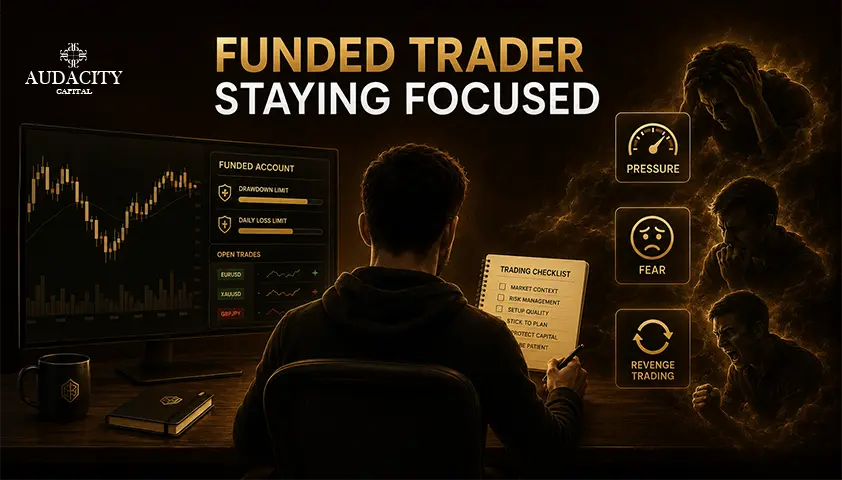
Trading Psychology for Funded Traders: Pressure, Fear and Revenge Trading
Struggling with pressure and tilt? Master trading psychology for funded traders with concrete systems to avoid revenge trading and stay disciplined.

10 Best Futures Prop Firms for Swing Trading In 2026
Compare the best futures prop firms for swing trading in 2026 with overnight holding, flexible rules, fast payouts, and funded accounts.

Introducing Ability One: One Step To Funding With Static Drawdown