


10 Best Leverage Trading Platforms in 2026


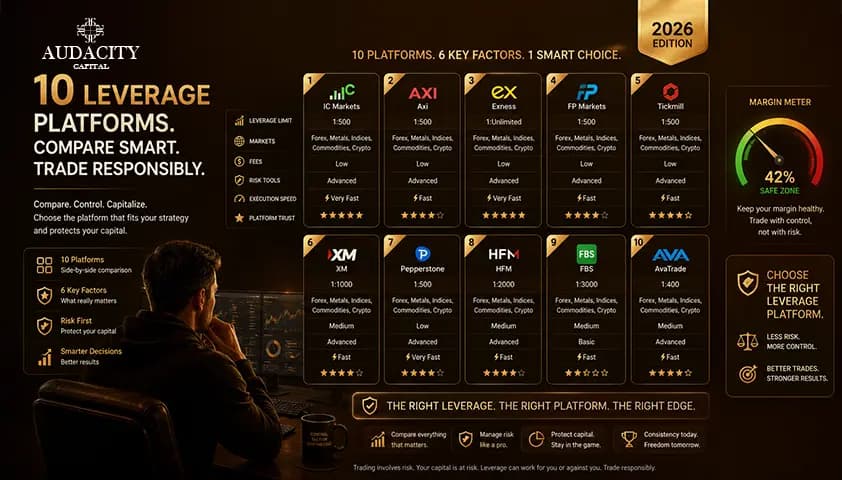
The best leverage trading platforms in 2026 are IG, CMC Markets, Pepperstone, Saxo, Interactive Brokers, FOREX.com, OANDA, eToro, Plus500 and XTB, though the order shifts by country, product and trading style.
Before you go further, correct one assumption: the platform advertising the highest ratio is not automatically the best. Regulation, the legal entity holding your account, execution quality, total costs, margin close-out rules and negative balance protection matter far more than a headline like 1:500.
This guide ranks regulated forex, CFD and exchange-traded margin platforms only. It does not rank crypto-only offshore exchanges or prop firms.
Leveraged products can produce rapid losses, a high proportion of retail CFD accounts lose money, and available products depend on your jurisdiction.
CFDs are not generally available to US retail traders. All platform facts were checked in 2026 but can change by entity.
The Best Leverage Trading Platforms in 2026 at a Glance
Here is the shortlist before any methodology, so you can compare the field quickly.
Platform | Best for | Product types | Platform options | Retail leverage framework | Demo account | Standout strength | Main limitation |
IG | Best overall | Forex, indices, commodities, shares, more via CFDs | Proprietary web/mobile, plus regional integrations | Up to the local retail cap, entity-dependent | Yes | Broad regulated coverage and mature platform | Breadth adds complexity |
CMC Markets | Best proprietary platform and market range | Wide CFD catalogue | Next Generation, mobile, regional third-party options | Entity-dependent | Yes | Feature-rich proprietary charting | Smaller range on MetaTrader accounts |
Pepperstone | Best platform choice and automation | Forex and CFDs | Proprietary, MT4, MT5, cTrader, TradingView | Entity-dependent, professional terms for eligible clients | Yes | Multi-platform and automation support | Feature parity varies across platforms |
Saxo | Best advanced multi-asset platform | Forex, CFDs, futures, options, stocks, ETFs, bonds | SaxoTrader web/mobile/desktop | Product-specific and tiered margin | Yes | Deep multi-asset access in one account | Excessive for simple forex-only needs |
Interactive Brokers | Best exchange-traded margin platform | Stocks, options, futures, forex, multi-asset | Trader Workstation, IBKR Desktop, web, mobile | Exchange or portfolio margin, not CFD-style | Yes | Global market access and margin models | Steeper learning curve |
FOREX.com | Best forex research and execution tools | Forex-first, CFDs internationally | Proprietary web/desktop, mobile, MetaTrader, TradingView | US forex rules or local CFD cap by entity | Yes | Forex research and tooling | US and international structures differ |
OANDA | Best forex-focused simplicity | Forex-first, some CFDs | OANDA Trade, TradingView, MetaTrader, API | US margin rules or local CFD cap by entity | Yes | Clean forex experience and charting | Narrower product range |
eToro | Best social and copy trading | Assets and CFDs by entity | Proprietary web/mobile | Entity-dependent, CFD availability varies | Yes | Social feed and CopyTrader | Less granular execution control |
Plus500 | Best simple proprietary CFD platform | CFDs, separate US futures | Proprietary web/desktop/mobile | Local entity cap, US futures separate | Yes | Straightforward single interface | No MetaTrader or cTrader |
XTB | Best education and xStation experience | CFDs, some investing products | xStation web/mobile | Local retail cap by entity | Yes | Education and integrated platform | Proprietary-only, limited automation |
Note: 30:1 is the common retail ceiling on major FX pairs under UK, EU and Australian CFD regimes. US leverage follows separate forex, futures and securities rules, so a single global maximum does not apply.
How We Ranked the Platforms
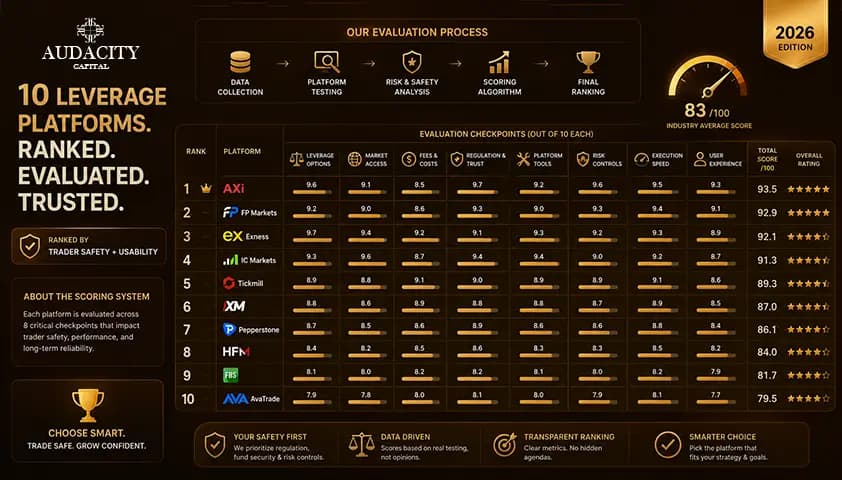
Maximum leverage is only one account term, and it receives no standalone reward in this ranking. A high ratio can add flexibility, but it can also remove the natural margin constraint that stops you opening an oversized position.
We scored each platform across six weighted factors:
- Regulation and entity clarity: 25%
- Platform quality and risk controls: 25%
- Total trading costs: 20%
- Market access: 15%
- Account access and support: 10%
- Transparency of margin terms: 5%
We excluded unregulated platforms, crypto-only derivatives exchanges, firms with unclear legal entities, platforms that hide financing or liquidation rules, and products unavailable to the intended audience.
It also helps to separate two things.
A platform review covers the order ticket, charting, stability, alerts, order types and margin visibility. A broker review covers the regulatory entity, execution, pricing, client-money handling and account terms.
Both matter, and both feed the scores above.
1. IG: Best Overall Leverage Trading Platform
Verdict: IG takes the overall position because it combines broad regulated coverage, a mature proprietary platform, extensive market access and clear margin information. It is the most balanced choice, not the one with the largest advertised ratio.
Best for: Traders who want one established platform for forex, indices, commodities, shares and other leveraged markets, with strong research and risk management built in.
Platform: The web and mobile platforms sit at the center of the experience.
By region, IG also offers specialist and third-party access such as MetaTrader 4, TradingView or ProRealTime. Availability differs by entity, so check what your specific account supports rather than assuming every integration is universal.
Leverage and margin: Retail leverage follows the rules of the entity holding the account. IG's product-details pages show how the margin requirement varies by asset class and exposure tier. Any professional or non-retail terms are separate from retail terms and should not be blended together.
Costs and tools: Expect spreads, share-CFD commissions where they apply, overnight financing, guaranteed stops in some regions, margin alerts, stop and limit orders, research and a demo account.
Main limitation: The sheer breadth of products and account types makes IG less simple than a single-purpose forex app. Pricing also varies by product and region, so compare the exact instruments you plan to trade.
2. CMC Markets: Best for Proprietary Platform and Market Range
Verdict: CMC Markets is the strongest option for traders who want a feature-rich proprietary web platform and a very broad CFD catalogue without depending entirely on MetaTrader.
Best for: Active multi-market CFD traders who value charting, pattern tools, watchlists, performance analytics and detailed order tickets.
Platform: The Next Generation platform, mobile app and regional third-party options such as TradingView, MT4 or MetaTrader 5 form the core. Some regions advertise more than 12,000 instruments, but verify the count for the specific entity you use.
Leverage and margin: Maximum retail leverage differs sharply across CMC entities. A global page may show a higher ratio than a UK, EU, Singapore or Australian retail account. Keep the legal entity beside every leverage figure you read.
Costs and tools: Look at standard versus active pricing, spread and commission structure, overnight holding costs, guaranteed stop-loss orders where available, margin display and demo access.
Main limitation: Some platform choices use separate account types, and the product range on MetaTrader can be much smaller than on the proprietary platform. Choose the account and the platform together.
3. Pepperstone: Best for Platform Choice and Automation
Verdict: Pepperstone suits traders who already know the interface they want and need a broker that supports several professional-grade third-party platforms.
Best for: Forex and CFD traders using MT4, MT5, cTrader, TradingView, Expert Advisors, custom indicators, automated strategies or VPS hosting.
Platform: Compare the proprietary Pepperstone platform against MT4, MT5, cTrader and TradingView. Instrument coverage and account compatibility can differ across them. TradingView may need a specific pricing account, and automation depends on the third-party platform you pick.
Leverage and margin: There is no single Pepperstone maximum for every reader. FCA, ASIC and EU regulated entities are separate from any entity offering higher ratios. Retail leverage caps and professional classification both shape the number you see.
Costs and tools: Weigh Standard versus Razor pricing, spreads, platform-specific commissions, overnight financing, execution disclosures, small trade sizes and demo access.
Main limitation: Platform choice is a strength that also adds complexity. Commissions, instruments and features are not identical across MT4, MT5, cTrader and TradingView.
4. Saxo: Best for Advanced Multi-Asset Trading
Verdict: Saxo is the best choice for experienced traders who want leveraged and non-leveraged products inside one advanced multi-asset account rather than a CFD-only interface.
Best for: Active traders using forex, CFDs, futures, options, stocks, ETFs, bonds and other products across multiple markets and currencies.
Platform: SaxoTrader runs on web, mobile and desktop, with advanced order types, multi-screen layouts, margin monitoring, account shield, alerts, market depth and portfolio reporting. The product range varies by residence.
Leverage and margin: CFD leverage, FX margin, futures margin, options risk and securities-backed lending are not the same thing, and Saxo does not compress them into one ratio. Margin is product-specific and sometimes tiered, rising as exposure grows.
Costs and tools: Review commissions, spreads, financing, market data subscriptions, currency conversion and the cost of holding a broad multi-currency portfolio.
Main limitation: The platform and product depth can overwhelm a beginner who only wants a few forex pairs. Data subscriptions and multi-product pricing need careful reading.
5. Interactive Brokers: Best for Global Margin Trading
Verdict: Interactive Brokers is the strongest choice for traders who want exchange-traded leverage and global market access rather than a conventional retail CFD trading platform experience.
Best for: Experienced traders using stock margin, options, futures, forex and multi-asset portfolios across global exchanges.
Platform: Trader Workstation, IBKR Desktop, web and mobile provide broad exchange access, advanced order types, portfolio analytics and risk management tools. Product and platform access differ by entity and account permissions.
Leverage and margin: There is no CFD-style ratio here. Interactive Brokers uses rules-based and risk-based margin, with initial versus maintenance margin, portfolio margin eligibility and exchange-set futures margin. Margin can change during volatility, and positions may be liquidated automatically if requirements are not met.
Costs and tools: Account for margin interest, commissions, market data, currency conversion and the difference between paying overnight CFD financing and borrowing cash in a margin trading account.
Main limitation: The interface, permissions and margin model carry a steeper learning curve. It is not the pick for someone who wants a simple high-leverage CFD app.
US note: This is one of the platforms that can serve US readers through regulated securities, futures and forex products, not retail CFDs.
6. FOREX.com: Best for Forex Research and Execution Tools
Verdict: FOREX.com is a strong forex-first choice for traders who want proprietary platforms, third-party options and integrated research from an established regulated group.
Best for: Currency traders who want web, desktop and mobile access, charting, research, market commentary and the option to use MetaTrader or TradingView where supported.
Platform: The proprietary web and desktop experience, mobile app, current MetaTrader versions and TradingView integration cover most needs. The US product set is separate from international CFD entities.
Leverage and margin: US forex leverage follows CFTC and NFA rules. International CFD leverage follows the reader's local entity. Do not apply a global maximum to a UK, EU, Australian or US reader.
Costs and tools: Look at standard and commission-based pricing where available, spreads, commissions, rollover, active-trader terms, research tools and demo access.
Main limitation: The strongest case is forex. Broader CFD range and platform integrations vary by region, and the account structure can look completely different between US and international sites.
7. OANDA: Best for Forex-Focused Simplicity
Verdict: OANDA fits traders who want a relatively clean forex-first experience with flexible platform access and strong charting.
Best for: Forex traders using a proprietary web or mobile platform, TradingView, MetaTrader or an API, depending on region.
Platform: The OANDA Trade interface, TradingView-powered charts, mobile app and current third-party platforms form the core. API access exists in some entities, so confirm it for your specific account.
Leverage and margin: US margin rates and forex rules are separate from UK, EU, Australian or global CFD leverage. Use the official margin schedule for the exact account rather than a group-wide statement.
Costs and tools: Consider spreads, core or commission pricing where offered, overnight financing, conversion, small position sizing, order execution through various order types, demo access and technical-analysis tools.
Main limitation: The product range is narrower than the largest multi-asset platforms, and platform options vary significantly across OANDA entities.
8. eToro: Best for Social and Copy Trading
Verdict: eToro makes the list for its integrated social interface and CopyTrader, not for maximum leverage or advanced execution.
Best for: Readers who want to view other investors, copy portfolios and manage leveraged and unleveraged assets from a simple web or mobile interface.
Platform: Note the distinction between buying an underlying asset and opening a leveraged CFD position. The same instrument can be structured differently depending on leverage, direction, residence and product availability.
Leverage and margin: Leverage levels and even CFD availability vary by entity. Copying another user does not remove leverage risk, and copied positions can include stop-loss changes, take-profit changes and closures beyond your control.
Costs and tools: Review spreads, overnight and weekend fees on CFDs, currency conversion, any withdrawal or inactivity charges, copy-trading minimums and demo access.
Main limitation: Execution control is less granular than on specialist active-trading platforms, and spreads can matter more than the absence of an explicit copy fee.
9. Plus500: Best for a Simple Proprietary CFD Platform
Verdict: Plus500 fits traders who want a straightforward proprietary interface with a clear order ticket and do not need MetaTrader, cTrader or extensive integrations.
Best for: Retail CFD traders who prioritise ease of navigation, mobile access and a single integrated platform.
Platform: The proprietary web, desktop and mobile experience covers instrument search, alerts, risk orders and a demo mode. The CFD entities are separate from the US futures platform and any share-dealing product.
Leverage and margin: Use the local entity's product pages and legal documents. The available ratio, negative balance protection and close-out rules differ between regulated CFD entities and US futures accounts.
Costs and tools: Account for spread-based pricing, overnight funding, currency conversion, inactivity charges, guaranteed-stop costs where offered and any instrument-specific fees.
Main limitation: No MetaTrader or cTrader, limited customisation for algorithmic traders, and limited portability if you later want a different execution interface.
10. XTB: Best for Platform Education and xStation
Verdict: XTB is a strong choice for traders who want the xStation platform, integrated education and a combined view of trading and investing products where available.
Best for: Newer and intermediate traders who prefer a proprietary web and mobile experience with market news, calendar, education and position management in one place.
Platform: xStation on desktop and mobile brings together charting, market search, news, education, order tickets and current investing features. XTB has moved away from MT4 for current accounts in some regions, so verify this by entity.
Leverage and margin: Use local retail caps and the instrument specification table. Do not infer leverage from an older MT4 account or a different XTB entity.
Costs and tools: Weigh spreads and commissions, overnight swaps, share-CFD commissions where they apply, currency conversion, inactivity fees, minimum trade size and demo access.
Main limitation: Traders who require MT4, MT5, cTrader or third-party automation may find the proprietary-only approach restrictive.
Which Leverage Trading Platform Is Best for You?

Turn the list into a decision instead of re-reading ten reviews. Match your need to a shortlist:
Then decide in this order: country and legal entity, product type, platform interface, total cost, risk controls, and available leverage last.
The ratio comes last because it means nothing without the product and margin rules attached to it.
Work through these questions:
- Which entity will hold the account?
- Which products are legal and available where you live?
- Is the platform compatible with your strategy?
- What are the all-in costs at your expected holding period?
- How visible are used margin, free margin and the close-out level?
- Is negative balance protection included?
Why the Maximum Leverage Changes by Country?
The leverage a platform shows you is set by the product, legal entity, regulator and client classification, not by the brand alone. Two users on the same app can receive different ratios and different protections.
Under the UK and EU retail CFD framework, set by the FCA and ESMA, maximum leverage on major FX pairs is generally 30:1, stepping down to 2:1 on crypto references, with a 50 percent margin close-out rule and negative balance protection in place.
Australia applies comparable product intervention rules through ASIC, with its own thresholds, so treat it as a separate regime rather than an identical one.
In the United States, retail CFDs are not the normal regulated product. Leverage is available through registered retail forex, futures, options and securities margin accounts, each with its own rules and its own stop-out level mechanics.
Professional classification deserves care. Eligible clients may access different margin terms, but they can lose retail protections in the process. This is not a route to higher leverage, and reclassification is not something to pursue for the ratio alone.
Some entities advertise much higher ratios offshore. State the trade-off plainly: higher leverage can come with weaker protections, different dispute resolution, less transparent client-money rules and more aggressive close-out risk.
That is why this list does not name or recommend offshore entities.
Leverage Trading Platforms vsProp Firm Platforms
A retail leverage platform and a prop firm platform can share the same interface while the account economics underneath differ completely.
A broker account uses your deposited capital and regulated margin rules. Whereas a prop evaluation or funded account uses contractual drawdown, position and strategy rules set by the firm, applied to the firm's capital rather than your own.
That is why the same strategy can behave differently on each, even when both display MetaTrader, cTrader or another familiar interface.
Leverage may be lower on the prop side. Symbol specifications can differ. Lot sizes can differ. Commissions and swaps can differ. And a prop drawdown limit can stop the account before a broker's margin close-out would ever trigger.
Neither model is a safer substitute for the other. They are different structures for different goals, so read the rules of each on their own terms before assuming a strategy will translate cleanly from one to the next.
Frequently Asked Questions
There is no single global winner, because the ratio depends on the legal entity, product and client classification rather than the brand. A platform may advertise a high figure on one entity while capping a UK, EU or Australian retail account far lower. Always read the ratio next to the entity that will actually hold your account.
There is no ideal ratio to recommend, so judge a beginner platform on clarity instead. Clear margin display, a working demo account, small trade increments and strong risk controls matter more than any headline number. Platforms like XTB, OANDA and Plus500 are often cited for simpler interfaces, but you should still confirm the products available in your country.
No, CFDs are not generally available to US retail traders. US readers access leverage through regulated retail forex, futures, options and securities margin accounts instead, each with its own rules. An offshore CFD account is not a normal alternative and should not be treated as one.
Not under the main UK, EU and Australian retail regimes, where major FX pairs are typically capped near 30:1. Higher ratios usually appear on offshore entities or under professional classification, and both come with trade-offs in protection or eligibility. Treat a 1:500 headline as a prompt to check the entity, not as a benchmark for the best high leverage trading platform.
Pepperstone is the common answer among platforms for leverage trading because it supports MT4, MT5 and cTrader alongside TradingView and automation. Feature parity is not identical across those platforms, so confirm commissions, instruments and compatibility for the one you plan to use. Other brokers offer MetaTrader too, but the range on those accounts can be narrower than on their proprietary platforms.
No, leverage differs by asset class and by regulator. Major FX pairs usually carry the highest retail ratios, while stocks, indices and crypto references sit progressively lower, and futures use exchange-set margin rather than a CFD-style ratio. Never assume one number carries across every market on the same platform.
Minimums vary widely, from small deposits on some retail CFD entities to larger balances on multi-asset or exchange-traded margin platforms. The account minimum is only the entry point, not a sensible position size, since leverage lets a small balance control much larger exposure. Fund the account according to your risk plan, not the lowest number the platform allows.
No, regulation reduces specific risks but cannot make leveraged trading safe. Client-money rules, negative balance protection and margin close-out obligations lower certain hazards, yet they do nothing to prevent market losses, which is why a high proportion of retail accounts lose money. Choose a regulated leverage trading platform to reduce structural risk, then manage the market risk yourself.

¿Listo para aplicar un riesgo disciplinado a las criptomonedas? Explore los nuevos instrumentos de cripto de Audacity Capital y traiga su estrategia de trading.
Aprender másBoletín
Únase a nuestro boletín para mantenerse al día.
Únete a Nuestra Comunidad Social

Comienza Tu Viaje Hoy Con Nuestra Prueba Gratuita
Muestra con orgullo tus habilidades y logros a través de certificados y obtén reconocimiento por tu arduo trabajo y dedicación de posibles inversores y compañeros.
Prueba GratuitaArtículos Relacionados

Minor Forex Pairs (Cross Currency Pairs): The Complete Trader's Guide
Learn what minor forex pairs are, explore the full list of cross currency pairs, and understand spreads, volatility, risks, and how to trade them.

9 Best Prop Firms That Allow HFT in 2026
Compare 9 prop firms and find prop firms that allow HFT in 2026. Review minimum hold times, drawdowns, EAs, trading rules, and funded account limits.

What Is Stop Loss in Trading? A Complete Beginner's Guide
What is stop loss in trading? Learn the stop loss meaning, how a stop loss order works, the types, where to place it, and its real limits in forex and leveraged trading.
7 Best Charting Platforms for Trading in 2026
The best charting platform for 2026, ranked with limits, forex and funded-trader guidance, along with charting-versus-execution split nobody.