



Swap in Trading: What It Is, How It Is Calculated and How It Affects Your Positions



Introduction
Most traders obsess over spreads and commissions because they see them the moment a trade opens. Swaps are quieter. They do not show up on entry, they rarely appear in strategy backtests, and plenty of traders only notice them when a winning swing trade closes for less than expected, or when a position sitting flat on price has somehow drifted into a loss.
Yet for anyone holding trades overnight, swaps are a real and recurring cost (and occasionally a source of income). Over a week, a month or a quarter, they can quietly change the maths of a strategy that looked profitable on paper.
This guide breaks down exactly what a swap is, why it exists, how it is calculated, why one particular day of the week costs three times as much, and how to factor swaps into your trading decisions whether you scalp, day trade or hold positions for weeks.
What Is a Swap in Trading?
A swap in trading is an overnight financing adjustment applied to a position that remains open past a broker's daily rollover time. Depending on the instrument, trade direction, and provider's rates, the adjustment may be a charge or a credit.
Swaps are common in leveraged forex and CFD trading. Their value can depend on interest rate differentials, financing costs, broker markups, position size, and the length of time a trade remains open. Traders should check the current swap rate for their instrument before holding a position overnight.
The key points to understand:
- Swaps only apply to positions held past rollover. Open and close a trade within the same trading day and you will never pay or receive a swap.
- Swaps can be negative or positive. Depending on the instrument and the direction of your trade, you may be charged or credited.
- Swaps are charged per night, per lot. The bigger the position and the longer you hold it, the larger the effect.
- Swaps are applied directly to your account. On most platforms they appear in a dedicated "Swap" column and feed straight into your floating and realised profit or loss.
Why Swaps Exist: Interest Rate Differentials

To understand swaps, you need to see a currency pair for what it really is: a transaction in two currencies at once.
When you buy EUR/USD, you are buying euros and selling US dollars. When you sell GBP/JPY, you are selling pounds and buying yen. Each of those currencies carries its own interest rate, set broadly by its central bank: the European Central Bank, the Federal Reserve, the Bank of England, the Bank of Japan and so on.
Holding a currency pair overnight means you are notionally earning interest on the currency you bought and paying interest on the currency you sold. The swap reflects the difference between the two, which is known as the interest rate differential.
In simple terms:
- If the currency you bought has a higher interest rate than the currency you sold, the differential works in your favour.
- If the currency you bought has a lower interest rate than the currency you sold, the differential works against you.
On top of the raw differential, brokers and liquidity providers add a markup to cover their own financing and administration costs. This markup is why, in practice, both sides of a pair can sometimes carry a negative swap, even when the interest rate differential alone suggests one side should be positive.
For CFDs on indices, commodities and shares, the logic is similar but simpler. Rather than two currencies, the swap is usually based on a benchmark lending rate for the relevant currency plus or minus a broker markup, and in some cases adjusted for factors such as storage costs or dividends.
Positive Swaps vs Negative Swaps
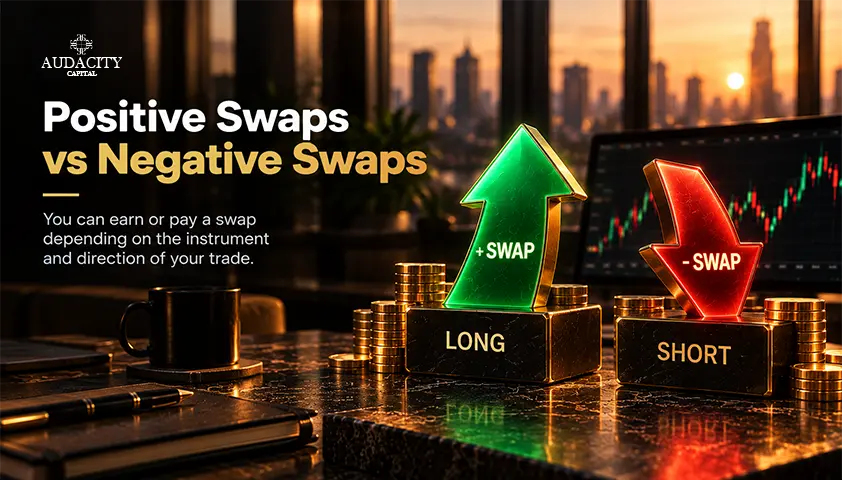
Negative swap
A negative swap is a charge deducted from your account. It is the more common outcome, particularly because of broker markups. For example, if you are long a low-yielding currency against a high-yielding one, you will almost certainly pay every night you hold the trade.
Positive swap
A positive swap is a credit added to your account. It typically occurs when you are long the higher-yielding currency against a meaningfully lower-yielding one, and the differential is wide enough to survive the broker's markup.
Why the long and short swaps are not mirror images
New traders often expect that if the long swap is +5, the short swap must be -5. That is rarely the case. Because the markup is applied to both sides, the positive side gets smaller and the negative side gets larger. A pair might show something like +4 on the long side and -11 on the short side. The asymmetry is the cost of the service, and it is worth remembering whenever you compare instruments.
When Swaps Are Charged: The Daily Rollover
Swaps are applied at a fixed point each trading day, known as the rollover. In the forex market, this is conventionally tied to 5pm New York time, the point at which one trading day ends and the next begins. Depending on daylight saving time, that falls at either 21:00 or 22:00 UK time.
On MetaTrader platforms, rollover usually coincides with 00:00 server time, because many brokers set their server clocks so that midnight lines up with the New York close.
A few practical points:
- Only positions open at the moment of rollover are affected. Close a trade one minute before rollover and you pay no swap for that night. Open one a minute after and you also avoid it.
- The rollover window often has wider spreads. Liquidity thins out around the New York close, so spreads can widen considerably for a short period. Trying to dodge a swap by closing right at rollover can end up costing more in spread than the swap itself.
- Your platform's server time matters. Always check what time your broker's server applies swaps, rather than assuming.
Triple Swap Day Explained
One day each week, swaps are charged at three times the normal rate. For most forex pairs, that day is Wednesday.
This catches a lot of traders off guard, so here is the reason behind it.
Spot forex transactions traditionally settle two business days after the trade date, a convention known as T+2. A position rolled over on Wednesday night is therefore treated as settling on Friday. Rolling it forward again pushes settlement past the weekend to Monday. Because the market does not settle trades on Saturday or Sunday, the financing for those two days has to be accounted for somewhere, and it lands on the Wednesday rollover.
The result: Wednesday night's swap covers Wednesday, Saturday and Sunday.
Some important nuances:
- Not every instrument uses Wednesday. Many CFDs on indices, commodities and some metals apply their triple swap on Friday instead, because their settlement conventions differ. Always check the specification of the specific instrument you trade.
- Triple swap applies to positive swaps too. If you are on the right side of a positive carry, Wednesday is your best night of the week.
- Holiday periods can add extra days. Around major bank holidays, brokers sometimes apply additional rollover days to account for non-settlement dates.
For swing traders, triple swap day deserves to be part of the planning process. A large position on a heavily negative pair held through Wednesday night can cost as much as several ordinary nights combined.
How Swaps Are Calculated
Brokers present swaps in different ways, but most fall into one of a few formats. The two most common are swaps quoted in points and swaps quoted as an annual percentage.
Method 1: Swap quoted in points
This is the format you will see most often on MetaTrader. The swap long and swap short values are expressed in points (the smallest price increment, often one tenth of a pip).
The formula is:
Swap = Lot size × Swap rate (in points) × Point value per lot × Number of nights
Where the point value is calculated in the quote currency and then converted into your account currency.
For example, on EUR/USD, one standard lot is 100,000 euros and one point is 0.00001. The point value per lot is therefore 100,000 × 0.00001 = 1 US dollar. If the swap long is -6.5 points and you hold 2 lots for one night:
2 × -6.5 × 1 = -13 US dollars
On a triple swap night, that becomes -39 US dollars.
Method 2: Swap quoted as an annual percentage
Some brokers quote the swap as an annualised interest rate. In that case, the daily charge is calculated on the notional value of the position:
Swap = Notional position value × (Annual swap rate ÷ 100) ÷ 365 × Number of nights
For example, if you hold a position with a notional value of 200,000 US dollars and the annual swap rate is -3%:
200,000 × 0.03 ÷ 365 = -16.44 US dollars per night
Some instruments use a 360-day year instead of 365, so this detail is worth confirming in the instrument specification.
Method 3: Swap shown in money
A few platforms simply display the swap as a cash amount per lot per night in the account currency. This is the easiest format to work with, since you just multiply by lot size and nights held.
Whichever format your broker uses, the underlying principle is the same: swap cost scales with position size and time held.
Swaps Across Different Asset Classes
Forex
Forex swaps are driven primarily by central bank interest rate differentials. Pairs combining a high-yield currency with a low-yield one tend to have the widest gap between long and short swaps. Pairs between two currencies with similar rates usually have small swaps, often negative on both sides once markups are applied.
Gold and silver
Precious metals such as XAU/USD are not currency pairs in the traditional sense, since gold pays no interest. Swaps on metals are generally based on the financing cost of the dollar side of the trade plus markups, and it is common for both the long and short swaps to be negative. Gold traders holding positions for weeks should keep a close eye on this.
Read 10 Gold Trading Strategies That Actually Work
Indices
Index CFDs such as the UK 100, Germany 40 or US 500 typically use a benchmark rate for the index's currency plus or minus a markup. Long positions usually pay financing. Short positions may receive a small credit or pay a smaller charge, depending on rates. Dividend adjustments can also appear on index CFDs, though these are separate from the swap itself.
Commodities
Energy CFDs like crude oil can be priced from futures contracts. Some brokers apply a swap; others handle the cost through periodic contract rollovers, where a price adjustment is made when the underlying futures contract expires. Both approaches reflect the cost of carrying the position forward.
Cryptocurrencies
Crypto CFDs often carry notably high swap rates, sometimes charged every day of the week, including weekends, since the underlying market trades continuously. Holding a leveraged crypto position for weeks can become expensive quickly.
Share CFDs
Share CFDs generally charge financing on long positions based on a benchmark rate plus a markup, with short positions sometimes receiving a small credit and sometimes incurring borrowing fees for hard-to-borrow stocks.
Swap-Free (Islamic) Accounts
Many brokers offer swap-free accounts, often referred to as Islamic accounts, designed for traders whose religious beliefs prohibit earning or paying interest (riba).
On a swap-free account, no overnight interest is charged or credited. That does not necessarily mean holding positions is free. Brokers commonly replace swaps with alternatives such as:
- A fixed administration fee charged after a position has been held for a set number of days
- Wider spreads on certain instruments
- Limits on how long a position can be held without a fee
The specific terms vary considerably between providers, so anyone using a swap-free account should read the conditions carefully, particularly regarding which instruments are covered and after how many days fees begin.
The Carry Trade: Using Swaps as a Strategy
The carry trade is the best-known strategy built directly around swaps. The idea is to buy a high-yielding currency against a low-yielding one, hold the position, and collect the positive swap every night, on top of any price appreciation.
Historically, low-yielding currencies such as the Japanese yen and Swiss franc have been popular funding currencies, while higher-yielding currencies have been the targets.
Why it can work
- Positive swap income accumulates daily, including triple credits midweek.
- During calm, risk-on market conditions, high-yield currencies often appreciate steadily, adding price gains to swap income.
Why it can go badly wrong
- Carry trades are crowded. When sentiment turns, many traders exit at once, and the unwind can be violent. A sharp example came in early August 2024, when a shift in Bank of Japan policy contributed to a rapid unwinding of yen-funded positions and steep moves across markets.
- Price risk dwarfs swap income. A position might earn a few dollars per lot per night but lose hundreds in a single bad session.
- Rate expectations change. If the central bank of the funding currency raises rates, or the high-yield central bank cuts them, the differential narrows and the edge disappears.
- Broker markups eat into returns. The positive swap you receive is always smaller than the raw interest differential.
The carry trade is best treated as a supporting factor rather than a strategy in its own right. Many experienced swing traders simply use swap direction as a tiebreaker: when two setups look equally strong, they favour the one that pays them to wait.
How Swaps Affect Different Trading Styles
Scalpers
Scalpers are almost unaffected. Trades lasting seconds or minutes are closed long before rollover. The only consideration is avoiding the rollover window itself, when spreads can spike.
Day traders
Pure intraday traders, who close everything before the New York close, never pay swaps. The risk comes from trades that were meant to be intraday but are left running overnight. A single forgotten position held through a triple swap night can be an unwelcome surprise.
Swing traders
Swing traders, who hold for days to a couple of weeks, feel swaps the most in relative terms. Swaps become a genuine line item in their trading costs, alongside spreads and commissions. A strategy with a modest edge can be pushed to break-even or worse if it consistently trades against heavily negative swaps.
Position traders
Position traders, holding for weeks or months, feel swaps in absolute terms. Over long holding periods, swap direction can make a meaningful difference to total returns, which is why longer-term traders often build swap considerations into instrument selection from the start.
Funded and evaluation account traders
For traders working with funded or evaluation accounts, swaps typically count towards account equity just like any other profit or loss. That means a negative swap can contribute towards a daily or overall drawdown limit, and it reduces the net profit counted towards targets. It is worth knowing your account's rules on holding overnight and over weekends, and factoring swaps into how close you allow yourself to get to any limits.
Check Audacity Capital's Funded Trader programs
How to Check Swap Rates on Your Platform
Swap rates change regularly as central bank policy and broker financing costs shift, so it is worth checking them directly rather than relying on memory or old figures.
MetaTrader 4 and MetaTrader 5
- Open the Market Watch window.
- Right-click the instrument you want to check.
- Select Specification.
- Look for Swap long, Swap short, the swap type (points, percentage, money and so on) and the 3-day swap day.
Open positions also display their accumulated swap in the Trade tab, in the "Swap" column.
cTrader
Open the symbol information panel for the instrument. The swap long, swap short and triple swap day are listed under the instrument's trading details.
Broker website
Most brokers also publish swap tables on their websites, though platform figures are usually the most up to date.
A useful habit is to check the swap rates for your regular instruments once a week, ideally before planning any trades you intend to hold over Wednesday night.
Worked Example: Holding GBP/JPY for a Week
Let us put the numbers together with an illustrative example. The figures below are hypothetical and chosen to show the calculation clearly; actual swap rates vary by broker and change over time.
The setup
A trader spots a swing opportunity on GBP/JPY and plans to hold the position from Monday until Friday, closing before Friday's rollover.
- Position size: 1.5 standard lots
- Swap long: +8.5 points
- Swap short: -22.0 points
- Triple swap day: Wednesday
- USD/JPY rate (for conversion): 150.00
- Account currency: US dollars
Step 1: Work out the point value
One standard lot of GBP/JPY is 100,000 pounds. One point is 0.001.
Point value per lot = 100,000 × 0.001 = 100 Japanese yen
Converted to US dollars: 100 ÷ 150 = 0.667 US dollars per point per lot
Step 2: Count the rollover nights
Opening Monday and closing Friday before rollover, the position is open at:
- Monday rollover: 1 night
- Tuesday rollover: 1 night
- Wednesday rollover: 3 nights (triple swap)
- Thursday rollover: 1 night
Total: 6 nights' worth of swap
Step 3: Calculate the swap for each direction
If the trade is long:
1.5 × 8.5 × 0.667 = 8.50 US dollars per night 8.50 × 6 = +51.00 US dollars credited
If the trade is short:
1.5 × -22.0 × 0.667 = -22.00 US dollars per night -22.00 × 6 = -132.00 US dollars charged
Step 4: Put it in context
Say the trader is targeting 120 pips. On GBP/JPY, one pip (0.01) is worth 1,000 yen per standard lot, or about 6.67 US dollars. At 1.5 lots, that is roughly 10 US dollars per pip, making the profit target around 1,200 US dollars.
- On the long, swaps add 51 US dollars, roughly 5 extra pips in the trader's favour.
- On the short, swaps cost 132 US dollars, the equivalent of giving back about 13 pips, or around 11% of the target.
The difference between the two directions is 183 US dollars, more than 18 pips, on a trade where nothing about the chart has changed. If the short trade only made 60 pips instead of 120, swaps would consume more than a fifth of the profit.
This is exactly why swing traders should know the swap direction before entering, not after.
Common Swap Mistakes Traders Make
- Ignoring swaps in backtests. Many backtesting tools do not model swaps accurately, if at all. A swing strategy that looks profitable may be far less so once realistic overnight costs are included.
- Forgetting about triple swap day. Holding a large negative-swap position through Wednesday night (or Friday, for some CFDs) without realising it costs three nights' worth.
- Assuming long and short swaps mirror each other. Markups make the negative side heavier, so a pair is not "neutral" just because one side is positive.
- Chasing positive swaps at the expense of price risk. A few dollars of daily carry is easily wiped out by a single adverse move.
- Closing at rollover to avoid swaps. Spreads often widen sharply around the New York close, and the extra spread can exceed the swap you were trying to avoid.
- Using old swap rates. Rates move with central bank decisions and broker adjustments, so figures from a few months ago may be well out of date.
- Overlooking swaps on drawdown-limited accounts. On accounts with daily or maximum drawdown limits, swap charges count towards equity like any other loss.
Key Takeaways
- A swap is the overnight interest paid or earned for holding a leveraged position past the daily rollover.
- In forex, swaps are driven by the interest rate differential between the two currencies, plus a broker markup.
- Swaps can be positive or negative, and long and short swaps are rarely equal because markups apply to both sides.
- Rollover is conventionally tied to 5pm New York time, and only positions open at that moment are affected.
- Most forex pairs charge a triple swap on Wednesday to cover the weekend, while many CFDs use Friday instead.
- Swap cost scales with position size and holding time, so it matters most to swing and position traders.
- Swap-free accounts remove interest but often replace it with admin fees or wider spreads.
- The carry trade uses positive swaps as a source of return, but price risk and sudden unwinds can easily outweigh the income.
- Always check current swap rates in your platform's instrument specification before planning a multi-day trade.
Frequently Asked Questions
A swap is the interest adjustment applied to a forex position held overnight. It reflects the difference between the interest rates of the two currencies in the pair, plus a broker markup, and can either be charged to or credited to your account.
No. Swaps are only applied to positions that are still open at the daily rollover time. If you open and close a trade before rollover, no swap is charged or credited.
Spot forex settles two business days after the trade date. A position rolled over on Wednesday night is pushed past the weekend, so the financing for Saturday and Sunday is applied at that point, making Wednesday's swap three times the normal amount.
Yes. If you hold a position on the side of a pair with a positive swap, you are credited each night. This is the basis of the carry trade, although price movements usually have a far bigger impact on your result than swap income.
Brokers add a markup to both sides of the swap to cover financing costs. On pairs or instruments where the interest rate differential is small, this markup can push both sides into negative territory.
Yes. Most CFDs, including gold, indices, commodities, shares and cryptocurrencies, carry overnight financing charges. The calculation method and triple swap day may differ from forex, and crypto CFDs often apply swaps every day of the week.
A swap-free (or Islamic) account does not charge or pay overnight interest. Instead, brokers may apply administration fees after a set holding period or adjust spreads. Terms vary, so it is important to review the conditions for each provider.
On most funded and evaluation accounts, swaps affect account equity in the same way as trading profit or loss, so a negative swap can count towards drawdown limits. Check the specific rules of the account you are trading.
Swap rates can change at any time, often following central bank rate decisions or changes in broker financing costs. Checking your platform's instrument specification regularly is the best way to stay up to date.

¿Listo para aplicar un riesgo disciplinado a las criptomonedas? Explore los nuevos instrumentos de cripto de Audacity Capital y traiga su estrategia de trading.
Aprender másBoletín
Únase a nuestro boletín para mantenerse al día.
Únete a Nuestra Comunidad Social

Comienza Tu Viaje Hoy Con Nuestra Prueba Gratuita
Muestra con orgullo tus habilidades y logros a través de certificados y obtén reconocimiento por tu arduo trabajo y dedicación de posibles inversores y compañeros.
Prueba GratuitaArtículos Relacionados
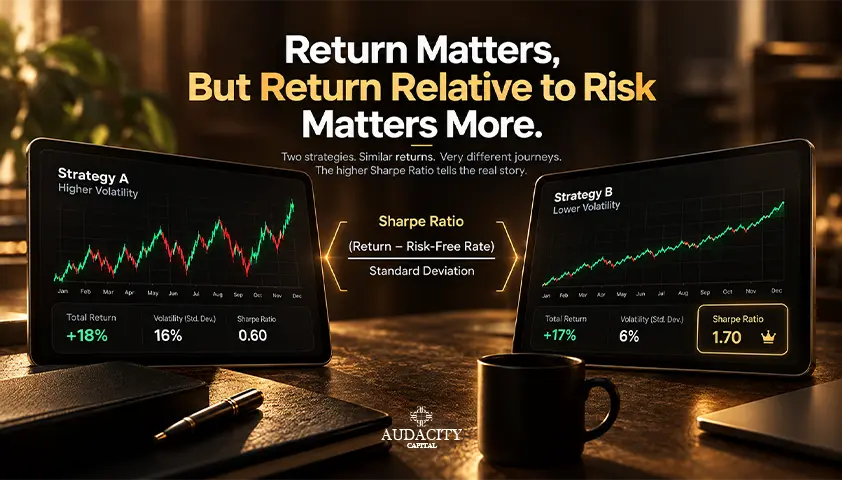
Sharpe Ratio: Formula, Calculation, Uses and Limitations
Learn how the Sharpe ratio works, how to calculate it, what a good score means, and where it can mislead investors, portfolios, and trading strategies.

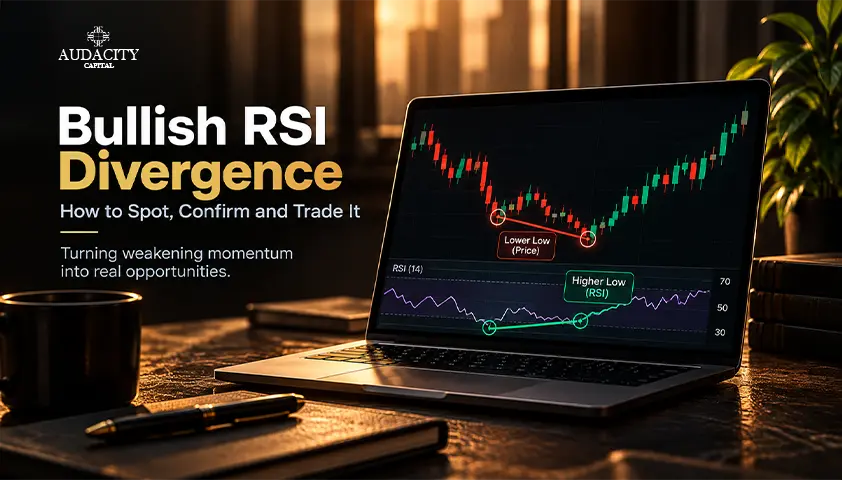
Bullish RSI Divergence: How to Spot, Confirm and Trade It
Learn how to identify bullish RSI divergence, confirm reversal signals, choose entries, set stop losses, and manage risk effectively.
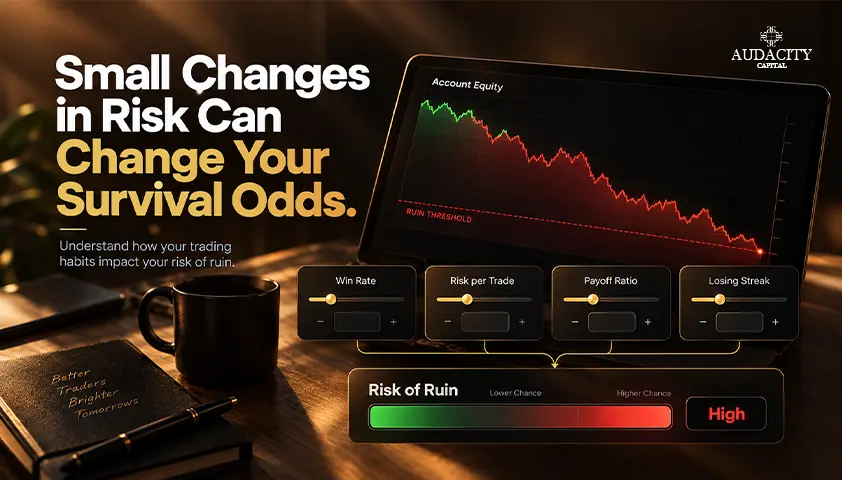
Risk of Ruin in Trading: Formula, Examples and How to Reduce It
Learn what risk of ruin in trading means, how the formula works, what affects it, and how position sizing can reduce the chance of account failure.
All About the Shooting Star Candlestick Pattern – Learn to Decode It
Learn what the shooting star candlestick pattern means, how to identify it, confirm bearish reversal signals, and manage trading risk.