


Is Day Trading Profitable? The Honest Truth, Backed by Data


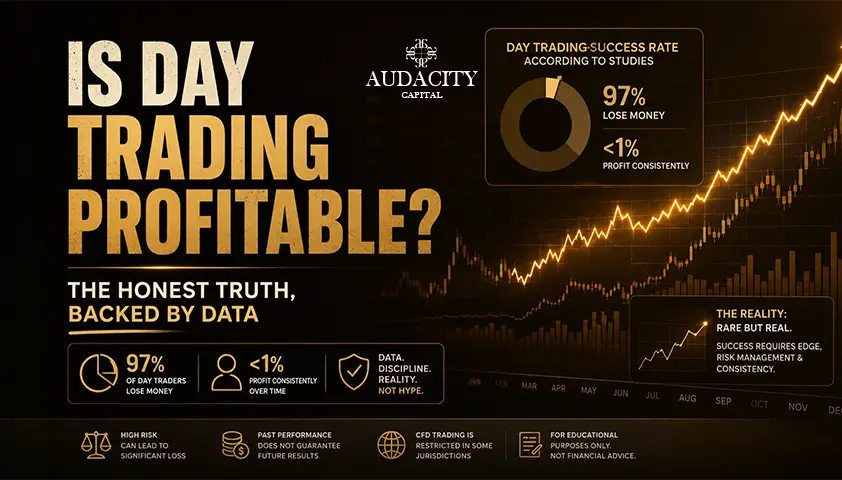
Here’s the straight answer: Yes, but only for a tiny fraction of people who try it. It is a bitter pill to swallow, but here are the cold facts: Most traders are losing money, and fewer than one percent of them are profitably trading after accounting for expenses.
As per one of the most quoted studies on the issue, made by Chague, De-Losso, and Giovannetti, almost 97% of all individuals who day-traded for over 300 days were making losses. In another seminal study, conducted among Taiwanese investors, less than 1% turned out to be predictably profitable from year to year.
This post cuts through the social media spin and explains the actual results of the research: why most day traders lose, what winning day traders do differently, and how to get into day trading with a clear conscience before you lose a cent.
The Honest Answer: What the Data Says About Day Trading Profitability
If you are wondering about the profitability of day trading, then YouTube is definitely not the answer. It is academic research. These include analyzed data from real trader accounts over several years.
One such comprehensive study comes from Taiwan. Researchers Brad Barber, Yi-Tsung Lee, Yu-Jane Liu, and Terrance Odean analyzed the complete trading records of the Taiwan stock market from 1992 to 2006.
Results: Only less than 1% of all day traders were able to consistently make profits while only 3% made positive returns net of all fees.
The Brazil day trading study mentioned earlier has similar results. In their study, Chague and colleagues tracked everyone who began day trading Brazilian equity futures between 2013 and 2015.
Of those that lasted more than 300 trading days, 97% were losing money, and only less than 1% were making more than the Brazilian minimum wage.
Older data from the US paints the same picture. Jordan and Diltz (2003) investigated US day traders and discovered that there are nearly twice as many lost money as made money.
In around 2000, a US Senate subcommittee investigating the day trading industry learned that over 75% of day traders are losing money. Broadly speaking, it is estimated that about 90% of day traders lose money in the long run, only about 10% of whom profit on a consistent basis and very few of whom make a living.
To be fair, the statistics vary according to the specifics of the market, timeframe, and how "profitable" is defined.
Profitable for a month is different from profitable for a career. However, the message of any credible study is the same.
A few minorities manage to make it. Most do not. There is no serious dataset anywhere that contradicts this.
What the Studies Show
Study / Source | Market and Period | Key Finding |
Barber, Lee, Liu, Odean | Taiwan, 1992–2006 | Fewer than 1% predictably profitable; ~3% profitable after fees |
Chague, De-Losso, Giovannetti | Brazil, 2013–2015 | 97% of those trading 300+ days lost money; under 1% earned above minimum wage |
Jordan & Diltz | US, 1998–1999 | About twice as many traders lost money as profited |
US Senate subcommittee testimony | US, ~2000 | More than 75% of day traders lose money |
Note: figures vary by market, time period, and the definition of "profitable" used. What is important is consistency: most day traders lose money.
What Is Day Trading, Exactly?
A brief refresher before we delve into it.
Day trading is a trading strategy of buying and selling the same asset within the trading day, taking advantage of the price fluctuation and exiting all trades by the end of the trading day to minimize overnight risk.
At the other end of the spectrum from day trading is swing trading, where trades are held for weeks or days, and long-term investing, which holds for years.
An important change: today, most of the day traders are retail traders who trade their own money with commission-free apps and online brokers.
But they are all playing in the same league as institutional desks and trading algorithms with better technology, more data and more professional infrastructure.
That discrepancy is important, and we’ll circle back to it.
So Can You Actually Make Money in Day Trading?
Yes. The successful traders are actually out there, not mythical creatures. Some of them make their living by day trading.
The Taiwan researchers found some traders who beat the market one year after another, meaning that their performance was more than a coincidence.
So can you make a living day trading? There are a handful of people who clearly do.
But it is an extremely rare occurrence that demands years of hard work, capital and extreme discipline.
Avoid two extremes. The statement 'Anyone can do it with the right course' is false. “Nobody makes money, it's all a scam” is also a lie. The truth sits in the uncomfortable middle: real, but rare.
Another factor to be aware of is survivorship bias, which occurs when one only sees the wins and not the losses. The successful trader who posts screenshots of profits on social media is one of thousands you never hear from. In the meme-stock era, lots of accounts went viral by posting successful trades which were sheer luck.
Why Do Most Day Traders Lose Money?
This should be the main point here, since the dropout rate is not a coincidence. The study pinpoints causes and they are repeatable.
Reason 1: Most quit before they learn.
Mastering the process is not easy. Barber and colleagues found that only around 15% of day traders are still active after three years. The majority of people go broke, lose patience or both before they actually get any good at it. Those who trade for survival, few survive.
Reason 2: Overconfidence and cognitive bias.
Nearly all new traders think they can outperform the average. The data says almost all of them are wrong.
One of the most well-established findings in behavioral finance is overconfidence, and trading psychology research reveals that this trait leads people to trade too often, too big and to ignore evidence that their strategy isn't working.
The winners learn from their losses and adapt. The losers rationalize their losses and remain in the game too long.
Reason 3: Transaction costs, fees, and slippage.
In day trading, there are many trades, and all those trades have a cost associated with them. This includes spreads, commission (if applicable), and slippage (which is the price difference between what you think it should be and what it actually is).
These expenses keep mounting up ruthlessly. A 50% win rate can still represent a money losing system if you take transaction costs out of the equation. That's exactly what the Taiwan study found: some traders ended up profiting before costs were considered but lost profits after they were included.
Reason 4: You're dealing with other professionals and algorithms.
High-frequency trading or HFT involves firms with automated systems that place their orders in microseconds. HFT firms make up a significant portion of the U.S. equity volume.
These firms have faster internet, better data, and quant research analysts working for them. The retail trader doesn't have an information or speed advantage in the retail traders vs institutions battle.
But it doesn't mean that profit can't be realized, it just means that any retail advantage must be derived from an area where machines are not already exploiting it.
Reason 5: Undercapitalization and the pattern day trader rule
Poor capitalization results in poor decisions; either taking too many risks for the profits to have any significance or having too small of positions and the costs eating away at everything.
For those trading in the United States, the pattern day trader rule (a FINRA regulation) requires a minimum equity balance of $25,000 in a margin account.
While the PDT rule is US-specific, the actual issue is universal: smaller accounts are likely to perish within the learning period.
Reason 6: Premature scaling and weak risk management
When facing pressure, many traders ignore stop-losses, take too many risks on single trades and grow their positions before they have shown an edge.
Poor risk management results in wiping out one's account after only a handful of losses. A significant number of accounts get blown off due to this reason alone.
The Psychology Problem (and the Gambling Parallel)
Even when traders understand the math behind the process, they still succumb to their emotions. According to research, there are some common causes: The Fear Of Missing Out (FOMO) prompts traders to make trades too late and at unfavorable prices.
Revenge trading, in which traders try to recoup their losses with a high-risk and big trade, turns one bad trade into five. Overconfidence inflates at an inopportune moment, after a winning streak.
This is measurable. Research by Andrew Lo and colleagues at MIT found that emotionally charged traders showed a significant drop in performance.
Moreover, research into trader psychology indicates that many people continue trading regardless of their profitability, almost equally active. It means that the activity is what's being attractive, not the results.
This raises the question many ask on forums like Reddit or Quora: Is day trading just gambling?
The true answer really depends on the trader.
For those traders who are disciplined, have an empirical trading edge, along with strict risk control mechanisms, day trading can be a probabilistic business, closer to running a casino than playing in one.
In the minds of many traders, however, the psychology of the trade is similar to gambling: chasing losses, looking for excitement and ignoring negative expected value. In fact, personality traits (sensation-seeking) have been found to be correlated to increased trading volume.
One fact that shouldn't be ignored without judgment: some people are in danger of compulsive trading. Just like with any compulsive behavior, if you cannot stop trading even after losing multiple times, it's a sign to take a step back.
"If It Loses Money, Why Do So Many People Still Do It?"
It's the most common query among the traders. Let us try to find the answer.
First, the temptation is big. Fast money, freedom, no boss, a laptop on a beach. Lifestyle marketing sells that dream relentlessly, and survivorship bias makes success look far more common than it is.
Second, people overestimate themselves. They believe they win because of their talents but lose due to bad luck. As a result, people are stuck in a vicious circle of their own making.
Third, for some people it is entertainment. The screen, the action, the dopamine of a winning trade. That pull is real even when their account is shrinking.
And fourth, there is a whole business built on selling the dream rather than living it: courses, signal groups, mentorship programs, and so-called financial gurus.
In case you thought this way yourself, here is the harsh truth that a lot of many readers already suspect: a substantial part of trading "educators" earn more money selling courses than they ever made trading.
The incentive is to keep the dream alive, not to tell you the failure rate.
Is Day Trading a Scam?
No. Day trading itself is not a scam. It is a real, legal activity that a small minority of people do profitably, as the research confirms.
But the ecosystem around it is full of scams and misleading marketing: courses promising guaranteed returns, signal-selling groups with fabricated track records, fake "verified" profit screenshots, and affiliate schemes that earn money from your sign-up regardless of whether you ever profit.
Here is a practical filter that holds up everywhere: anyone promising guaranteed profits, a secret system, or easy money is selling a fantasy.
Real trading edges are hard to find, statistical in nature, and never guaranteed. The moment "guaranteed" enters the conversation, the conversation should end.
What Separates the Profitable Minority?
So what percentage of day traders are profitable, and what are they doing differently?
The studies put the consistently profitable group somewhere between under 1% and roughly 10% depending on market and definition. The research and credible practitioner sources point to a recognizable set of shared traits:
- A genuine, tested edge. A specific, repeatable setup with positive expectancy, proven through backtesting and live data, not a feeling about charts.
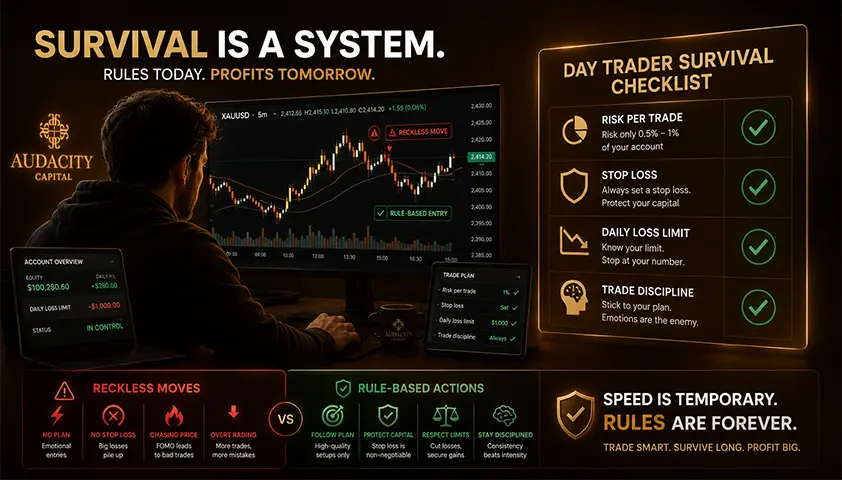
- Strict risk management. Many consistent traders risk only 0.5% to 1% of their account per trade, which makes a normal losing streak survivable rather than fatal.
- Discipline under pressure. They follow their rules during drawdown, and they have hard stops on daily losses.
- Sufficient capital and a realistic runway. Enough money to size positions sensibly and enough time to learn without needing income from day one.
- A professional process. They treat trading as a business with routines and review, not a series of punts.
- Rigorous self-measurement. Journaling every trade, tracking expectancy and maximum drawdown, not just win rate.
One honest caveat: these traits improve your odds. They do not guarantee profit. Skill shifts probabilities. It never removes risk.
How Much Money, and How Long, Before Day Trading Is Profitable?
Honest ranges, not promises.
Capital. Undercapitalization is one of the top documented failure causes. In the US, the pattern day trader rule sets a $25,000 floor for actively day trading stocks, a US-specific regulation. Other markets and instruments, such as futures and forex, have lower entry points but typically involve leverage, which magnifies both gains and losses. Note also that CFD trading is restricted or banned in some jurisdictions, including the US.
Time. Expect a long apprenticeship, often measured in years. The research is sobering here too: profitability, where it appears, correlates with experience, but most experienced traders still lose money. Time in the market improves your odds; it does not assure consistency or an edge.
This is general education, not financial advice. There is no reliable timeline to profitability, and no one can promise you an income from trading.
The Honest Verdict (and a Disciplined Path Forward)
Is day trading profitable? For a small, disciplined, well-prepared minority, genuinely yes. For the overwhelming majority, no. That is what every credible dataset shows, and any answer that softens it is selling you something.
The deciding factors are not luck or secrets. They are edge, risk control, capital, psychology, and persistence. The honest implication is that most people should either not day trade at all, or approach it slowly: with money they can afford to lose, after testing a strategy thoroughly through backtesting and simulated trading, and with hard risk limits from day one.
For the minority who have actually built and tested an edge, the constraint usually stops being skill and becomes capital and structure. That is the specific problem prop firms exist to solve.
Firms like Audacity Capital,established in 2012, provide traders with structured funding programs, profit shares of up to 90%, scaling opportunities, and free education through Trader University. One thing should be plainly stated: a funded account provides capital and structure, not an edge. It does not make anyone profitable. The discipline still has to be yours.
Trading involves significant risk of loss and is not suitable for everyone. Nothing in this article is investment, financial, legal, or tax advice, and past or hypothetical performance does not guarantee future results.
Related Articles
Day Trading Guide For Beginners
Analysis For Day Trading: A Complete Guide
Financial Instruments In Day Trading
Best Prop Trading Firms for Day Traders in 2026
Frequently Asked Questions
Studies suggest a low single-digit percentage are consistently profitable. The landmark Taiwan study (Barber et al.) found fewer than 1% were predictably profitable and around 3% profitable after fees. Broader estimates suggest roughly 10% achieve some profitability, while the majority lose money over time.
A small minority of traders genuinely do, but it typically requires years of experience, sufficient capital, a proven edge, and strict risk management. The Brazil study found fewer than 1% of persistent day traders earned more than minimum wage. It is possible, but statistically rare.
For most beginners, no, at least not with real money on day one. The data shows the majority lose, and most quit within three years. If you want to try, start with education, backtesting, and simulated trading, and only ever risk money you can afford to lose.
It depends on the trader. With a tested statistical edge and strict risk rules, it is a probabilistic business. Without those, the behavior, such as chasing losses and trading for excitement, closely resembles gambling. Research links sensation-seeking to higher trading volume, which supports that parallel for many participants.
There is no guaranteed timeline. Realistic estimates run from two to five years of consistent study and practice, and most traders never reach lasting profitability. Research shows experience improves outcomes on average, but the majority of experienced traders still lose money after costs.
For most people, no. Low-cost, long-term investing has dramatically better average outcomes with far less time and stress. Day trading is higher-risk and higher-effort, and the data shows most participants underperform or lose money. Day trading suits only a small, disciplined minority.

¿Listo para aplicar un riesgo disciplinado a las criptomonedas? Explore los nuevos instrumentos de cripto de Audacity Capital y traiga su estrategia de trading.
Aprender másBoletín
Únase a nuestro boletín para mantenerse al día.
Únete a Nuestra Comunidad Social

Comienza Tu Viaje Hoy Con Nuestra Prueba Gratuita
Muestra con orgullo tus habilidades y logros a través de certificados y obtén reconocimiento por tu arduo trabajo y dedicación de posibles inversores y compañeros.
Prueba GratuitaArtículos Relacionados

6 Best Markets for Day Trading in 2026 Compared
Compare the best markets for day trading in 2026, including forex, futures, stocks, indices, commodities, and crypto, based on capital, hours, and risk.


How to Create a Day Trading Risk Management Plan?
Build day trading risk management strategies with daily loss limits, position sizing rules, drawdown controls, and a practical trading checklist.
Day Trading Tips: The Rules That Actually Decide Whether You Survive
Practical day trading tips ordered by what actually matters. Risk rules, discipline, execution, and the 2026 pattern day trader change explained honestly.
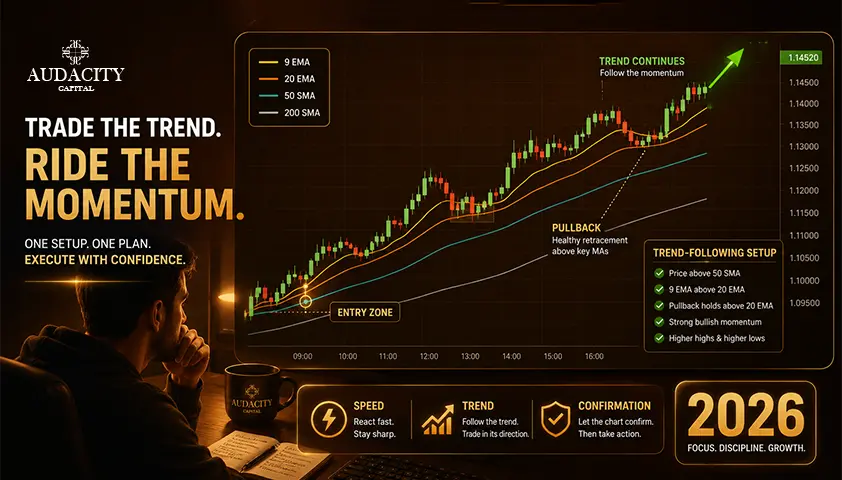
Best Moving Average for Day Trading in 2026
Compare the 9, 20, 50 and 200 moving averages for day trading, when each works best, and how to avoid lag, noise and false signals.