


Swing Trading vs Day Trading: Key Differences Explained



Swing trading vs day trading is one of the most popular subjects amongst traders who want to find a trading style that will match their trading objectives, lifestyle, and risk tolerance. While both strategies are aimed at profiting from price movement, they vary in terms of trade duration, frequency, and the time you need to spend watching the market.
Swing trading typically takes between a few days and weeks to capture price movement. This means you can analyze market trends and control your position without the need to look at your charts all day. Whereas day trading involves opening and closing positions on the same day. This usually involves more attention to price movement during the day.
What Is Swing Trading?
Swing trading is a strategy designed to capture price movements over multiple days/weeks. Swing traders will trade using patterns and take advantage of price movements in an established trend or reversal. This style can be applied to plenty of different financial markets such as forex, stocks, indices, and crypto.
Our swing trading guide covers the mechanics in full.
How Swing Trading Works
Swing traders will use technical analysis, fundamental factors, or both to find potential entry and exit points. They will look at price charts, market trends, economic factors, and key support/resistance levels to see when an asset may move in the right direction. The position will generally be held for a few days up to a few weeks. Depending on the set-up, traders may use daily or 4-hour charts to identify trends.
Common Swing Trading Strategies
There are several common strategies used in swing trading:
- Trend following: Trading in the direction of the market trend.
- Pullback trading: Trading after a pullback in the market. Price goes against the trend but then continues in the original direction.
- Support and resistance: Identify points where there may be buying/selling pressure.
- Breakout trading: Breakout trading is when price breaks through a support or resistance level, then continues in the same direction.
Tools Used In Swing Trading
Many traders often use candlestick charts, moving averages, relative strength index, and moving average convergence divergence to help them analyze price movement. Some traders also look at economic calendars.
For example, a trader may see that a currency pair is trending upwards and then wait for it to retrace back down to a support level. If there are signs of the price bouncing back up, they may go long and try to exit at a resistance level. This is market structure and is also another way traders look for valid setups in the market.
When swing trading, traders should know there can be overnight, and sometimes weekend exposure. Unexpected news can create a gap in price, which can cause losses to occur that would not have been covered by your stop loss. You could also incur financing charges for holding overnight depending on the instrument and broker. Hence, risk management is fundamental.
What Is Day Trading?
Day trading is a strategy that involves opening and closing positions on the same day to make money from short-term price movements. It is popular to trade using this strategy in markets like forex, stocks, indices, and cryptocurrencies. Unlike swing trading, you will be looking for opportunities that happen over the course of minutes or hours.
Our day trading guide for beginners covers the mechanics in full.
How Day Trading Works
Day traders look at the intra-day price movement of a forex pair to find potential entry and exit points. They will use technical analysis, price action, volume, and news to help them make their decisions. Because the market can be volatile, traders often need to act quickly and have a set of rules that they follow.
Common Day Trading Strategies
Many different strategies are popular with Day Traders;
- Scalping: This involves placing many trades to take advantage of small price movements. Positions can be held for seconds or minutes.
- Momentum Trading: This strategy is all about timing the momentum of the market. Traders enter a trade when there is strong movement in one direction.
- Breakout Trading: Entering a position when the price breaks out of a support/resistance level.
- Range Trading: Buy at support and sell at resistance when an asset is moving between well-defined levels.
Tools Used in Day Trading
Intraday charts, volume indicators, candlestick patterns, market scanners, and real-time news are all common tools used by day traders to track price movement, spot potential trading setups, and adapt to changing market conditions.
A forex day trader could spot that EUR/USD has been having difficulty breaking through a certain resistance level. Once the price finally breaks through that level with increased buying pressure, the trader could open a long position and have a profit target based on how much they expect EUR/USD to move during the day. The position will be closed before the end of the day either because the target is hit or when another exit criterion is met.
End-of-day position management is an important part of traditional day trading. Closing positions before the end of the trading day removes overnight exposure to those trades, although intraday volatility, slippage, spreads, and transaction costs can still impact the results.
Day trading can be a demanding endeavor as many day traders are focused on maintaining a high level of attention, making quick decisions and consistently executing their trades. However, trading too often without a defined plan and strict risk management can cause unnecessary losses.
Swing Trading vs Day Trading: Key Differences
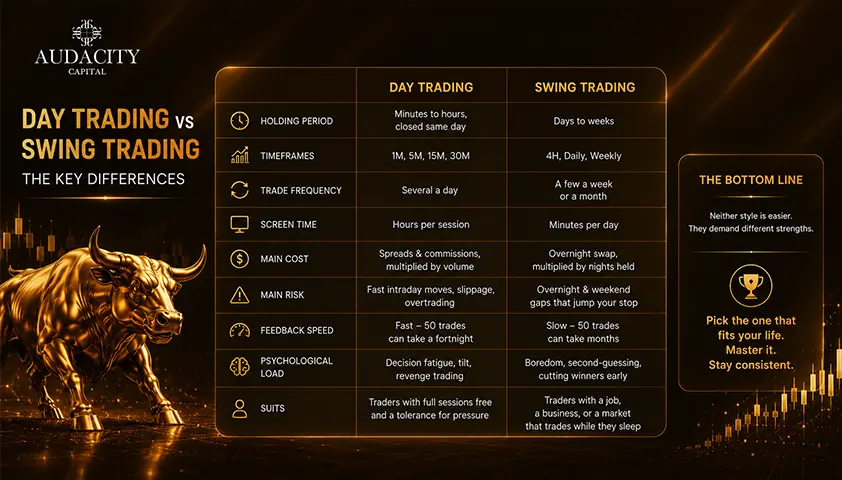
Holding Period and Market Exposure
The most obvious difference between swing vs day trading is the duration of positions opened. Swing traders aim to profit from price movements that occur over a longer period of time. This can be over a few days/weeks, whereas day traders will look to take advantage of short-term opportunities. They usually close their positions before the day ends.
Swing traders can also be exposed to price gaps if markets move whilst they are holding a position, for example, if there is an unexpected economic announcement, geopolitical news, or corporate news. They can also be exposed to risks over the weekend.
Day traders who close all positions before the end of the trading day avoid overnight exposure on those trades. But they are still exposed to intraday volatility, execution risks, and sudden market moves.
Time Commitment and Trading Frequency
Swing trading can be a good option for those who don’t have time to watch charts throughout the day. However, you will still need to analyze the markets, set your entry/exit points, and check your positions from time to time. You will also need to watch for relevant news and manage your trades.
When it comes to day trading, it requires more focus during active market sessions. You will need to spot opportunities, monitor your positions, and react to price movements. Swing traders generally trade less than day traders. Day traders can often enter and exit positions several times in the same session, which can lead to higher transaction costs and more opportunities for emotional decisions.
Analysis and Decision-Making
Swing traders often use the 4-hour and daily charts to identify larger trends, support and resistance levels, and potential breakout opportunities. Other fundamental factors can also be taken into consideration, such as economic data, interest rate decisions, and other factors that might influence the price over the next few days.
Day traders, on the other hand, typically look at shorter time frames such as 1 minute, 5 minute and 15-minute charts. They can use price action, volume, momentum indicators, and news to identify potential setups for the day.
Costs, Risk Management, and Lifestyle
The costs you pay depend on the type of instrument you are trading, your broker, and how frequently you trade. Day traders can incur high levels of spreads and commissions from trading frequently. Swing traders may not trade as frequently but will have overnight funding costs.
Both strategies require proper risk management and stop-loss planning. Swing traders need to consider gap risk in the market, causing their stop orders to be filled at less favorable prices. Day traders also need to consider volatility, slippage, and overtrading.
Factor | Swing Trading | Day Trading |
|---|---|---|
Holding period | Several days to weeks. | Seconds to hours, within the trading day. |
Time commitment | Periodic market monitoring. | Often requires extended intraday attention. |
Chart timeframes | Commonly 4-hour and daily charts. | Commonly 1-minute to 15-minute charts. |
Trading frequency | Usually fewer trades. | Often more frequent trades. |
Market exposure | Overnight and weekend exposure may apply. | Positions are generally closed before the trading day ends. |
Decision-making | Often allows more time to evaluate setups. | Frequently requires faster decisions. |
Transaction costs | Fewer transactions may reduce cumulative costs, but overnight charges may apply. | Frequent transactions can increase cumulative costs. |
Common analysis | Technical analysis and relevant fundamental developments. | Intraday price action, volume, momentum, and news. |
Stop-loss considerations | Stops may be affected by gaps and slippage. | Stops may be affected by intraday volatility and slippage. |
Suitable for | Traders who prefer less continuous market monitoring. | Traders who can dedicate time to intraday markets. |
Swing Trading vs Day Trading: Pros and Cons
Advantages and Disadvantages of Swing Trading
Advantages of Swing Trading
- Less screen time: Many swing traders will not need to be glued to their screen all day as they can check their positions from time to time.
- More significant price movements: Holding positions for a few days/weeks means you can target bigger swings in the market.
- More time for analysis: Swing traders have more time to analyze the market and decide when to enter and exit positions.
- More flexibility: If you have a job, studying, or other commitments, swing trading can be more flexible for you as long as you can keep an eye on key events.
Disadvantages of swing trading
- Overnight and weekend exposure: Risk of overnight and weekend gaps due to unexpected news events causing you to lose money or have poor trade execution.
- Holding Costs: Overnight fees depending on the instrument and your broker can eat into your profits.
- Longer Waiting Period: Longer time frame trades can take days/weeks to hit their target and can sometimes not work out.
- Emotional Pressure: You can become stressed watching your position go against you for multiple days before hitting your take profit.
Advantages and Disadvantages of Day Trading
Advantages of day trading
- No overnight positions: There is no overnight exposure as you are closing all of your positions at the end of your trading day.
- Many trading opportunities: You may get many opportunities to trade due to the short-term price movements.
- Clear daily boundaries: Traders can finish the day without open positions and review their performance before the next session.
- Active market participation: If you like dealing with short-term price movements and being actively involved in trading, this could be a good option for you.
Disadvantages of day trading
- High Time Commitment: You need to constantly monitor your charts and manage your positions.
- Potentially higher transaction costs: You may be entering and exiting positions often, increasing your spread, commission, and overall trading costs.
- Pressure to make quick decisions: Due to the fast-moving prices, you can get carried away and make rash decisions.
- Risk of Overtrading: Emotional decisions may cause you to overtrade and increase your losses. This can affect your overall trading strategy.
Which Is More Profitable: Swing Trading or Day Trading?
When comparing day trading vs. swing trading, neither approach is automatically more profitable. Returns depend on execution, strategy performance, trading costs, market conditions, and risk management.
Factors That Affect Profitability
- Trade Frequency: Day traders may execute a large number of trades during a session, but this does not always translate into increased profits. As more trades are made, costs will increase, and you run the risk of overtrading.
- Price Movements: Swing traders try to benefit from large price movements over multiple days/weeks. This can result in larger profits per trade. However, the time period you are holding the trade for increases the risks of overnight gaps and unexpected market movement.
- Trading Costs: The spread, commission, slippage, and overnight funding costs can all reduce your profits. It is important to consider your net profit.
- Risk Management: Your position size, stop-loss strategy, and discipline will affect how much of your capital you are risking. Even if you have a strategy that results in frequent winning trades, if you are losing large amounts, then you will lose money.
How Should Traders Evaluate Profitability?
Instead of judging a strategy by looking at a few winning trades, you should look at how it performs within a reasonable sample size. Some of the things to check are: your overall net returns, winning percentage, average win/loss ratio, max drawdown, and risk-adjusted returns.
Backtesting and demo trading can help you to find any issues with your strategy before risking any real money. However, past performance does not guarantee future performance.
How to Choose Between Swing Trading and Day Trading
Before selecting, consider how much time you can commit to trading, how you handle market uncertainty, and whether you can follow a consistent trading plan.
Swing Trading may be a good choice if:
- You have limited time: You can still stay on top of your positions and act on any key news.
- You like to watch price trends: You love analyzing trends and finding opportunities that have developed over a few days/weeks.
- You can be ok with holding positions overnight: You understand that there can be news and gaps in the price.
- You are patient: You’re happy to wait for the right setups to come along.
Day Trading is a good option if you have:
- Enough time to spend watching the intraday market.
- Like trading shorter-term charts.
- Like analyzing price action over short time frames.
- Can cope with pressure and make fast decisions while sticking to your trading rules.
- Have the right tools to trade, i.e., good charts, market data, and trading conditions.
Questions to Ask Before Choosing
- How much time can I realistically dedicate to trading each day?
- Can I remain disciplined during losing streaks and periods of uncertainty?
- Can I afford the potential losses and trading costs involved?
- Is my preferred market sufficiently liquid during my available trading hours?
- Have I tested my strategy using historical data or a demo account?
How much capital does each style need?

There is no single number, but the constraints differ, and one of them is a rule rather than a guideline.
Day trading US stocks in a margin account brings in the pattern day trader rule. Four or more day trades in five business days flags the account, and it then has to hold $25,000 in equity to keep day trading.
Two things it is not. It does not apply to forex or futures, and it does not apply to swing trading, because a position held overnight is not a day trade. Traders who cannot meet the $25,000 threshold and still want to trade US equities often swing trade for exactly that reason.
Past that rule, the practical minimum is set by risk, not regulation. If you cannot risk 1% of your account and still size a position sensibly against your stop, the account is too small for the setup, whichever style you are trading. Our guide to how much money you need to start swing trading works through the tiers.
How prop firm rules change the answer
This is the part generic comparisons leave out, and for a funded trader it matters more than any timeframe debate. Trading simulated capital means trading inside a rulebook, and a rulebook is never style-neutral. Some rules punish day traders. Others make swing trading impossible.
Daily loss limits are a day trader’s problem
A daily loss limit, commonly 5%, caps how much you can lose in a single day. For a swing trader taking two positions a week it is close to invisible. For a day trader having a bad morning it is a wall, and breaching it is the most common way funded accounts are lost. The rule exists to stop the exact behavior that ends most day trading careers, which is worth sitting with rather than resenting. Our guide to drawdown in prop trading explains how the limits interact.
Overnight and weekend holding decides whether swing trading is even possible
Plenty of firms close positions before the weekend, forbid overnight holds entirely, or sell the permission as a paid add-on labeled a "swing account." If you are a swing trader, read that rule before you read the profit split. A firm that flattens your book every Friday is not a firm you can swing trade with.
Audacity Capital permits overnight and weekend holding on the funded programs.
Static vs trailing drawdown is a swing trader’s problem
A trailing drawdown limit follows your account’s high-water mark upward. For a swing trader holding a position that runs deep into profit and then retraces, a trailing limit can breach the account on an ordinary pullback, on a trade that is still open and still valid. A static drawdown is fixed against your starting balance and does not chase you up.
Audacity Capital uses static drawdown. For a swing trader that is not a small detail.
Minimum trading day requirements
Most evaluations require a minimum number of trading days. Day traders clear that without noticing it exists. A swing trader who takes three positions a month has to plan around it, because a rule written to prove consistency can quietly push you into trading a style you do not trade.
So which should you choose?
Day trading is a reasonable fit if you can be at the screen for your market’s active hours, you make decisions cleanly under pressure, you have a hard rule for stopping after a loss, and you would rather not carry risk overnight.
Swing trading is a reasonable fit if you have a job or a business, your market’s best hours fall in your night, you can leave a position alone through a drawdown, and you accept that a gap will eventually go straight through a stop.
If you are new, start with swing trading. Not because it is easy, but because it gives you time to think, costs less to run while you are still learning, and does not require you to be right within thirty seconds.

Are You Looking For Instant Funding Trading Programs?
Funded Trader ProgramCan you trade both?
Yes, and plenty of traders do. The mistake is doing it by accident.
Trading both deliberately means two plans, two risk budgets and ideally two accounts, so that a swing position does not get panic-closed during a bad intraday session. Trading both accidentally means a day trade that went against you and has now been promoted to "a swing trade." That is not a style. That is a loss you have not accepted yet.
Common mistakes to avoid
- Turning a losing day trade into a swing trade to avoid booking the loss
- Sizing a swing position as though the stop will hold through a weekend gap
- Day trading a session you cannot realistically attend
- Ignoring swap costs on a multi-week hold and wondering where the profit went
- Switching styles after a losing streak instead of after a review
- Choosing a style based on the returns someone showed you rather than the hours you have
Where Audacity Capital fits
Both styles are supported here. Audacity Capital is a proprietary trading firm, so traders trade a simulated funded account on MT5 or DXTrade under a published set of rules, and keep up to 90% of the simulated profits they generate.
For day traders, the daily loss limit is the rule to respect. For swing traders, overnight and weekend holding is permitted and the drawdown is static, which are the two rules that most often make holding a position for a week impractical elsewhere.
To be plain about it, a funded account is capital and structure, not an edge. It will not turn a day trader into a swing trader, or make either one profitable, and most people who attempt an evaluation do not pass it. What it does is put a proper risk framework around the style you have already chosen, which is more than most traders ever build for themselves.
Explore the Funded Trader Program or start with the free monthly trading competition.

Free Prop Firm Challenge
Free Prop Firm ChallengeConclusion
Swing trading vs. day trading comes down to your schedule, trading preferences, and ability to manage risk consistently. Essentially, choose the approach you can execute consistently, not simply the one that promises higher returns. Consider how well you are doing after taking into account the costs and understand the risks involved before committing your money.
Related Article
Check latest guide How Much Money Do You Need to Start Swing Trading? (2026 Guide)
Read the full guide here: Is Day Trading Easier Than Swing Trading?
Read the guide about best forex trading strategy
Frequently asked questions
Most run from a couple of days to a few weeks. If your positions are routinely open for months, that is position trading. If they close in the same session, they were never swing trades.
A single daily check is usually enough, and it should have a purpose: manage the open position, mark the levels, act on the plan. Watching a swing position tick is how swing traders talk themselves into day trading it.
Intraday trading needs liquidity and movement inside the session, so major forex pairs and index CFDs are the usual homes. Multi-day trading rewards markets that trend and respect higher-timeframe structure, which again includes forex, plus indices and commodities. Thin, erratic instruments punish both.
No, it is a subset. Scalpers take dozens of positions for very small moves, often holding for seconds. Every scalper is a day trader, most day traders are not scalpers, and the cost structure of scalping is unforgiving.
Multi-day trading, yes, and it is the most common reason people choose it. Setups are found and orders placed outside working hours, and pending orders do the rest. What you cannot honestly do around a full-time job is trade a session that runs while you are working.
It stays open and it stays exposed. Markets can gap on the Sunday or Monday open, past your stop, on news that broke while they were closed. Some traders reduce or close on Friday for that reason. Others accept the risk and size for it.
Usually, at least at first, because you restart your learning curve and your sample size at the same time. Switching after a considered review is a decision. Switching after three losing trades is tilt with better branding.

Ready to apply disciplined risk to crypto? Explore Audacity Capital's new crypto instruments and bring your trading strategy.
Learn MoreNewsletter
Join our newsletter to stay up to date on features and releases.
Join Our Social & Community

Start Your Journey Today With Our Free Trial
Proudly showcase your skills and accomplishments through certificates and get recognition for your hard work and dedication from potential investors and peers.
Free TrialRelated Articles

What Is a Black Swan Event? Meaning, Examples and Impact on Forex Trading
Understand what black swan events are, explore major financial market examples, and learn how unexpected events affect forex trading and risk management.


Introducing Ability One: One Step To Funding With Static Drawdown

How To Choose The Right Prop Firm – A Complete Checklist
Learn how to choose the right prop trading company with our expert guide. Compare fees, rules, profit splits, and platforms to trade confidently.

Trading Psychology for Funded Traders: Pressure, Fear and Revenge Trading
Struggling with pressure and tilt? Master trading psychology for funded traders with concrete systems to avoid revenge trading and stay disciplined.